This guide covers what VOCs are, why they matter for household water quality, how carbon block whole house filters remove them, what these systems can and can't do, and what to look for when choosing one.
Key Takeaways
- VOCs enter tap water from industrial sites, fuel leaks, agricultural chemicals, and chlorine disinfection reactions
- Carbon block filters remove VOCs through adsorption — organic molecules bond to the carbon's internal surface as water passes through
- Whole house protection matters — VOCs in shower steam and bath water cause inhalation and skin exposure that an under-sink filter won't prevent
- These filters do not remove dissolved minerals, nitrates, fluoride, or most heavy metals — supplemental technology is needed for those
- Always test your water before selecting a system — VOCs have no taste or odor at harmful concentrations
What Are VOCs and How Do They Get Into Your Water?
USGS defines VOCs as chemicals that both vaporize into air and dissolve in water. In household water, the most relevant examples include benzene, toluene, trichloroethylene (TCE), tetrachloroethylene (PCE), and trihalomethanes (THMs).
How VOCs Reach Your Tap
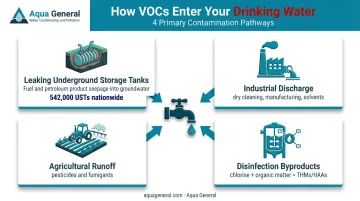
Several pathways bring these compounds into drinking water:
- Leaking underground storage tanks — The EPA reports roughly 542,000 underground storage tanks (USTs) nationwide, with 583,313 confirmed releases since 1984 and over 52,000 still awaiting cleanup. These tanks leak petroleum-based VOCs including benzene directly into groundwater
- Industrial discharge — Dry cleaning facilities, manufacturing plants, and chemical operations release chlorinated solvents like PCE and TCE
- Agricultural runoff — Pesticides and fumigants can reach surface water and groundwater sources
- Disinfection byproducts — Chlorine in municipal treatment reacts with naturally occurring organic matter to produce THMs (trihalomethanes) and HAAs (haloacetic acids), which are themselves classified as VOCs
That last source is especially relevant for Houston-area residents. The City of Houston water system serves over 2.2 million people. EWG's tap water database shows it detected average TTHMs of 30.4 ppb and average HAA5 of 21.2 ppb between 2013 and 2024 — below federal legal limits, but above EWG's health guidelines.
VOCs have no taste or odor at the concentrations that pose health risks. Lab testing is the only way to know what's in your water — a critical first step before choosing any filtration system.
Why VOC Exposure Through Household Water Is a Real Health Risk
Acute and Chronic Effects
Short-term VOC exposure can cause headaches, dizziness, nausea, and skin or eye irritation — symptoms easily attributed to something else. The longer-term picture is more serious.
Two of the most regulated VOCs illustrate the stakes:
- Benzene: The EPA classifies benzene as a known human carcinogen linked to blood disorders and leukemia, with a maximum contaminant level (MCL) of 0.005 mg/L and a goal of zero.
- TCE (trichloroethylene): Used in dry-cleaning and industrial degreasing, the EPA classifies TCE as carcinogenic by all routes of exposure, with documented effects on the central nervous system, liver, kidneys, and immune system.
The Inhalation Route Most Homeowners Ignore
Drinking filtered water is not enough if your showers and baths are unfiltered.
Volatile chemicals vaporize when water is heated — meaning hot showers and baths release VOC vapors directly into your breathing space. ATSDR's SHOWER model evaluates this inhalation and dermal exposure route specifically because of this risk. A 2005 peer-reviewed study found that 10-minute showers increased breath chloroform levels approximately 5-fold, and 14-minute baths increased them roughly 6-fold.
This is why a kitchen under-sink filter doesn't constitute complete VOC protection. Every hot shower delivers unfiltered water vapor to your lungs if the source water hasn't been treated before it enters the home.
How Carbon Block Whole House Filters Remove VOCs
The Adsorption Mechanism
Carbon block filters work through adsorption — not absorption. Adsorption is a surface bonding process where VOC molecules adhere to the carbon's exterior and pore walls as water is forced through — holding contaminants by molecular attraction across an enormous internal surface area, not soaking them up like a sponge.
Activated carbon is produced by heating carbon-rich raw materials — coconut shell, coal, and wood — in a controlled, low-oxygen environment. This creates millions of microscopic pores throughout each particle.
The resulting surface area is staggering. According to the WQA's GAC fact sheet, one pound of activated carbon can provide more than 35 acres of surface area for contaminants to bond to — which is what makes it such an effective VOC trap.
What Carbon Block Effectively Targets
Activated carbon has well-documented effectiveness against a specific range of organic contaminants:
- Chlorinated solvents — TCE, PCE
- Petroleum hydrocarbons — benzene, toluene, ethylbenzene, xylenes
- Disinfection byproducts — THMs, chloroform, bromodichloromethane
- Pesticides and herbicides
- Chlorine and chloramines — which generate disinfection byproducts in distribution systems
- Hydrogen sulfide (rotten egg odor), taste, and odor compounds
The EPA notes that activated carbon technology can achieve up to 99.9% removal efficiency for many VOCs including TCE and PCE under appropriate conditions. Actual performance depends on the specific product, its certified capacity, and proper maintenance.
Why Certification Matters More Than Marketing Claims
When evaluating any carbon block whole house system, the certification labels tell you what the filter is actually verified to do:
- NSF/ANSI 42 covers aesthetic improvements — chlorine, taste, odor, and particulates
- NSF/ANSI 53 covers health-related contaminant reduction, and VOC reduction is specifically listed under Standard 53
For any VOC-specific claim, NSF/ANSI 53 certification is what you need to confirm. You can verify individual product certifications through NSF's certified drinking water treatment unit database.
Aqua General's whole house systems use WQA- and NSF-validated components — and a free on-site water test can help identify which certified system matches your specific contamination profile.
What Carbon Block Filters Do — and Don't — Remove
What They Handle Well
A properly certified carbon block whole house filter effectively reduces:
- VOCs (benzene, TCE, PCE, THMs, chloroform)
- Chlorine and chloramines
- Pesticides and herbicides
- Industrial solvents
- Hydrogen sulfide
- Taste and odor compounds
Aqua General's whole house systems also incorporate anti-microbial media that inhibits bacterial growth within the filter itself — something standard carbon block filters typically do not include.
What They Don't Remove
Carbon block filters have clear limits. Standard carbon filtration does not reliably remove:
- Dissolved minerals (calcium, magnesium — hardness)
- Nitrates and fluoride
- Bacteria and viruses
- Heavy metals (lead and arsenic)
Lead and arsenic reduction is product-specific. Always confirm NSF/ANSI 53 certification for any carbon filter before assuming it covers these contaminants.
When You Need Additional Technology
| Water Quality Issue | Recommended Addition |
|---|---|
| Lead, arsenic, PFAS, nitrates | Reverse osmosis (RO) system |
| Bacterial contamination (well water) | UV sterilization |
| Hard water causing scale buildup | Water softener paired with carbon filter |
| Chloramine-heavy municipal water | Catalytic carbon stage in RO or dedicated catalytic filter |
Most households need more than one technology. Aqua General's team combines these solutions based on actual water test results. Their AquaGuard whole house conditioner, for example, integrates softening, anti-microbial media, chemical reduction, and fine particle filtration into a single point-of-entry system.
The Filter Saturation Problem
Carbon media eventually reaches saturation, at which point it stops trapping VOCs and can release previously captured compounds back into the water. Replacement is not optional. Aqua General recommends media replacement approximately every three years for whole house systems, though actual frequency depends on water quality and household usage.
How to Choose and Maintain Your Whole House Carbon Block Filter
Start With Water Testing
Before purchasing any system, get your water tested by a certified laboratory. EPA directs homeowners to state-certified drinking water labs rather than generic field test strips — especially for VOCs, which require accredited laboratory analysis to detect accurately.
For VOC-specific concerns, a certified lab analysis is the most reliable way to confirm contaminant concentrations. Aqua General also provides free on-site water testing across its eight-county service area in Greater Houston — a useful complement to lab results when evaluating your full water profile.
Key Selection Criteria
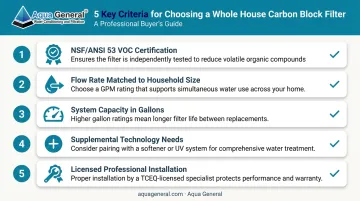
- NSF/ANSI 53 VOC certification : confirm the specific system is certified, not just "contains activated carbon"
- Flow rate matched to household size : undersized systems create pressure drops
- System capacity : rated in gallons treated, not just physical size
- Supplemental technology needs : your water test results determine what additional treatment, if any, is required
- Licensed professional installation : in Texas, TCEQ Class III Water Treatment Specialist licensing is required for proper POE system installation
Maintenance Basics
- Whole-house carbon media systems: replacement approximately every 3 years
- Cartridge-style whole-house carbon filters: typically every 6–12 months depending on water quality and usage volume
- Follow system-specific manufacturer guidelines — not just a calendar date
- Skipping replacements allows VOC breakthrough and risks bacterial buildup in the media
Frequently Asked Questions
What does a whole house carbon filter remove?
Carbon block whole house filters effectively reduce VOCs (benzene, TCE, THMs), chlorine and chloramines, pesticides, herbicides, sediment, and taste and odor compounds. Actual performance depends on carbon type, system capacity, and NSF certification level — check for NSF/ANSI 53 certification for any health-related contaminant claims.
What do carbon filters not remove?
Carbon filters don't reliably remove dissolved minerals, nitrates, fluoride, bacteria, or viruses. Heavy metal reduction (lead, arsenic) is product-specific and requires confirmed NSF/ANSI 53 certification for those contaminants. For these contaminants, carbon block should be paired with RO, UV, or specialty media systems.
How do I know if my water has VOCs?
VOCs have no taste or odor at concentrations that pose health risks : they're undetectable without testing. A certified laboratory analysis is the only reliable method. In Texas, TCEQ maintains a list of NELAP-accredited drinking water labs, and Aqua General offers free on-site water assessments across the Greater Houston area.
Is carbon block better than granular activated carbon (GAC) for VOCs?
Carbon block generally provides more consistent contact between water and carbon media than GAC, where loose granules can allow water to channel around the media. The best measure of any system's VOC performance is its NSF/ANSI 53 certification and rated capacity, not just the physical form of the carbon.
How long does a whole house carbon block filter last?
Cartridge-style whole house carbon filters typically need replacement every 6–12 months; bulk carbon media systems often last around 3 years. Both depend heavily on water quality and household usage. Delaying replacement risks contaminant breakthrough , so follow manufacturer guidelines and your water test results.
Do I need a whole house filter if I already have an under-sink filter?
An under-sink filter protects one tap. It doesn't filter the water you shower with, bathe in, or run through your dishwasher and washing machine — all of which create inhalation and skin exposure to any VOCs present. A whole house carbon block filter at the point of entry is the only way to address all those pathways simultaneously.