In 2026, whole house water filter pricing ranges from under $500 for a basic sediment housing to well over $10,000 for a fully installed multi-stage system with UV disinfection and specialty media. That gap isn't random — it reflects real differences in what each system treats, how long it lasts, and what it protects.
Misreading those variables leads to two predictable mistakes: overspending on capabilities you don't need, or underspending on a system that can't actually handle your water. This guide breaks down current pricing by tier, explains what drives costs up or down, and helps you budget accurately for your specific situation.
Key Takeaways
- Whole house water filter costs range from $300–$10,000+ depending on system type, home size, and installation complexity
- The two biggest cost drivers are filtration technology and water source (city vs. well water)
- Entry-level systems suit basic city water needs; high-end systems are necessary for well water or confirmed contaminant issues
- Total cost of ownership (equipment, installation, and ongoing maintenance) matters more than the upfront price
- Always test your water before selecting a system to avoid buying the wrong solution
How Much Does a Whole House Water Filter Cost?
Whole house water filter pricing isn't fixed. Costs shift based on what contaminants you're treating, the scale of the system, and whether professional installation is involved.
Two budgeting mistakes are common. The first is focusing only on equipment price while ignoring installation and maintenance costs. The second is choosing the wrong system type for your home's actual water quality problems. Both end up costing more in the long run.
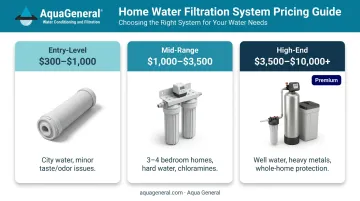
Here's how the current price landscape breaks down:
| Tier | Price Range | Typical Use Case |
|---|---|---|
| Entry-Level | $300–$1,000 | City water, minor taste/odor issues |
| Mid-Range | $1,000–$3,500 | 3–4 bedroom homes, hard water, chloramines |
| High-End / Advanced | $3,500–$10,000+ | Well water, heavy metals, whole-home protection |
Entry-Level Systems ($300–$1,000)
Single-stage sediment or basic carbon cartridge filter with minimal flow rate and DIY-friendly installation.
Best for:
- Renters or smaller homes under 1,500 sq ft
- City water with minor taste or odor concerns
- Homeowners who have confirmed low contaminant levels via water testing
These systems handle basic particulates and mild chlorine taste. They won't address hardness minerals, chloramines, lead, or bacteria.
HomeGuide reports that standard installed carbon or sediment systems run $850–$1,400. The lower end of this tier typically reflects equipment-only pricing without professional installation.
Mid-Range Systems ($1,000–$3,500)
Multi-stage systems combining carbon filtration, sediment pre-filter, and often a salt-free conditioner or water softener. Covers chlorine, chloramines, hardness minerals, and sediment. May include professional installation.
Best for:
- Typical 3–4 bedroom homes on municipal water
- Moderate hardness issues
- Houston-area homeowners dealing with hard water and chloramine-treated city water
This is the most common configuration for Greater Houston homeowners. HomeAdvisor's 2026 data puts the normal installed range at $1,129–$3,540, with an average of $2,274.
High-End / Advanced Systems ($3,500–$10,000+)
These systems are built for homes where basic filtration isn't enough. A typical high-end setup includes:
- Whole-home softening with fine particle filtration down to 0.02–5 microns
- Anti-microbial media, UV disinfection, and reverse osmosis add-ons
- Specialty filters targeting arsenic, iron, or PFAS
- Professional installation with WQA/NSF-certified components
They're the right call for well water homes with iron, manganese, or bacterial contamination — or any household with confirmed heavy metal issues needing comprehensive protection.
Angi's 2026 cost guide lists whole-house systems up to $10,000, with whole-house RO systems running $4,800–$8,000 installed.
Key Factors That Affect the Cost of a Whole House Water Filter
Pricing is shaped by technical, site-specific, and operational variables. Understanding them is the only way to budget accurately.
System Type and Filtration Technology
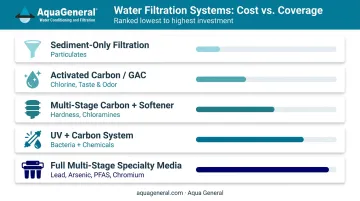
The type of filtration is the single biggest cost driver:
| System Type | Coverage | Relative Cost |
|---|---|---|
| Sediment-only | Particulates | Lowest |
| Activated carbon (GAC) | Chlorine, taste, odor | Low–Medium |
| Multi-stage carbon + softener | Hardness, chlorine/chloramines, sediment | Medium |
| UV + carbon | Bacteria + chemicals | Medium–High |
| Full multi-stage with specialty media | Lead, arsenic, PFAS, chromium | Highest |
Arsenic, hexavalent chromium, PFAS, and lead can't be adequately addressed with standard carbon filters. They require specific adsorptive or ion-exchange media — materials engineered to bind those contaminants chemically — which adds cost but can't be substituted with generic alternatives.
Water Source: City vs. Well Water
City water typically requires carbon filtration for chlorine or chloramines plus a conditioner for hardness — lower cost baseline overall.
Well water often requires multi-stage treatment for iron, manganese, bacteria, sediment, and pH imbalance — substantially higher cost.
One important Houston-specific note: most of the city's main water system uses chloramines, not free chlorine. The City of Houston's 2024 Water Quality Report confirms chloramine use in the Main System and Belleau Woods, while Kingwood and several other districts use free chlorine. Chloramine removal requires catalytic carbon, not standard GAC — an important distinction that affects both system selection and cost that many homeowners miss when shopping online.
Home Size and Flow Rate Requirements
Larger homes need higher-capacity systems with greater flow rates (GPM). Undersizing a system causes pressure loss at every fixture and reduces contact time with filter media — both undermine filtration quality. Size based on peak simultaneous fixture demand:
- Shower: 1.5–3 GPM
- Dishwasher: 2–4 GPM
- Washing machine: 3–5 GPM
High-capacity whole house systems can reach 14 GPM or more. Pentair's High Flow series is designed for homes with 6+ bathrooms. Commercial or multi-unit applications require industrial-grade systems that exceed residential pricing entirely.
Installation Complexity
Flow rate requirements directly influence installation scope. Professional labor for whole house filtration installation typically runs $200–$600 according to HomeGuide, but complex jobs cost more. Angi notes plumbers charge $45–$200 per hour, with whole house installations often requiring 4–8 hours.
Cost factors that push installation higher:
- Pipe modifications or drywall access required
- New bypass valves or electrical outlet needed
- Distance from main water line entry point
- Drain or backwash connections for UV, RO, or backwashing systems
Professional installation by a licensed water treatment specialist — such as a TCEQ-licensed professional — protects your system warranty and ensures local code compliance. That's a meaningful distinction from hiring a general plumber for the hookup.
Filter Media and Component Quality
The components inside a system matter as much as the system itself. NSF/ANSI-certified media costs more upfront but is independently verified — the key standards to know:
- NSF/ANSI 42 — aesthetic effects (chlorine, taste, odor, particulates)
- NSF/ANSI 53 — health-related contaminants (lead, VOCs, Cryptosporidium)
- NSF/ANSI 58 — reverse osmosis performance
- NSF/ANSI 401 — emerging contaminants (certain pharmaceuticals, herbicides)
WQA Gold Seal certification adds product testing, annual facility inspections, and periodic retesting on top of standard NSF verification. Premium certified media — catalytic carbon, anti-microbial media, specialty arsenic or chromium reduction media — has longer service intervals and validated performance claims that generic media can't match.
Full Cost Breakdown: Beyond the Purchase Price
The total cost of ownership goes well beyond the equipment sticker price. Homeowners who ignore ongoing costs often face budget surprises within the first year.
Initial Equipment Purchase
The largest upfront expense. Based on current market data: basic systems $300–$1,000 (equipment only); mid-range $1,000–$3,500 installed; advanced systems $3,500–$10,000+. WQA/NSF-certified systems command a premium but deliver verified performance.
Professional Installation
Labor, fittings, bypass valves, and any pipe modifications. Typical range: $200–$600 for straightforward installations, higher for complex configurations. TCEQ-licensed specialists may charge more than general plumbers, but they ensure proper system configuration and warranty compliance.
Filter Cartridge or Media Replacement (Recurring)
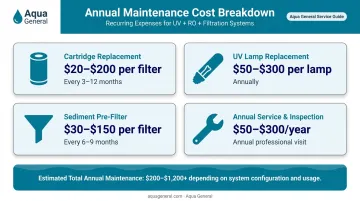
- Cartridge systems: replacement every 3–12 months, $20–$200 per filter (Angi, 2026)
- Backwashing systems: media replacement every 3–10 years depending on system design
- UV lamps (such as Aquasana): annual replacement required
- Sediment pre-filters (such as Pentair): replacement every 6–9 months; carbon media lasts up to 5 years or model-specific gallon limits
- Annual maintenance costs typically run $50–$300, including replacements and inspection
Annual Service and Inspection
Professional servicing catches early mechanical issues, and manufacturers often require annual servicing to keep warranties valid. For Houston-area homeowners, Aqua General's parts inventory covers a wide range of brands — including Fleck, Clack, Pentair, and Puronics — so systems get serviced without long delays or sourcing problems.
Unexpected Repairs
Control valves, pressure gauges, pre-filter housings, and UV bulbs have finite lifespans. Systems with superior manufacturer warranties — particularly lifetime tank warranties — reduce long-term out-of-pocket costs from unexpected failures.
Budget vs. Premium: What Are You Actually Paying For?
The gap between a $400 and a $4,000 whole house water filter reflects measurable differences — not just brand prestige.
Performance and Contaminant Coverage
- Entry-level systems: Handle basic sediment and mild chlorine. Appropriate for confirmed low-risk city water.
- Premium systems: Remove a much wider spectrum — lead, arsenic, hexavalent chromium, disinfection by-products, PFAS, and bacteria.
For homeowners in areas with known arsenic or chromium concerns — relevant across Texas given that TWDB identifies arsenic as the most frequently detected constituent exceeding drinking water standards in Texas public water systems — a budget system simply isn't capable of addressing the actual problem.
Durability and Long-Term Value
Premium systems use NSF/WQA-certified components, higher-grade construction, and longer-lasting media. A $1,500 system replaced every 5 years costs more over a decade than a $3,500 certified system lasting 15+ years.
The math favors the higher upfront investment once you factor in replacement costs, reinstallation labor, and the periods your home runs on degraded filtration between service calls.
Hidden Savings of Better Systems
High-quality filtration generates real downstream savings:
- Protects water heaters, dishwashers, and washing machines from scale buildup — the WQA/Battelle softened water research confirms measurable performance gains for scale-controlled systems.
- Cuts soap and detergent use, since soft filtered water lathers more effectively with less product.
- Eliminates most bottled water spending: at 47.3 gallons consumed per capita annually (Beverage Marketing Corporation, 2025), multi-member households pay a real ongoing cost that quality filtration replaces.
- Prevents the slow, expensive pipe and fixture damage that scale accumulation causes over time.
How to Estimate Your Budget — and Avoid Common Mistakes
Start With a Water Test, Not a Price List
The biggest mistake Houston homeowners make is shopping for a system before knowing what's in their water. A professional water test identifies specific contaminants, hardness level, pH, and flow requirements — the actual information needed to select the right system.
Aqua General's water assessments identify exactly what your Houston-area water contains, so you pay only for the protection you actually need — not a system that over-engineers or underdelivers.
Match the System to the Home
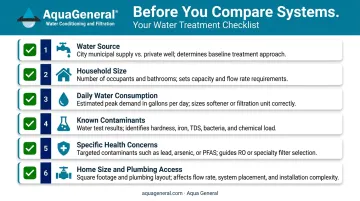
Use this checklist before comparing systems:
- Water source: City or well?
- Household size: Number of occupants and bathrooms?
- Daily water consumption: Peak demand periods?
- Known contaminants: Results from water testing or Consumer Confidence Report?
- Specific health concerns: Lead, arsenic, bacteria, PFAS?
- Home size and plumbing access: Affects flow rate requirements and installation complexity?
Don't Ignore Total Cost of Ownership
The right budget accounts for equipment, installation, and recurring maintenance over a 10-year horizon, not just the purchase price. A system that costs $500 more upfront but lasts twice as long with lower media replacement costs is almost always the better investment.
For an accurate cost estimate tied to your specific home and Houston-area water conditions, a consultation with a TCEQ-licensed water treatment specialist will give you real numbers — not a ballpark pulled from a national average.
Frequently Asked Questions
How much does it cost to install a whole house water filtration system?
Professional installation typically runs $200–$600 for straightforward setups, but complex jobs involving pipe modifications, electrical connections, or limited plumbing access can push costs higher. Getting a site-specific quote from a licensed water treatment specialist is the only way to know your actual number.
Is it worth getting a whole house water filtration system?
For most homeowners, yes. Appliance protection, reduced bottled water spending, lower soap and detergent use, and improved water quality for drinking, bathing, and cooking create real financial returns over time. Most systems pay for themselves within a few years.
What is the best whole house filter for arsenic?
Arsenic requires specialty filtration media — typically activated alumina or iron-oxide-based adsorptive media — and cannot be effectively removed by standard carbon filters. Get a professional water test to confirm your arsenic levels before selecting any system, as the required media and system configuration depend on actual concentration.
What is the average annual maintenance cost for a whole house water filter?
Annual maintenance typically runs $50–$300, covering filter replacements and professional inspection, Annual maintenance typically runs $50–$300, covering filter replacements and professional inspection, according to HomeAdvisor. Higher-quality systems with longer-lasting media often cost less to maintain annually over a 10-year period than cheaper systems with frequent cartridge replacements.
How long does a whole house water filtration system last?
Quality tanks often last 10–25+ years. Cartridge systems need media swapped every 3–12 months, while bulk media in backwashing systems lasts 3–10 years; UV lamps need annual replacement. Proper installation and regular maintenance are the biggest factors in system longevity.
Do I need a water test before buying a whole house filter?
Yes. Testing first prevents the two most common mistakes: buying the wrong system type and undersizing for your actual water quality problems. City water customers can start with their annual Consumer Confidence Report; well water owners should use a certified lab.