Water softener system costs vary widely — from around $200 for a basic electronic conditioner to $6,000+ for a professionally installed whole-house system. That spread exists for good reason: system type, household size, water hardness, and installation complexity all pull the final number in different directions.
This guide breaks down every cost component — equipment tiers, installation labor, recurring salt and maintenance expenses, and the long-term math between budget and premium systems — so you can budget accurately before making a decision.
Key Takeaways
- Professionally installed residential water softener systems typically cost $500–$6,000, including equipment and labor.
- The four primary cost drivers are system type, household size, water hardness (GPG), and installation complexity.
- Total ownership cost covers one-time expenses (equipment and installation) plus ongoing costs like salt and maintenance.
- Higher-quality systems with strong warranties deliver lower long-term costs despite a higher purchase price.
- Get a professional water test before purchasing — it prevents costly sizing mistakes.
How Much Does a Water Softener System Cost?
Water softeners don't have a single fixed price. The cost reflects the system type, its grain capacity, and how complex the installation turns out to be. Two common mistakes derail buyers: choosing a system too small for their actual water hardness, and fixating on purchase price while ignoring installation and operating costs. Both lead to overspending in the long run.
Here's how pricing breaks down across the three main tiers.
Entry-Level Systems ($200–$800)
This range covers magnetic and electronic water conditioners (such as the iSpring ED2000, available for around $104) and basic single-tank salt-based units sold at big-box retailers — for example, the Rheem 32,000 Grain softener at roughly $489.
A few important caveats:
- Most entry-level units are not professionally installed
- Electronic/magnetic conditioners are not certified under NSF/ANSI 44 for hardness removal — research on their effectiveness shows mixed results
- Warranties are typically limited, and replacement parts availability varies
- Shorter lifespans increase the total cost over time
Best for: Small households with mildly hard water (under 7 GPG) who want a low-commitment starting point and understand the limitations.
Mid-Range Systems ($800–$2,500)
This tier covers quality single-tank salt-based ion exchange softeners and salt-free conditioning systems with metered demand valves and better resin quality. Verified equipment-only examples include the US Water Matrixx Smart Metered Softener at $1,232 and the SpringWell Salt Water Softener at $1,620.
Key differences from entry-level:
- Metered (demand-initiated) regeneration uses salt more efficiently than timer-based valves
- Better resin quality extends system lifespan
- Most suppliers in this range offer professional installation as a bundled option or add-on
Best for: Average-sized households (2–4 people) with moderate water hardness who want reliable performance and lower ongoing operating costs.
High-End / Professional-Grade Systems ($2,500–$6,000+)
At this level, you're looking at high-capacity dual-tank systems, integrated whole-house filtration units, and systems with WQA/NSF-certified components. The US Water Synergy Twin-Alternating softener runs around $2,322 for equipment alone; a SpringWell integrated filter-plus-softener combo comes in at $2,250.
What justifies the price:
- Dual-tank design ensures continuous soft water during regeneration cycles
- Integrated systems address chlorine, sediment, and chemical contaminants alongside hardness — potentially eliminating the need for separate treatment equipment
- WQA/NSF-certified components provide verified performance claims
- Long-term manufacturer warranties reduce repair costs
For Houston-area homeowners dealing with hard water alongside chlorine and sediment concerns, professionally installed systems in this tier can consolidate treatment into a single unit. Aqua General, for example, installs whole-house systems that combine softening, anti-microbial media, fine particle filtration (down to 0.02–5 microns), and chemical reduction — addressing multiple water quality issues without separate equipment for each.
Best for: Larger households, homes with very hard water or additional concerns (iron, chlorine, sediment), and homeowners who want comprehensive treatment with less day-to-day upkeep — such as self-regulating regeneration cycles and fewer service calls.
Key Factors That Affect the Cost of a Water Softener
The final price of a water softener reflects several interacting variables. Knowing which ones carry the most weight helps you budget accurately before you start shopping.
System Type and Technology
Technology drives the widest price variation:
| System Type | How It Works | True Hardness Removal? |
|---|---|---|
| Salt-based ion exchange | Replaces calcium/magnesium with sodium | Yes (NSF/ANSI 44 certified) |
| Salt-free conditioner | Alters mineral structure to reduce scale | No (conditioning only) |
| Dual-tank salt-based | Alternating tanks for continuous operation | Yes (NSF/ANSI 44 certified) |
| Magnetic/electronic | Electromagnetic field treatment | Not verified (mixed evidence) |
NSF/ANSI Standard 44 specifically covers residential cation-exchange softeners and evaluates hardness reduction, material safety, structural integrity, and brine accuracy. Salt-free and magnetic systems fall outside this standard's scope, which matters when comparing performance claims.
Systems with integrated capabilities — anti-microbial media, fine particle filtration, chemical reduction — cost more upfront but eliminate the need for additional treatment equipment.
System Capacity (Grain Rating)
Grain capacity determines how much hardness a system can remove between regeneration cycles. To calculate your minimum daily softening demand:
People in household × gallons per person per day × water hardness (GPG) = daily grains to remove
The EPA estimates the average American uses 82 gallons per day at home. For a family of four in a Houston-area home with 8 GPG water:
4 × 82 × 8 = 2,624 grains per day
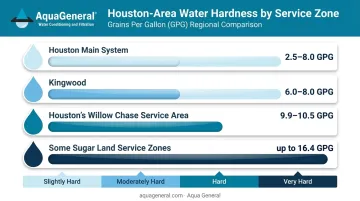
Houston-area hardness varies widely by location — undersizing for the higher ranges is one of the most common and costly mistakes local homeowners make:
- Houston main system: ~2.5–8.0 GPG
- Kingwood: 6.0–8.0 GPG
- Houston's Willow Chase service area: 9.9–10.5 GPG
- Some Sugar Land service zones: up to 16.4 GPG
Installation Complexity
Professional installation typically ranges from $200 to $1,000+, depending on:
- Whether your home has an existing softener loop (pre-plumbed homes cost significantly less)
- Distance from the main water line
- Whether new drain connections or electrical outlets are needed
- Local permit requirements
In Texas, TCEQ licenses water treatment specialists for softener installations. Houston allows licensed contractors to apply for plumbing permits online, and some municipalities have specific water softener permit processes. Factor permits into your budget early.
Component Quality and Certifications
Valve type has a direct impact on long-term operating costs:
- Timer-based valves regenerate on a fixed schedule regardless of actual water use — wasteful with salt and water
- Metered demand-initiated valves regenerate only when needed, reducing operating costs over time
- WQA Gold Seal and NSF/ANSI 44 certification provide independent verification that a system actually removes hardness to claimed levels
When comparing bids, WQA Gold Seal and NSF/ANSI 44 certification are the fastest way to verify a system's performance claims — no amount of sales language substitutes for independent third-party testing.
Complete Cost Breakdown: One-Time and Recurring Expenses
Equipment Purchase (One-Time)
| System Type | Equipment-Only Range |
|---|---|
| Basic salt-based ion exchange | $489–$1,200 |
| Quality single-tank salt-based | $1,200–$2,000 |
| Salt-free conditioner | $457–$2,000+ |
| Dual-tank / integrated whole-house | $2,250–$5,000+ |
Professionally supplied systems typically include warranty protections that retail units don't.
Installation and Setup (One-Time)
Labor generally runs $200–$1,000, with straightforward installations in homes with existing softener loops falling on the lower end. Older homes requiring new plumbing infrastructure push toward the higher end. Permits add variable costs depending on your municipality, so confirm local requirements with your permitting office before finalizing your budget.
Salt and Operating Costs (Recurring)
Salt-based systems need periodic replenishment. Based on manufacturer guidance from Morton and Diamond Crystal:
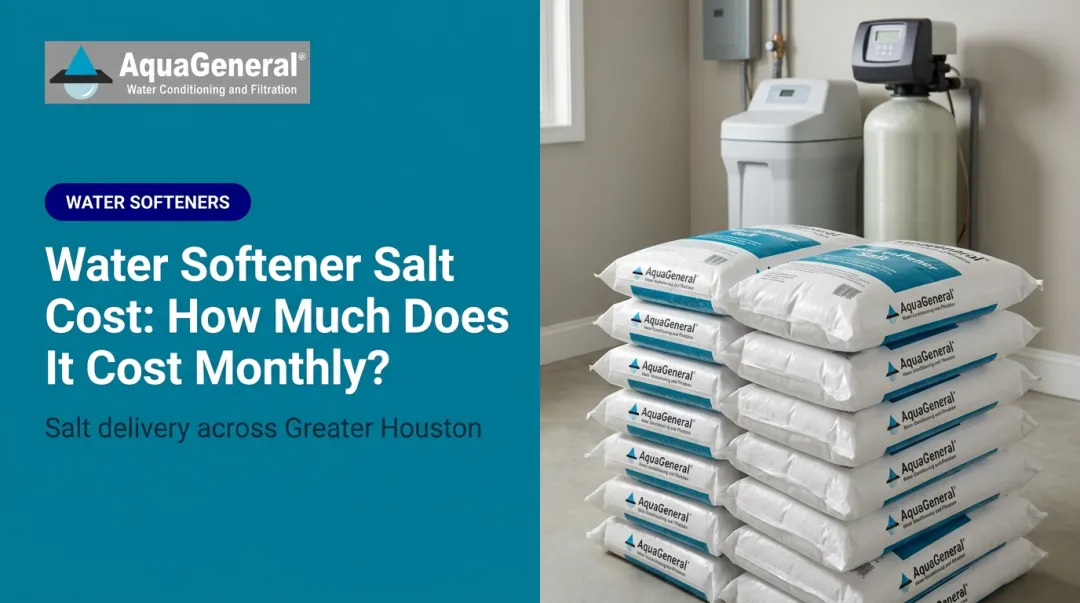
- Average consumption: Approximately one 40 lb bag per month
- Current bag prices: $8.58–$9.58 per 40 lb bag (Home Depot pricing)
- Estimated annual salt cost: Roughly $103–$115 per year (before tax or delivery)
High-efficiency systems with demand-initiated regeneration (which regenerates based on actual water usage rather than a fixed timer) use significantly less salt than standard models. WQA best practices target removing 4,000 grains per pound of salt, so it's worth asking any vendor where their system lands against that benchmark.
Salt delivery services, like those offered by Aqua General across Harris, Fort Bend, Galveston, Montgomery, and surrounding counties, eliminate the hassle of transporting heavy bags and ensure the system never runs dry.
Maintenance and Replacement (Recurring)
Annual professional maintenance covers resin bed inspection, valve servicing, brine tank cleaning, and system performance checks. Consumer Reports notes that most softeners should run well for 10–15 years with normal maintenance.
Lower-cost retail units may require replacement sooner, making their total lifecycle cost higher than a premium unit bought once and maintained properly. A strong manufacturer's warranty is the clearest indicator of expected system lifespan. Look for units backed by a limited lifetime warranty, and confirm exactly what parts and labor are covered before committing.
Budget vs. Premium Water Softeners: What's the Difference?
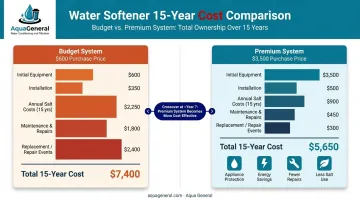
The gap between a $600 big-box softener and a $3,500+ professionally installed system isn't just about features. It reflects real differences in how the systems perform over years of daily use.
| Factor | Budget System | Premium System |
|---|---|---|
| Valve type | Timer-based | Demand-initiated metered |
| Hardness reduction | Often unverified | NSF/ANSI 44 certified |
| Resin quality | Standard crosslink | High-grade crosslink |
| Warranty | Limited (1–3 years typical) | Extended or lifetime manufacturer's warranty |
| Local service availability | Varies | Dedicated service network |
| Lifespan | 10 years or less | 15+ years with maintenance |
The research on long-term savings is specific. Independent studies found that softened water delivers measurable reductions in both utility costs and product consumption:
- WQRF-funded research found softened water enabled 50% lower laundry detergent use and up to 70% savings on dishwasher detergent
- A Battelle study found gas water heaters on softened water maintained original factory efficiency over a 15-year lifespan — hard water caused a 4% efficiency loss for every 5 GPG of hardness
A premium system that lasts 15+ years typically costs less over its lifetime than cycling through two budget units — before factoring in the higher utility bills and appliance wear that accumulate in between.
How to Estimate the Right Budget for Your Home
The right budget isn't the lowest possible price — it's the cost of a system sized correctly for your actual water hardness, household demand, and any additional water quality concerns in your supply.
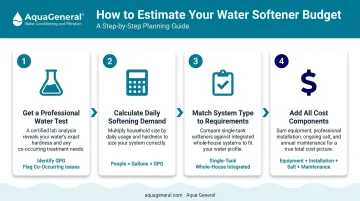
Follow this four-step process:
Get a professional water test — Identify hardness in GPG and flag co-occurring issues like iron, chlorine, sediment, or disinfection byproducts. Aqua General provides free on-site water testing for residential customers across their eight-county Greater Houston service area.
Calculate your daily softening demand — Use the formula: people × gallons per day × GPG hardness. This determines the minimum grain capacity you need.
Match system type to your requirements — If your water test shows only hardness, a single-tank ion exchange system may suffice. If it reveals chlorine, sediment, or chemical concerns alongside hardness, an integrated whole-house system eliminates the need for multiple separate units.
Add all cost components — Equipment + installation + estimated annual salt costs + maintenance = realistic total budget.
Getting those four steps right keeps costs predictable. These common oversights do the opposite:
Oversights that inflate long-term costs:
- Focusing only on the sticker price and ignoring installation and operating expenses
- Choosing a system too small for actual water hardness (especially relevant in higher-GPG areas like Sugar Land or Willow Chase)
- Buying from a source with no local service capability when repairs are eventually needed
- Skipping the water test and guessing at hardness levels
A WQA-certified water treatment specialist can perform an on-site water test and recommend a correctly sized, certified system for your specific location. Aqua General's team holds a TCEQ Class III Water Treatment Specialist License and has been serving the Houston area for over 32 years.
Frequently Asked Questions
How much does a typical water softener system cost?
Water softeners range from around $200 for basic electronic conditioners to $6,000+ for professionally installed whole-house systems. Most homeowners with a professionally installed residential salt-based system spend between $1,500 and $4,000 all-in. The right number depends on your system type, household size, and water hardness level.
How much do plumbers charge to install a water softener system?
Professional installation typically runs $200–$1,000. Homes pre-plumbed with an existing softener loop land on the lower end; older homes requiring new drain connections or electrical outlets push toward the higher end. Permits may also apply, and professional installation is strongly recommended to ensure proper sizing, code compliance, and warranty validity.
Are water softener systems worth the cost?
For most households with hard water, yes. Softened water can cut laundry detergent use by up to 50% and dishwasher detergent by up to 70%, while protecting appliances and plumbing from scale buildup. Most properly sized systems pay for themselves through reduced cleaning product costs and fewer appliance repairs.
What is the cheapest type of water softener?
Magnetic and electronic conditioners are cheapest at $100–$600, but their effectiveness is debated and unverified under NSF/ANSI 44. For proven hardness removal, basic salt-based ion exchange systems starting around $489 are the most cost-effective entry point.
How long do water softener systems last?
Consumer Reports indicates most softeners run well for 10–15 years with normal maintenance. High-quality, professionally installed systems with strong manufacturer warranties tend to reach the upper end of that range or beyond. Budget retail units often need replacement sooner, making total lifecycle cost a better comparison metric than purchase price alone.
Does water hardness level affect how much I should spend on a system?
Yes, directly. Higher GPG water requires a higher grain-capacity system, which increases both equipment and operating costs. Houston-area homes range from around 2.5 GPG in some areas to over 16 GPG in parts of Fort Bend County — and undersizing for your actual hardness level is one of the most common causes of poor performance and early system failure.