The good news: you don't have to wait for utilities to act. Home filtration, specifically reverse osmosis, gives homeowners a meaningful layer of protection right now. This article covers how RO works against PFAS, how effective it actually is, how it stacks up against other filter types, and what to look for when choosing a system for your Houston home.
Key Takeaways
- Reverse osmosis reduces PFAS by 94% or more, making it one of the most effective residential filtration options available.
- Only systems certified under NSF/ANSI 58 or NSF/ANSI 53, ideally certified for Total PFAS reduction, offer validated protection.
- Pitcher filters and fridge filters produce inconsistent PFAS results; some remove very little.
- Boiling water does not remove PFAS and may concentrate them further.
- PFAS can appear in both municipal water and private wells, making point-of-use filtration a smart precaution regardless of your water source.
What Are PFAS and Why Should Houston Homeowners Be Concerned?
PFAS are a family of thousands of man-made chemicals used since the 1940s in non-stick cookware, food packaging, firefighting foam, and stain-resistant fabrics. The EPA's CompTox database identifies more than 8,000 PFAS compounds based on chemical structure. They've earned the nickname "forever chemicals" because they break down extremely slowly — both in the environment and inside the human body.
What the Research Says About Health Risks
Long-term PFAS exposure has been linked to serious health concerns. According to the EPA and ATSDR, documented associations include:
- Increased risk of certain cancers, including prostate, kidney, and testicular cancers
- Thyroid dysfunction and disease
- Reduced antibody response to some vaccines
- Elevated cholesterol levels (specifically linked to PFOA, PFOS, PFNA, and PFDA)
How Widespread Is the Problem?
A 2023 USGS study testing 716 locations across the U.S. estimated that at least 45% of U.S. tap water contains one or more PFAS. Detection probability ran about 75% in urban tap water and 25% in rural areas.
For Houston specifically, five City of Houston water systems are actively being tested for 29 PFAS compounds under EPA's UCMR5 monitoring program through 2025. EWG's tap water database lists confirmed PFAS detections in the Houston main system (TX1010013), including 6:2 Fluorotelomer Sulfonic Acid, PFBA, PFHxA, and PFPeA.
Texas public water systems aren't required to meet federal PFAS maximum contaminant levels until 2029 under TCEQ's current compliance schedule. That's a seven-year gap — and it's the reason many Houston homeowners aren't waiting on municipal action.
How Reverse Osmosis Works to Remove PFAS
RO works by forcing water through a semipermeable membrane with pores so small that PFAS molecules physically cannot pass through. Water molecules pass through; PFAS and other dissolved contaminants are rejected and diverted to drain.
The Multi-Stage Process
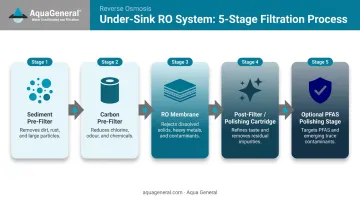
Modern under-sink RO systems don't rely on the membrane alone. A typical 3- to 5-stage system includes:
- Sediment pre-filter — removes particles, silt, and debris that could foul the membrane
- Carbon pre-filter — reduces chlorine, chloramines, and organic compounds before the membrane
- RO membrane — the primary barrier against PFAS, heavy metals, nitrates, and dissolved solids
- Post-filter or polishing cartridge — often a carbon block that catches any remaining trace contaminants
- Optional dedicated PFAS polishing stage — found in higher-end systems specifically targeting PFAS
Not All RO Systems Are PFAS-Certified
Filtered-out PFAS don't accumulate inside the system — they're carried away in a reject/wastewater stream that flows down the drain. This is a real advantage over carbon filters, which absorb contaminants into filter media and hold them there until the cartridge is replaced or saturated.
That said, not all RO systems are built the same. PFAS reduction specifically depends on the system having the correct additional filtration stages and the right membrane specifications. Buyers should verify their system carries certification for PFAS reduction — NSF/ANSI 58 is the benchmark standard — rather than relying on general contaminant reduction claims.
How Effective Is Reverse Osmosis at Removing PFAS?
Multiple independent studies and EPA testing confirm that reverse osmosis is one of the most effective residential technologies for reducing PFAS in drinking water.
Study-Based Evidence
A widely cited study by researchers at Duke University and NC State University — published in Environmental Science & Technology Letters — analyzed water samples from 73 homes. Under-sink RO systems achieved PFAS reductions of 94% or more, including greater than 97% removal for perfluoroalkyl ether acids. Even GenX, a next-generation PFAS compound that replaced some older chemicals, was reduced by more than 75%.
EPA Findings
EPA's own research found that high-pressure membranes like RO are typically more than 90% effective across a wide range of PFAS, including shorter-chain compounds that some other filters handle poorly. In EPA lab testing, certain RO systems reduced PFOA, PFOS, PFHpA, PFBS, PFHxS, and PFNA to non-detect levels below 3 ppt.
PFOA/PFOS vs. Total PFAS Certification
Some systems are only certified for PFOA and PFOS — the two PFAS compounds with the most historical scrutiny. But with thousands of PFAS variants in existence, a certification covering Total PFAS (which includes PFOA, PFOS, PFHpA, PFHxS, PFNA, and PFBS under current NSF standards) offers broader protection. Prioritize Total PFAS-certified systems when possible.
Filter Maintenance Affects Long-Term Performance
An RO system that performed well when new can lose its effectiveness if filters aren't replaced on schedule. Typical replacement intervals are:
- RO membrane: every 2–3 years
- Pre- and post-filter cartridges: every 6–12 months
Follow manufacturer guidelines closely. Skipping replacements can result in a system that no longer meaningfully reduces PFAS.
How RO Compares to Other Water Filters for PFAS Removal
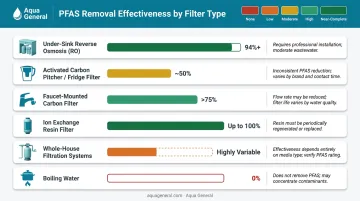
| Filter Type | Typical PFAS Removal | Key Limitation |
|---|---|---|
| Under-sink RO | 94%+ | Requires maintenance; higher upfront cost |
| Activated carbon (pitcher/fridge) | ~50% average (variable) | Inconsistent; better for long-chain PFAS |
| Faucet-mounted carbon | >75% in some studies | Varies by brand and condition |
| Ion exchange (IX) resin | Up to 100% (temporarily) | Must be certified specifically for PFAS |
| Whole-house systems | Highly variable | Some increased PFAS levels in testing |
| Boiling | 0% | May concentrate PFAS as water evaporates |
Activated Carbon Filters
The Duke/NC State study found that pitcher and refrigerator filters averaged about 50% removal for PFAS acids overall — roughly 60–70% for longer-chain PFAS, dropping to around 40% for shorter-chain variants. Results didn't correlate reliably with filter brand, age, or source water concentration. Researchers still recommend them over no filter at all, but the inconsistency is a real limitation.
Ion Exchange Resin
IX resin systems designed and certified specifically for PFAS can achieve up to 100% removal — at least temporarily. They use charged beads that attract and hold PFAS molecules until the resin is exhausted. Third-party PFAS-specific certification is required; general IX filters don't deliver the same results.
Whole-House Systems
In 4 of 8 whole-house systems tested by the Duke/NC State study, PFAS levels in filtered water were actually higher than in the unfiltered supply. Filter saturation and inadequate maintenance were the likely culprits. Whole-house systems are not a reliable primary strategy for PFAS in drinking water.
Boiling is similarly ineffective. NSF is direct on this point: heat doesn't destroy PFAS the way it kills bacteria or viruses. As water evaporates during boiling, PFAS concentrations in what remains can actually increase.
What to Look for in an RO System for PFAS Removal
Certifications to Verify
Before purchasing, check for these specific certifications from an accredited third-party body (NSF, WQA, or IAPMO):
- NSF/ANSI 58 — covers reverse osmosis systems broadly
- NSF/ANSI 53 — covers filtration systems including activated carbon and anion exchange
- Total PFAS reduction claim — the most comprehensive PFAS coverage available under current NSF standards (covers PFOA, PFOS, PFHpA, PFHxS, PFNA, and PFBS)
To verify a system's certification before you buy, use these official search tools:
What to Look for in System Design
A reliable RO system for PFAS removal should include:
- 3–5 filtration stages minimum, including sediment and carbon pre-filtration before the membrane
- Dedicated post-filter or polishing cartridge beyond the RO membrane itself
- Manufacturer-specified replacement schedules — and a service provider who can help you maintain them
Aqua General's Role for Houston Homeowners
If you're in the Greater Houston area, Aqua General has been installing and servicing water treatment systems across Harris, Fort Bend, Montgomery, Galveston, Brazoria, and surrounding counties for over 32 years. Their systems and components are tested, certified, and validated by both the WQA and NSF. The company also holds a TCEQ Class III Water Treatment Specialist License.
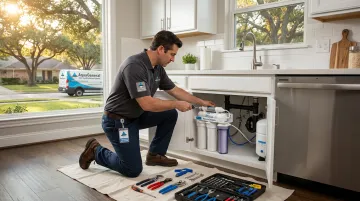
Whether you're on municipal supply or a private well, Aqua General can assess your water quality and recommend a certified RO solution for your home. Contact them at (713) 664-4601 or reach out at service@aquageneral.com to schedule a water quality consultation.
Frequently Asked Questions
How much PFAS does reverse osmosis remove?
Research from Duke University and NC State found under-sink RO systems reduce PFAS by 94% or more. EPA testing found certain RO systems reduce PFOA, PFOS, and related compounds to non-detect levels — provided the system is properly equipped with the right filtration stages and filters are replaced on schedule.
Which water filters remove PFAS?
RO systems, granular activated carbon (GAC) filters, and ion exchange resin filters can all reduce PFAS — but only when they carry third-party certification such as NSF/ANSI 53 or 58 for PFAS reduction. RO is the most consistent and comprehensive option across the widest range of PFAS compounds.
Does boiling water remove PFAS from drinking water?
No. Boiling water is only effective against biological contaminants like bacteria and viruses. NSF confirms it will not reduce PFAS exposure risk — and as water volume decreases during boiling, PFAS concentrations in the remaining water can increase.
Can PFAS be found in Houston tap water?
Yes. Five City of Houston water systems are being tested for 29 PFAS compounds under the EPA's UCMR5 program, and EWG's tap water database reports detections in the Houston main system. PFAS can also appear in private wells, making home filtration a practical measure regardless of your water source.
How often should I replace my RO filter to maintain PFAS removal?
RO membranes typically need replacement every 2–3 years; pre- and post-filter cartridges every 6–12 months. Following the manufacturer's schedule is essential, as an overdue filter can lose its PFAS reduction effectiveness even if it once performed well.
Is a whole-house water filter enough to remove PFAS?
Independent research found whole-house systems to be highly variable for PFAS ; in some cases, filtered water actually contained more PFAS than the unfiltered supply. A certified under-sink RO system is the more reliable choice for consistent PFAS reduction in drinking water.