Carbon block filters are one of the most widely recommended solutions, but the technology varies considerably in quality and capability. Not every carbon filter performs the same way, and the certifications, pore ratings, and system design choices matter more than most product marketing suggests.
This guide covers how carbon block filters work, how they compare to granular activated carbon, what the research actually shows about PFAS and VOC removal effectiveness, which certifications are worth trusting, and how to choose the right system for your home.
Key Takeaways
- Carbon block filters trap PFAS and VOCs through adsorption, outperforming loose granular carbon for fine chemical contaminants
- NSF/ANSI 53 and NSF/ANSI 58 are the certifications that confirm verified PFAS and VOC reduction claims — not just marketing language
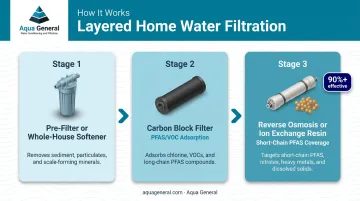
- Carbon block works best in a layered system — reverse osmosis or ion exchange resin adds critical protection at elevated PFAS levels
- Filter replacement is non-negotiable — a saturated carbon block can release trapped contaminants back into your water
- Professional water testing identifies your actual contaminants before you invest in a system
What Are PFAS and VOCs in Drinking Water?
PFAS: Why They're Called "Forever Chemicals"
PFAS (per- and polyfluoroalkyl substances) are a family of synthetic chemicals used in nonstick cookware, food packaging, stain-resistant fabrics, and firefighting foam. The carbon-fluorine bond at their core is one of the strongest in chemistry — which is precisely why they don't break down in the environment or in the human body.
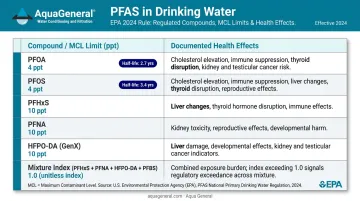
The EPA's 2024 PFAS National Primary Drinking Water Regulation established enforceable maximum contaminant levels (MCLs) for six PFAS compounds:
| PFAS Compound | EPA MCL |
|---|---|
| PFOA | 4.0 parts per trillion (ppt) |
| PFOS | 4.0 ppt |
| PFHxS | 10 ppt |
| PFNA | 10 ppt |
| HFPO-DA (GenX) | 10 ppt |
| Mixtures of two or more of the above | Hazard Index of 1.0 |
Health effects documented by ATSDR include elevated cholesterol, reduced vaccine response, liver enzyme changes, pregnancy complications, and increased risk of kidney and testicular cancer. PFOA has an estimated half-life in the human body of roughly 2.7 years; PFOS is closer to 3.4 years. That slow elimination means exposure builds up with each passing year.
VOCs in Drinking Water
VOCs (volatile organic compounds) reach drinking water through industrial discharge, fuel spills, agricultural runoff, and solvent contamination. Unlike PFAS, many VOCs do break down over time, but their acute toxicity makes even short-term exposure a concern.
The EPA's National Primary Drinking Water Regulations set MCLs for common VOCs:
- Benzene: MCL of 0.005 mg/L — linked to anemia, reduced blood platelets, and increased cancer risk
- Trichloroethylene (TCE): MCL of 0.005 mg/L — liver damage and cancer risk
- Tetrachloroethylene (PCE): MCL of 0.005 mg/L — liver damage and cancer risk
- Toluene: MCL of 1 mg/L — nervous system, kidney, and liver effects
VOC molecules bond readily to carbon surfaces, making them well-suited for carbon-based filtration. PFAS removal is more complex — effectiveness depends on chain length, contact time, and the specific carbon block design used.
How Carbon Block Filters Work
A carbon block filter starts with finely ground activated carbon — a highly porous material with an internal surface area that can exceed 1,000 m² per gram, according to WQA technical data. That carbon is compressed under high pressure into a solid, uniform block with a controlled pore structure.
The result is a filter that forces water through a consistent matrix rather than allowing it to find its own path through loose media.
Adsorption: The Core Mechanism
The removal process is adsorption — not absorption. As water passes through the carbon matrix, dissolved contaminant molecules are attracted to and bond with the enormous internal surface area of the carbon. The more surface area available and the slower the contact time, the more effective the adsorption.
Pore size directly determines which contaminants get captured. Finer pore ratings enable the filter to intercept smaller molecules, including certain PFAS compounds and small-molecule VOCs.
NSF product listings for certified carbon block components show micron ratings ranging from 0.5 to 5 microns for drinking water applications — though PFAS and VOC reduction is a certified performance claim, not a function of pore size alone.
Aqua General's carbon block systems, for example, are designed to achieve fine particle filtration to as small as 0.02 to 5 microns — finer than the diameter of a human red blood cell — enabling both chemical and particulate reduction in a single filter stage.
The Role of Anti-Microbial Media
One limitation of standard carbon block filters is the potential for bacterial growth within the filter housing over time. Moist, organic-rich filter environments can support bacterial growth — turning the filter itself into a contamination source if not properly designed.
Advanced systems address this by incorporating anti-microbial media within the filter matrix. Aqua General's systems use silver-impregnated anti-microbial media that inhibits bacterial growth inside the filter — keeping treated water clean between scheduled filter changes, not just during active filtration. Standard carbon block designs rarely include this protection.
The Flow Rate Trade-Off
Carbon block filters have lower flow rates than granular activated carbon (GAC) filters. Water must slow down to pass through the dense block structure. That slower contact time is actually an advantage — it gives contaminant molecules more time to adsorb onto the carbon surface, improving removal efficiency for both PFAS and VOCs.
Carbon Block vs. Granular Activated Carbon: Key Differences
Granular activated carbon uses loose, irregularly shaped carbon granules. Water passes through the gaps between granules rather than being forced through a uniform matrix. This creates variability in how water contacts the media — some water may move through channels between granules with limited carbon contact.
Carbon block eliminates that variability by compressing the media into a uniform matrix, forcing water through a consistent flow path across the entire filter.
| Factor | Carbon Block | Granular Activated Carbon |
|---|---|---|
| Pore uniformity | High — controlled compression | Variable — irregular granules |
| Particle filtration | Yes — sub-micron capable | Limited — primarily chemical |
| Flow path consistency | Uniform | Variable |
| Contact time | Longer (denser media) | Shorter at equivalent flow |
| Flow rate | Lower | Higher |
| PFAS/VOC removal | Generally superior for fine contaminants | Effective for longer-chain compounds |
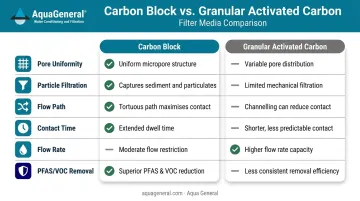
GAC still has a clear role in water treatment. Larger whole-house systems and high-flow applications commonly use GAC effectively, and it often serves as a pre-filter stage in multi-stage systems. The choice isn't binary — the right technology depends on the contaminants in your water, flow demands, and system design.
Both filter types benefit from NSF certification and proper sizing. Getting the sizing right matters as much as the filter type — an oversized or undersized unit will underperform regardless of the media.
How Effective Are Carbon Block Filters for PFAS and VOC Removal?
PFAS Removal
EPA research confirms that activated carbon is the most studied treatment technology for PFAS removal. It performs well on longer-chain PFAS like PFOA and PFOS, but is less effective on shorter-chain compounds like PFBS and PFBA.
For certified filters, NSF requires that systems with PFAS reduction claims reduce PFAS below 20 ppt — a threshold established in 2022 updates to NSF/ANSI 53 and 58.
NSF has noted that standards task groups are working to align certification thresholds with the EPA's 2024 MCLs of 4.0 ppt for PFOA and PFOS. Current certification does not automatically guarantee reduction to that level unless a specific product's test data confirms it.
Peer-reviewed research (MacKeown et al., 2024) reviewing point-of-use PFAS removal found that tested activated carbon filters achieved average removal efficiencies over 90% across POU devices. RO membranes showed similar performance, and combined systems performed consistently across a wider range of PFAS compounds.
One important field finding from Herkert et al. (2020): 4 of 6 whole-house GAC systems actually increased total PFAS concentrations in treated water, indicating breakthrough or desorption (releasing previously trapped contaminants) in saturated systems. Filter maintenance, not just filter selection, determines real-world performance.
VOC Removal
Carbon block filters have a well-established track record for VOC removal. EPA data shows GAC can achieve removal efficiencies up to 99.9% for various VOCs.
NSF/ANSI 53 uses chloroform as a surrogate contaminant to evaluate activated carbon removal of 53 regulated organic chemicals. That means certified filters have been independently tested against a standardized challenge representing a broad class of VOC compounds. Key performance benchmarks for NSF/ANSI 53-certified carbon block filters include:
- Tested against chloroform as a representative VOC surrogate
- Covers 53 regulated organic chemicals under a single certification standard
- Independent third-party validation required for certification listing
When Carbon Block Is Sufficient (and When It Isn't)
Carbon block alone is generally adequate for:
- Moderate PFAS/VOC levels in treated municipal water
- Longer-chain PFAS compounds (PFOA, PFOS) in certified systems
- Households on a well-maintained municipal supply with no industrial contamination nearby
A layered approach is needed for:
- Private wells or homes near industrial facilities or military bases
- Shorter-chain PFAS (PFBS, PFBA) where carbon adsorption is less effective
- Elevated contamination levels above certified filter performance thresholds
- Comprehensive PFAS coverage across both long- and short-chain compounds
For elevated contamination, combining carbon block with reverse osmosis or ion exchange resin provides substantially stronger protection. EPA research indicates high-pressure membranes like RO are typically more than 90% effective across a wider range of PFAS, including short-chain compounds that carbon block struggles to capture.
The Maintenance Factor
A saturated carbon block doesn't just stop working . It can release previously trapped contaminants back into your water. NSF-certified product listings show point-of-use carbon block filters with rated capacities ranging from 200 to 750 gallons.
Replacement intervals for Aqua General's point-of-use systems typically run 6–12 months under standard conditions. Households with high water usage or elevated contaminant levels will reach saturation faster.
Installing a whole-house softener or upstream pre-filter before a point-of-use carbon block can meaningfully extend filter life by reducing the contaminant load on the primary filter.
NSF Certifications to Look For in Carbon Block Filters
Certifications are what separate verified performance from unverified marketing claims. Two standards matter most for PFAS and VOC reduction:
- NSF/ANSI 53 — Covers health-effects contaminant reduction for point-of-use and point-of-entry systems. PFOA and PFOS reduction claims were added in 2017. A 2022 update lowered the combined PFAS threshold to 20 ppt and added a Total PFAS claim covering PFHpA, PFHxS, PFNA, and PFBS. VOC reduction is also covered, with chloroform used as the test surrogate.
- NSF/ANSI 58 — Covers reverse osmosis systems and their components. When a carbon block stage is part of a certified RO system, the entire system's PFAS reduction performance is validated here — not just the membrane in isolation.
- WQA Gold Seal — An independent certification from the Water Quality Association confirming that performance claims have been tested against NSF/ANSI standards by an accredited third-party lab.
How to Verify Before You Buy
Don't rely on a certification logo printed on packaging. Check directly:
- NSF certified drinking water treatment units database — search by product, manufacturer, standard, and specific contaminant claim
- WQA certified products database — searchable by product type and certification standard
- Look for the specific contaminant reduction claim (e.g., "PFOA/PFOS reduction" under NSF/ANSI 53), not just a generic certification number
That last point matters more than it might seem. A filter certified under NSF/ANSI 53 for aesthetic claims (taste and odor) is not the same as one certified for PFOA/PFOS reduction — both carry the NSF mark, but they cover entirely different performance claims.
Choosing the Right Carbon Block Filter System for Your Home
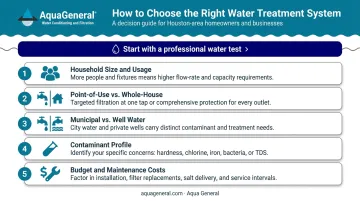
The starting point is always a professional water test. Your local utility's annual Consumer Confidence Report (CCR) provides a baseline, but CCRs reflect system-level averages — not what's coming out of a specific tap, and not contamination from localized industrial sources or private well conditions.
For Houston-area homeowners, water quality varies significantly across Aqua General's eight-county service region (Harris, Fort Bend, Galveston, Montgomery, Brazoria, and surrounding counties). Texas public water systems must complete initial PFAS monitoring by April 26, 2027 under TCEQ's framework — but that regulatory timeline doesn't address what's in your water today.
Private well owners receive no federal Safe Drinking Water Act protections at all. Testing is entirely the homeowner's responsibility.
Decision Factors for System Selection
- Household size and water usage — directly affects filter sizing and how quickly a rated-capacity filter reaches saturation
- Point-of-use vs. whole-house — under-sink systems address drinking and cooking water; whole-house systems require higher-flow configurations and professional sizing
- Municipal vs. well water — well water typically requires broader testing and often more comprehensive treatment
- Contaminant profile — moderate municipal PFAS levels may be manageable with a certified carbon block alone; private wells near industrial areas or with confirmed short-chain PFAS require a layered approach
- Budget for installation and ongoing maintenance — filter replacement costs over time are as important as upfront system cost
Working with a WQA-certified water specialist ensures system selection is based on actual test results rather than generic product assumptions. Aqua General has served Greater Houston for over 32 years with TCEQ-licensed expertise and provides free on-site water testing as the foundation for every recommendation.
Frequently Asked Questions
How long do carbon block filters last before they need to be replaced?
Replacement intervals for point-of-use carbon block filters typically range from 6 to 12 months, depending on incoming water quality, household usage, and rated gallon capacity. Watch for changes in taste, odor, or reduced flow rate, and follow the manufacturer's rated capacity rather than a calendar interval alone.
Do carbon block filters remove all types of PFAS, or only certain ones?
Carbon block filters are most effective at reducing longer-chain PFAS compounds like PFOA and PFOS through adsorption. Shorter-chain PFAS such as PFBS and PFBA are harder to capture reliably. For broader PFAS coverage, a certified carbon block should be paired with reverse osmosis or ion exchange resin in a multi-stage system.
Is a carbon block filter better than a reverse osmosis system for PFAS removal?
RO systems generally achieve higher PFAS reduction — the semi-permeable membrane physically blocks short-chain compounds that carbon struggles with. Carbon block is effective for moderate contamination and simpler to install, but RO is the stronger choice for elevated PFAS levels or private wells.
Can a carbon block filter be used for whole-house filtration, or only at a single tap?
Carbon block filters are most commonly point-of-use systems, but whole-house configurations do exist. These require larger, higher-flow systems with professional sizing to ensure adequate contact time — undersizing significantly reduces removal effectiveness.
How do I know if my water has PFAS or VOCs?
The only reliable method is a certified laboratory water test using EPA-approved methods. Municipal customers can reference their utility's annual Consumer Confidence Report, but private well owners and those near industrial sites should arrange independent testing, as CCRs don't cover private wells or localized contamination.
What certifications confirm that a carbon block filter is effective for PFAS reduction?
Look for NSF/ANSI 53 with a specific PFOA/PFOS or Total PFAS reduction claim, or NSF/ANSI 58 for RO systems with carbon stages. The WQA Gold Seal is equally valid. Verify directly on the NSF database or WQA database, and confirm the specific contaminant claim listed, not just the standard number.