The home water filtration market reached $12.12 billion in 2022 and is projected to hit $26.73 billion by 2030 — growth that reflects homeowners increasingly treating filtration as infrastructure, not an optional upgrade.
Costs range widely: from under $1,000 for basic setups to $10,000+ for advanced multi-stage configurations. This guide breaks down every layer of that investment — system tiers, cost factors, recurring expenses, and the mistakes that lead to either overpaying or buying the wrong system entirely.
Key Takeaways
- Most Houston-area homeowners spend $1,500–$4,000 all-in (unit + installation) for a mid-range whole-home system
- Hard water is the most common driver pushing homeowners toward multi-stage systems across Harris, Fort Bend, Galveston, and Montgomery Counties
- Installation labor ($300–$1,500) and annual maintenance ($100–$500/year) are costs most buyers underestimate
- Skipping a water test before buying is the single most expensive mistake in this process
- Premium systems with NSF/WQA-certified components last longer and carry stronger warranties — often with lifetime coverage
What Whole-Home Filtration Actually Costs: Breakdown by System Tier
Unlike a countertop or pitcher filter, a whole-home (point-of-entry) system treats every drop of water entering the house — every shower, faucet, and appliance. That scope drives both the technology requirements and the price.
Two common budgeting mistakes: assuming pitcher-filter pricing applies, and ignoring installation and ongoing maintenance when calculating total cost of ownership.
Entry-Level Systems: $800–$1,500
What's typically included:
- Single-stage sediment or basic activated carbon filtration
- Addresses chlorine taste and odor, large particulates
- Standard flow rates suitable for smaller homes
- Some models support DIY installation
Best for: Homeowners on municipal water with no serious contamination concerns who mainly want improved taste and reduced chlorine. Per NSF/ANSI Standard 42, these systems cover aesthetic effects like chlorine taste and odor — but they are not rated for heavy metals, bacteria, hardness, or regulated contaminants without additional applicable certifications.
Homes with hard water, iron, arsenic, or biological concerns will need a mid-range or premium system.
Mid-Range Systems: $1,500–$4,000
What's typically included:
- Multi-stage filtration: sediment pre-filter + activated carbon + water softening or conditioning
- Addresses hard water, chlorine, chloramines, common chemicals, and sediment
- Professional installation typically required
- Most popular tier for Greater Houston homes
Best for: The majority of Houston-area homeowners. Water hardness across the region varies widely: Houston's main system averages 110 ppm, suburban systems like Willow Chase reach 175 ppm, and parts of Fort Bend County climb to 280 ppm. At those levels, hard water causes scale buildup in pipes, cuts water heater efficiency, and reacts poorly with soap.
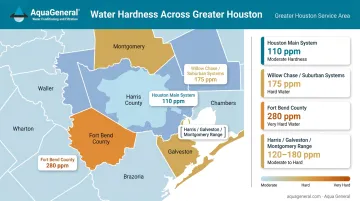
A multi-stage system covering both hardness and chemical contaminants is the right call for most households in Harris, Fort Bend, Galveston, and Montgomery Counties.
Aqua General's AquaGuard® Whole-House system, for example, combines softening, chemical reduction (including chlorine and disinfection by-products), fine particle filtration down to 0.02–5 microns, and silver-impregnated anti-microbial media — covering the full spectrum of challenges common in Houston municipal water.
Advanced/Premium Systems: $4,000–$10,000+
What's typically included:
- Whole-home reverse osmosis, UV disinfection, anti-microbial filtration media
- Sub-micron particle filtration
- Smart monitoring, extended warranties, NSF/WQA-certified components
- Professional installation and periodic professional servicing expected
Best for: Homes on well water, those with documented heavy metal contamination (lead, arsenic, hexavalent chromium), biological concerns, or commercial/mixed-use properties. For arsenic reduction specifically, NSF/ANSI 58 covers RO systems with certified reduction claims. UV systems certified to NSF/ANSI 55 Class A (requiring a minimum UV dose of 40 mJ/cm²) are the standard for Giardia, Cryptosporidium, bacteria, and viruses.
Key Factors That Drive the Final Price
Six variables have the most influence on what you'll pay — from the filtration technology itself to what's actually coming out of your tap.
System Type and Technology
Each filtration technology carries a different price point based on component complexity:
| Technology | Primary Purpose | Relative Cost |
|---|---|---|
| Sediment filtration | Particulates, turbidity | Lowest |
| Activated carbon | Chlorine, taste/odor, organics | Low–moderate |
| Ion exchange / softening | Hardness, heavy metals | Moderate |
| Multi-stage combinations | Broad-spectrum protection | Moderate–high |
| Reverse osmosis (whole-home) | Dissolved solids, heavy metals, arsenic | High |
| UV disinfection | Bacteria, viruses, Giardia | Add-on cost |
| Anti-microbial media | Bacteria growth within system | Premium tier |
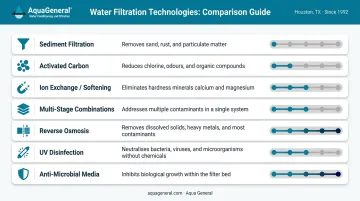
Systems combining softening, anti-microbial media, chemical reduction, and fine particle filtration cost more — but deliver protection that single-stage units cannot approach.
Household Size and Water Demand
Flow rate (measured in gallons per minute) must match peak household demand. Most manufacturers size whole-home systems by number of bathrooms — Pentair and Solventum/3M both publish sizing guidelines distinguishing between 1–3 bathroom and 4–6 bathroom homes.
An undersized system creates pressure drops during high-demand periods and forces the system to work harder, shortening component life. Retrofitting an undersized system after installation typically costs $500–$1,200 more than sizing correctly from the start.
Water Quality and Contaminants Present
What's actually in your water is the single biggest pricing variable. For Greater Houston households on municipal supply, that often means multiple contaminants to address simultaneously:
- Chloramines (average 3.0 ppm) — require specific media that standard carbon can't fully address
- Arsenic (up to 9.9 ppb detected in 2024) — requires certified RO or activated alumina stages
- TTHMs and HAA5s (disinfection by-products) — common in chloraminated systems
- Regional hardness ranging from moderate to very hard depending on county and utility
Homes with any combination of these contaminants — which describes a large share of Greater Houston households — generally land in the mid-to-premium tier.
Installation Complexity and Plumbing Conditions
Labor costs vary based on:
- Main line accessibility — accessible utility rooms with open pipe runs require less labor time
- Pipe age and material — galvanized or corroded pipes typically add $200–$600+ to the job
- **Bypass valve and plumbing modifications** — most whole-home installations require one
- Overall complexity — straightforward jobs run $300–$1,000; complex modifications can reach $1,500–$2,000
Certifications and Warranty
NSF/ANSI certifications (Standards 42, 53, 55, 58) and WQA Gold Seal validation confirm that a system has been independently tested for the performance claims it makes. Systems with these credentials cost more upfront but carry lower long-term risk of performance failures or voided coverage.
Budget systems without certification offer no third-party verification — only the manufacturer's word that the system performs as labeled.
The Full Cost Picture: What You're Actually Paying For
Whole-home filtration has two distinct cost layers: what you pay upfront and what you pay every year to keep the system working. Both matter when sizing your budget.
One-Time Costs:
- Unit purchase: $500–$800 (basic single-stage) to $3,000–$8,000+ (advanced multi-stage/RO)
- Professional installation: $300–$1,500 depending on complexity
- Pre-installation water testing: $30–$200 for DIY kits; $100–$500 for professional lab analysis
Skipping the water test is one of the most common and costly mistakes in this process. Without knowing what's actually in your water, you're guessing on system type — and either paying for filtration stages you don't need or buying something that doesn't address your actual problem.
Once the system is installed, ongoing maintenance drives the annual spend. Here's what to budget for:
Recurring Annual Costs:
- Sediment pre-filters: Every 3–6 months
- Carbon/media filters: Every 6–12 months per Pentair's maintenance guidance
- RO pre- and post-filters: Annually; membranes typically last 2–5 years depending on water quality
- UV bulb replacement: Annually (Pentair notes UV systems use no more energy than a 40-watt bulb)
- Water softener salt: Every 3 months approximately
- Professional inspection: $100–$300 every 1–2 years
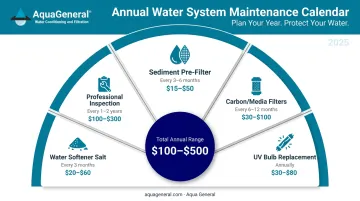
Total annual recurring costs run $100–$500 for standard systems, more for multi-stage or RO configurations.
What Most People Get Wrong About Filtration Costs
Focusing Only on the Unit Price
A $900 system isn't $900 — it's $900 plus installation, plus $300–$700/year in filter replacements, plus whatever it doesn't address that you eventually have to fix separately. Total cost of ownership over five years looks very different from the sticker price.
Buying Without a Water Test
Choosing a system without knowing your water chemistry leads to one of two outcomes: you over-specify and pay for filtration stages you don't need, or you under-specify and buy something that doesn't solve your actual problem. In the Houston area, where water characteristics vary meaningfully by county and utility — and where contaminants like arsenic, chloramines, and disinfection by-products are documented — a professional water quality assessment is the logical first step, not an afterthought.
Overlooking Long-Term Savings
Those ongoing costs extend well beyond the system itself. Americans spent $49.9 billion on bottled water in 2024, with wholesale prices averaging $1.44 per gallon — an expense a quality whole-home system eliminates for most households.
Hard water adds further hidden costs over time. Research from the Water Quality Research Foundation quantified what that looks like in practice:
- Water heaters on softened water maintained factory efficiency over a simulated 15-year lifespan; hard water reduced that efficiency through scale buildup
- Softened water allowed laundry detergent reductions of up to 50% with equivalent cleaning results
- Dishwasher detergent use dropped up to 70% under the same softened-water conditions
Factoring in these savings, the upfront cost of the right system looks considerably more reasonable than the sticker price suggests.
Conclusion
Whole-home water filtration costs range from under $1,000 for basic setups to $10,000+ for advanced configurations. The system that makes sense for your home depends on your water chemistry, household size, and long-term goals — not just the lowest upfront price tag.
Getting that match right starts with knowing what's actually in your water. Aqua General has been serving Greater Houston — across Harris, Fort Bend, Galveston, Montgomery, Brazoria, and surrounding counties — for over 32 years. Their team, led by WQA Certified Water Specialist and TCEQ Class III licensed David A. Davies, offers free on-site water testing and custom system recommendations before any purchase decision is made.
Call (713) 664-4601 or visit aquageneral.com to schedule a consultation.
Frequently Asked Questions
How much does it cost to install a water filter in your house?
Whole-home systems typically run $1,500–$4,000 all-in (unit plus labor), though the range spans from roughly $800 for basic single-stage setups to $10,000+ for advanced multi-stage configurations. Labor alone runs $300–$1,500 depending on plumbing complexity, pipe condition, and whether modifications are needed.
What is the best water filter for arsenic?
Reverse osmosis systems with NSF/ANSI 58 certification and activated alumina (identified by the EPA as a Best Available Technology for arsenic removal) are the most effective options. A professional water test confirming arsenic type and concentration should guide final system selection.
What is the best water filter for Giardia?
UV disinfection systems certified to NSF/ANSI 55 Class A are specifically validated for Giardia, Cryptosporidium, bacteria, and viruses, requiring a minimum UV dose of 40 mJ/cm². Pairing the UV unit with a sediment pre-filter is standard practice, as turbidity reduces UV effectiveness.
How long does a whole-home water filtration system last?
Most whole-home systems last 10–20 years with proper maintenance. Lifespan depends on build quality, local water chemistry, and whether filters, membranes, and UV bulbs are replaced on schedule. Premium, certified systems consistently reach the higher end of that range.
What maintenance does a whole-home water filtration system require?
Standard maintenance includes sediment pre-filter changes every 3–6 months, carbon or media filters every 6–12 months, UV bulb replacement annually, and a professional inspection every 1–2 years. Annual maintenance costs typically run $100–$500 depending on system type and configuration.