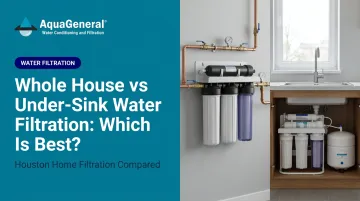
It's a fair question, and the answer isn't one-size-fits-all. Houston-area water presents specific challenges — hard water averaging 110–175 ppm across different municipal systems, chloramines in the Main System, trace arsenic detections up to 9.9 ppb, and ongoing PFAS monitoring — that make this decision genuinely consequential.
This guide breaks down how each system works, what it protects against, and how to choose the right solution for your home's actual water quality profile.
Key Takeaways
- Whole house filters treat water at the main line, protecting every faucet, shower, appliance, and pipe from sediment, chlorine, and hard water minerals
- Under-sink filters treat one tap with deeper purification, targeting lead, PFAS, arsenic, and nitrates
- Cost and installation differ significantly — whole house systems are a larger upfront investment, while under-sink units are lower cost and easier to add
- Under-sink systems are lower cost and ideal for drinking and cooking water purity
- Pairing both systems gives Houston homeowners whole-home protection plus high-purity drinking water at the tap
Whole House vs. Under-Sink: Quick Comparison
| Factor | Whole House (Point of Entry) | Under-Sink (Point of Use) |
|---|---|---|
| Coverage | Every faucet, shower, appliance | One tap only |
| Primary targets | Sediment, hardness minerals, chlorine/chloramines | Lead, PFAS, arsenic, nitrates, VOCs |
| Upfront cost | Higher; EPA notes POE systems can cost thousands and require professional installation | $86–$700 for standard filters; $200–$2,200 for RO systems |
| Installation | Professional required | Often DIY-friendly |
| Maintenance | Longer replacement intervals (varies by system) | More frequent cartridge changes; easier to service |
| Best for | Appliance protection, scale prevention, whole-home water quality | Drinking water purity, targeted contaminant removal |
What Is a Whole House Water Filter?
A whole house system — also called a point-of-entry (POE) system — installs at the main water line before water reaches any fixture. Every faucet, showerhead, dishwasher, and washing machine receives treated water.
What It Protects Against
For Houston homeowners, the benefits are directly tied to local water conditions:
- Hard water minerals — Houston's Main System averages 110 ppm hardness; Willow Chase reaches 175 ppm. Calcium and magnesium scale shortens water heater life, clogs pipes, and damages appliances
- Chloramines and chlorine — Houston's Main System uses chloramines (avg 3.0 ppm); Kingwood and Willow Chase use chlorine. Whole house carbon filtration removes taste, odor, and skin irritation from both
- Sediment — Whole house pre-filtration catches particulates before they reach appliances or fixtures
- Organic chemicals and microbial concerns — Advanced systems address a broader range of contaminants beyond standard sediment filters
What Advanced Whole House Systems Can Do
Not all whole house systems are equal. Aqua General's AquaGuard® Whole-House Anti-Microbial Water Filter combines softening, anti-microbial media, whole-house chemical reduction, and fine particle filtration — features most standard units don't include. Components are WQA and NSF tested and certified, backed by limited lifetime manufacturer's warranties.
Best Candidates for Whole House Filtration
- Families with children or anyone with sensitive skin
- Homeowners concerned about appliance lifespan and plumbing protection
- Properties with visible scale buildup, hard water staining, or high sediment
- Anyone who wants chlorine/chloramine removed at every outlet — not just the kitchen
What Is an Under-Sink Water Filter?
An under-sink system is a point-of-use (POU) device connected directly to a single tap — most often the kitchen sink. Because it treats water right before consumption, it can address contaminants introduced by internal plumbing (such as lead from older pipes) that a whole house system never encounters.
Why Under-Sink Filters Handle Contaminants Whole House Systems Often Miss
| Contaminant | Houston-Area Data | Certification Needed |
|---|---|---|
| Lead | Houston Main System: 9 samples exceeded the 15 ppb action level | NSF/ANSI 53 or 58 |
| PFAS | TCEQ enforces MCLs of 4.0 ppt for PFOA/PFOS; Houston monitors 29 PFAS under UCMR5 | NSF/ANSI 58 or 401 |
| Arsenic | Houston Main System max detection: 9.9 ppb (EPA limit: 10 ppb) | NSF/ANSI 53 or 58 |
| Nitrates | Main System distribution avg: 0.39 ppm | NSF/ANSI 58 (RO) |
| VOCs/DBPs | Conroe area: TTHMs at 39.3 ppb; Kingwood: xylenes up to 2.5 ppb | NSF/ANSI 53 |
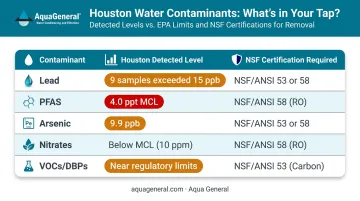
Reverse osmosis systems — the most capable under-sink option — filter through a sub-micron membrane, removing dissolved contaminants that most whole house systems can't touch. The EPA classifies point-of-use RO as a single-fixture treatment method, and it's the go-to recommendation for lead and PFAS reduction at the drinking tap.
For Houston households, a nine-stage RO system — with WQA and NSF certified components — addresses the specific contaminant profile the table above highlights, including PFAS, arsenic, and lead.
Key Limitations to Know
- Only the connected tap delivers filtered water — shower water, laundry, and appliances remain untreated
- Some RO models require a dedicated faucet and produce a small concentrate (waste) stream
- Doesn't address whole-home hardness, scale, or chloramine exposure during bathing
Best Candidates for Under-Sink Filtration
- Renters or homeowners on a tighter budget
- Anyone whose primary concern is the safety and taste of drinking and cooking water
- Older homes where lead from internal pipes is a specific concern
- Homeowners who already have a whole house system and want an additional purification stage
Whole House vs. Under-Sink: Which Is Best for Your Home?
Neither system is universally "better." The right choice depends on what your water actually contains and what you're trying to protect.
Decision Framework
Choose a whole house system if:
- Hard water is damaging appliances, leaving scale deposits, or causing dry skin and hair
- You want chlorine or chloramines removed throughout the entire home
- Sediment or iron is affecting multiple fixtures
- Protecting plumbing and extending appliance life is a priority
Choose an under-sink system if:
- Your main goal is purified drinking and cooking water
- You're renting or working with a limited budget
- Lead, PFAS, or arsenic reduction at the tap is the priority
- You want a simpler entry point into home water filtration
The Case for Using Both Together
For Houston homeowners dealing with both hard water and dissolved contaminants, the most effective approach is pairing both systems. The whole house unit handles sediment, hardness, and chloramines across every outlet — protecting appliances, skin, and laundry.
The under-sink RO then adds a second purification stage specifically for water you drink and cook with, catching lead, PFAS, and other dissolved contaminants that pass through even a well-maintained whole house filter.
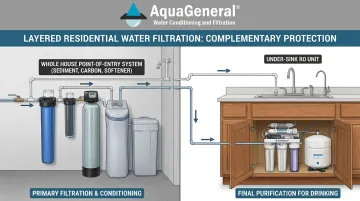
That layered combination is what Aqua General's WQA-certified specialists typically recommend after a professional water test identifies what's actually present. With over 32 years serving Houston-area homes across Harris, Fort Bend, Montgomery, and surrounding counties, their team matches systems to your home's specific water profile — not a generic recommendation.
Houston's 2024 Water Quality Report shows real variation across service areas: a Willow Chase home may have 175 ppm hardness with chlorine, while a Main System address sits at 110 ppm with chloramines. A free on-site water assessment from Aqua General removes the guesswork entirely.
Conclusion
For full-home water quality — appliance protection, scale prevention, chloramine reduction, and skin and hair benefits — a whole house system is the stronger choice. For targeted drinking water purity, particularly for lead, PFAS, and arsenic, an under-sink filter excels. For most Houston households, combining both systems addresses every layer of the problem — from the pipe entering your home to the glass on your counter.
Houston's water supply varies significantly by municipality and season, which means the right system depends on what's actually in your water. Aqua General offers free on-site water testing to identify your specific contaminants — so you can invest in the system that solves your actual problem, not just the most common one.
Frequently Asked Questions
Is a whole house reverse osmosis system better than under-sink?
Whole house RO delivers purified water to every outlet, but it comes with high installation costs, potential pressure drops throughout the home, and mineral removal that may require remineralization. For most households, an under-sink RO system achieves the same drinking water quality at a fraction of the cost. It's the practical choice unless a specific, tested whole-home need exists.
Can I use both a whole house and an under-sink water filter together?
Yes, and it's often the ideal setup. The whole house filter addresses sediment, hardness, and chloramines at the point of entry, while the under-sink filter adds a deeper purification stage for drinking and cooking water. Together, they provide more comprehensive protection than either system alone.
Is it healthier to drink tap water or filtered water?
Municipal tap water meets EPA regulatory standards, but it can still contain chloramines, trace lead, PFAS, and other contaminants at detectable levels. Filtered water from NSF/WQA-certified systems reduces these contaminants and is generally the healthier choice. In the Houston area, local water reports have flagged arsenic, lead, and PFAS as ongoing concerns worth addressing.
How often do whole house water filters need to be replaced?
Replacement intervals vary by system type and local water conditions. Standard cartridge-based whole house filters typically need replacement every 6–9 months; media-based systems can last considerably longer. A WQA-certified specialist can recommend the right maintenance schedule based on your specific water quality and usage.
Do I need a water test before choosing a filtration system?
A professional water test is strongly recommended before purchasing any system. It identifies the specific contaminants present in your water, allowing a certified specialist to match the right filtration technology to your home's actual needs — rather than relying on regional averages.