This matters more in Houston than in most cities. With water hardness in the city's main system averaging 110 ppm (about 6.4 grains per gallon) and some neighborhoods like Willow Chase reaching 175 ppm (over 10 gpg), softeners here work harder than average and consume more salt as a result.
This article focuses specifically on the ongoing monthly cost of running a water softener — salt as the primary expense, plus everything else that shows up on your operating ledger. You'll find salt cost ranges by household size, a full monthly cost breakdown, a comparison of salt types, and practical ways to keep expenses manageable.
Key Takeaways
- Standard sodium chloride pellets cost Houston households of 3–4 people roughly $7–$10/month
- Potassium chloride raises that figure to $43–$60/month
- Total monthly operating costs — salt, regeneration water, electricity, and maintenance — typically run $34–$64/month for an average household
- Water hardness, household size, salt type, and system efficiency are the four biggest cost drivers
- Switching to demand-initiated regeneration (DIR) can cut salt use by 26–60% compared to time-clock systems
How Much Does Water Softener Salt Cost Per Month?
Salt cost isn't a fixed number — it depends on how much water your household uses and how hard that water is.
The most reliable benchmark comes from Diamond Crystal, which states that a family of four with 7–10 grains per gallon hard water typically uses about 10 lbs of salt per week, or roughly one 40-lb bag per month.
Current Salt Prices at Houston-Area Retailers
Standard sodium chloride pellets at major retailers currently run:
- Diamond Crystal Bright and Soft (40 lb): $7.28–$7.33 per bag
- Morton Clean and Protect (40 lb): $8.28–$8.76 per bag
- Morton Clean and Protect Plus Rust Defense (40 lb): $10.28 per bag
- Buy-10 pricing at Home Depot: $6.55–$9.25 per bag (depending on brand)
Potassium chloride runs considerably higher:
- Nature's Own KCl (40 lb) at Home Depot: $42.98, or $38.68 when buying 10+
- Morton KCl (40 lb) at Walmart: $59.89
Monthly Salt Cost by Household Size
Using the family-of-four benchmark as a baseline, here's how monthly costs scale by household size:
| Household Size | Approximate Monthly Salt Use | Estimated Monthly Cost (NaCl) | Estimated Monthly Cost (KCl) |
|---|---|---|---|
| Small (1–2 people) | ½–1 bag (20–40 lbs) | $4–$8 | $20–$45 |
| Average (3–4 people) | ~1 bag (40 lbs) | $7–$10 | $43–$60 |
| Large (5+ people) | 1½–2+ bags (60–80+ lbs) | $11–$20+ | $65–$120+ |
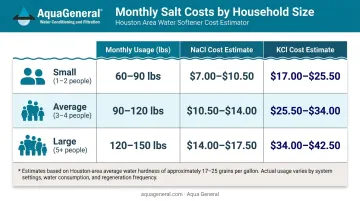
Note: These figures assume water hardness around 7–10 gpg. Houston households in harder-water areas or on well water will likely fall at the higher end or above these ranges.
Annual Salt Expense
At about one bag per month for a family of four, annual sodium chloride costs land around $84–$120. Potassium chloride users pay $516–$720 per year for the same usage — $400–$600 more annually. The University of Minnesota's Water Resources Center notes that potassium chloride is 3–5 times more expensive than sodium chloride and 15–30% less efficient at the same task, so that premium adds up fast for most Houston households.
Key Factors That Affect Your Monthly Salt Costs
Salt consumption isn't uniform. Several variables determine exactly how much your system burns through each month.
Water Hardness Level
Harder water exhausts your softener's resin capacity faster, triggering more frequent regeneration cycles — and each cycle consumes salt.
Houston's 2024 Water Quality Report from Houston Public Works shows meaningful variation across the city:
| Water System | Average Hardness | Approximate GPG |
|---|---|---|
| Houston Main System | 110 ppm | ~6.4 gpg |
| Kingwood | 118 ppm | ~6.9 gpg |
| Belleau Woods | 119 ppm | ~7.0 gpg |
| Willow Chase | 175 ppm | ~10.2 gpg |
A homeowner in Willow Chase will generally use more salt each month than someone on the Main System — all else being equal.
Household Size and Water Consumption
More people means more water used daily, which exhausts the resin bed faster and requires more frequent regeneration. Softeners programmed to your actual household consumption use salt far more efficiently than those running on factory default settings.
System Type and Age
System type has a direct, measurable impact on salt use. According to the University of Minnesota's Water Resources Center, demand-initiated regeneration (DIR) systems use 26–60% less salt and 25–40% less water than time-clock softeners that regenerate on a fixed schedule regardless of actual usage.
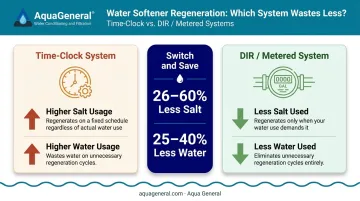
Older systems regenerate more often than necessary and use more salt and water per cycle. If your softener is 10+ years old and running on a time-clock, switching to a metered DIR system typically delivers the fastest reduction in monthly operating costs.
Regeneration Settings and Programming
A miscalibrated system regenerating too frequently wastes salt with every unnecessary cycle. Under-regeneration causes hard water to slip through. Neither is good.
Having your water tested and your system programmed to match actual usage patterns is one of the most effective ways to control monthly costs. Aqua General's WQA-certified specialists — serving Greater Houston for over 32 years — can assess your water hardness and calibrate your system settings to eliminate waste.
Iron or Manganese in Well Water
Some Houston-area well water contains iron or manganese alongside hardness minerals. These contaminants require more aggressive regeneration or specialty salt additives, which can push monthly costs well above the typical ranges for hardness alone.
If you're on well water, test for iron and manganese before estimating monthly salt use. Key signs your water may contain these minerals include:
- Reddish-brown staining on fixtures or laundry (iron)
- Black or dark brown deposits in pipes or fixtures (manganese)
- Shortened resin bed life or frequent regeneration despite low water usage
Full Monthly Cost Breakdown of Running a Water Softener
Salt is the most visible monthly expense, but it's not the only one. Below is a full cost picture for an average Houston household, covering every line item worth tracking:
Salt
Estimated: $7–$10/month (standard NaCl, 3–4 person household at 7–10 gpg)
This is the baseline. Harder water or larger households push this higher; a well-calibrated system with DIR regeneration can bring it down.
Water for Regeneration
Each regeneration cycle uses water for backwash, brine draw, and rinse. Most residential systems use 40–100 gallons per cycle, depending on system size, settings, and water hardness. (Pentair's whole-house softener, for example, specifies drain flow rates of 2.5–3.5 gallons per minute with minimum 10-minute backwash cycles.)
At Houston's current residential water rates, regenerating once or twice per week adds roughly $3–$8/month to your water bill, depending on your system and regeneration frequency.
Electricity
Modern softeners draw very little power. The Pentair Fleck 5600 service manual lists 3 watts maximum for the control valve and timer. At that draw, monthly electricity cost is minimal, typically $1–$3/month even running year-round.
Professional Maintenance (Prorated)
An annual professional service visit — covering brine tank cleaning, resin inspection, hardness testing, and settings adjustment — typically runs $150–$400 for residential customers, based on Angi benchmark data. Prorated monthly, that's roughly $13–$33/month.
Budget an additional $10–$20/month as a repair reserve for eventual component replacements like the resin bed or control valve.
Total Monthly Operating Cost Summary
| Cost Component | Estimated Monthly Range |
|---|---|
| Salt (NaCl, avg. household) | $7–$10 |
| Water for regeneration | $3–$8 |
| Electricity | $1–$3 |
| Maintenance (prorated) | $13–$33 |
| Total | $24–$54 |
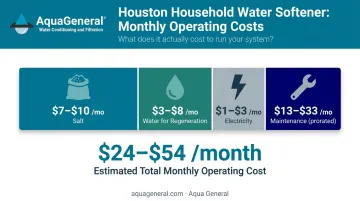
These ranges reflect typical conditions. Harder water, larger households, or an older time-clock system will push costs toward or above the upper end.
Types of Water Softener Salt: Costs Compared
Not all water softener salt performs the same, and the type you choose affects both monthly costs and how often you need to clean the brine tank.
| Salt Type | Typical Price (40 lb bag) | Purity | Notes |
|---|---|---|---|
| Rock salt | ~$6–$9 | Lower | Contains calcium sulfate and other impurities; can cause bridging or mushing in the brine tank |
| Solar crystals (NaCl) | $7.28–$8.99 | Up to 99.6% | Good performance; slightly less residue than rock salt |
| Evaporated pellets (NaCl) | $7.28–$8.76 | Up to 99.8% | Recommended by most professionals; dissolves completely, minimal minimal residue |
| Potassium chloride | $38.68–$59.89 | ~99% sodium-free | For sodium-restricted diets; significantly higher monthly cost |
According to Culligan, high-purity evaporated or solar salt is the preferred choice for most residential ion-exchange softeners. Lower-purity options can cause salt mushing (sludge buildup in the brine tank) or salt bridging, where a hardened crust blocks salt from dissolving. Both problems reduce system efficiency and increase salt consumption.
High-purity pellets cost slightly more per bag than rock salt, but the reduced brine tank cleaning frequency often offsets that difference over time.
How to Lower Your Monthly Water Softener Salt Costs
A few practical adjustments can meaningfully reduce what you spend on salt each month.
1. Switch to demand-initiated regeneration If your system runs on a time-clock schedule, switching to DIR or metered regeneration is the highest-impact change available. The University of Minnesota's Water Resources Center documents 26–60% less salt use with DIR systems compared to time-clock models.
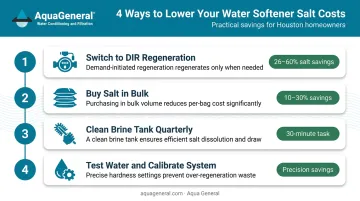
2. Buy salt in bulk Home Depot's buy-10 pricing drops Diamond Crystal pellets from $7.28 to $6.55 per bag — roughly a 10% savings. Buying a full pallet from a local supplier typically yields 20–30% savings over individual bag pricing. Salt stores indefinitely in a dry location, so calculating your annual usage and buying accordingly pays off quickly.
3. Clean the brine tank quarterly Salt bridges and mushing reduce how effectively salt dissolves into the brine solution, which forces the system to work harder and use more salt. A quarterly brine tank inspection and cleaning takes about 30 minutes and keeps the system running at peak efficiency.
4. Get your water tested and system calibrated Knowing your actual water hardness — in grains per gallon — allows your system to regenerate exactly as often as needed, no more. Aqua General offers free on-site water testing, which can reveal whether your current system settings are aligned with actual Houston-area water conditions and whether recalibration could cut your monthly salt use.
Frequently Asked Questions
How much does it cost to refill a water softener?
Refilling a water softener means purchasing salt. Standard sodium chloride pellets run $7–$9 per 40-lb bag at most Houston stores, so an average household spending one bag per month pays roughly $7–$10 for a refill. Potassium chloride users pay $43–$60 for the equivalent amount.
How often should you refill water softener salt?
Check the brine tank monthly and refill when the salt level drops below half-full. A typical family of four with moderately hard water uses about one 40-lb bag per month, though harder water or larger households may need more frequent refills.
What type of salt is best for a water softener?
High-purity evaporated sodium chloride pellets (99.5%+ purity) are the best choice for most households, offering reliable performance, minimal brine tank residue, and mid-range cost. Potassium chloride works well for households with sodium dietary restrictions, though it costs 3–5 times more.
How many bags of water softener salt do I need per month?
A small household (1–2 people) typically uses half to one 40-lb bag monthly. An average household (3–4 people) uses about one bag. Larger households may use 1.5–2+ bags depending on water hardness and system size.
Does water hardness affect how much salt I use?
Yes, directly. Harder water exhausts the resin bed faster, triggering more frequent regeneration cycles that each consume salt. In Houston, hardness ranges from around 6.4 gpg on the Main System to over 10 gpg in some neighborhoods, so getting your water tested helps calibrate your system for actual local conditions.
Can I reduce how much salt my water softener uses?
Three strategies make the biggest difference:
- Switch to demand-initiated regeneration (documented 26–60% salt reduction)
- Buy salt in bulk to lower the per-bag cost
- Clean the brine tank quarterly to prevent bridging and mushing