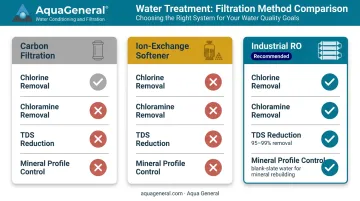
Industrial reverse osmosis systems solve this by stripping source water down to a near-pure blank slate — 95–99% TDS removal — so brewmasters can rebuild precise ionic profiles for every style. Generic carbon filters remove chlorine; softeners swap calcium for sodium. Neither gives you the control that serious commercial brewing demands.
This guide covers the top industrial RO systems for breweries, how to select the right one, and what every brewery should know before specifying a system.
Key Takeaways
- Industrial RO removes 95–99% of dissolved solids, giving brewers complete control over water chemistry batch to batch.
- Pre-treatment is required before RO — activated carbon for municipal sources, multimedia filtration for well water.
- System sizing must account for peak brew-day demand, not average daily usage.
- Food-grade certifications (NSF/ANSI 58) and continuous-duty engineering are non-negotiable for commercial brewery applications.
- A WQA-certified water treatment specialist ensures correct sizing, configuration, and installation for your specific brewing operation.
Why Water Quality Is Critical for Commercial Breweries
According to the Oxford Companion to Beer, water makes up 85–95% of most finished beers, and commercial breweries consume 4 to 5 liters of water for every liter produced. That ratio makes water quality a production variable, not just a background detail. Every mineral in that water — calcium, sulfate, chloride, bicarbonate — directly influences mash pH, hop utilization, yeast behavior, and long-term flavor stability.
The Two Problems Industrial RO Solves
Commercial breweries typically face two distinct water quality challenges:
Municipal source water:
- Contains chlorine and chloramines for public health compliance
- Chloramines react with beer phenols to produce chlorophenol off-flavors — the classic "band-aid" or medicinal taste
- Residual chlorine also oxidizes RO membranes, degrading salt rejection and shortening membrane life if pre-treatment fails
Well source water:
- High hardness, alkalinity, and iron create unpredictable mash chemistry
- Ideal mash pH runs 5.2–5.6; high alkalinity pushes pH out of range, dulling flavors and stressing yeast
- Iron and manganese foul membranes and heat exchangers, driving up maintenance costs
Why RO Outperforms Alternatives
Carbon filters handle chlorine but leave TDS untouched. Ion-exchange softeners swap calcium and magnesium for sodium — they don't reduce total dissolved mineral content or remove chloramines. Industrial RO is the only option that produces consistent, near-blank-slate water. That consistency lets brewers add back precise doses of calcium sulfate, calcium chloride, and other minerals to hit the exact profile a given style demands — batch after batch.
Best Industrial Reverse Osmosis Systems for Breweries
These systems were evaluated across five criteria:
- Flow capacity relative to production volume
- Membrane rejection rate for TDS and ionic contaminants
- Pre-treatment compatibility with existing infrastructure
- Food-grade material standards (NSF/ANSI certifications)
- Suitability for commercial brewing duty cycles
Pentair Commercial RO Systems
Pentair has deployed filtration and purification equipment across commercial breweries and beverage manufacturers worldwide for decades. Their systems carry broad service network support from certified water treatment specialists, including WQA-certified providers like Aqua General serving the Greater Houston area.
Key differentiators include high-rejection spiral-wound membranes, modular skid designs scalable across facility sizes, and NSF/ANSI Standard 58 certification on commercial product lines.
| Specification | Details |
|---|---|
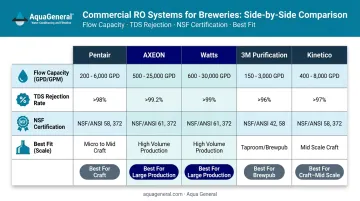
| Flow Rate / Capacity | Foodservice models range from ~375 GPD (EZ-RO) to 600 GPD (MRS-600HE-II); industrial skid configurations scale significantly higher for production brewing |
| Key Features | NSF/ANSI 58 certified; high-efficiency spiral-wound membranes; modular skid design; 80% reduction in water rejection vs. standard configurations |
| Best For | Craft breweries and regional producers seeking certified systems with broad service network support |
AXEON Water Technologies
AXEON designs and engineers custom industrial RO systems specifically for brewing, distillation, and beverage production. Their product range spans from microbrewery-scale skids up to large-format production systems, with direct factory engineering support.
The N-Series turn-key skids use XE1-Series membranes with 98.5% nominal TDS rejection. The X1-Series scales from 20 to 395 GPM (up to 570,000 GPD), making it viable for the largest regional production breweries.
| Specification | Details |
|---|---|
| Flow Rate / Capacity | N-Series: 2,000–16,000 GPD; X1-Series: 20–395 GPM (30,000–570,000 GPD) |
| Key Features | 98.5–99% nominal TDS rejection; turn-key skid configurations; CIP (Clean-in-Place) compatible; ultra-low-energy membranes with 10% greater surface area than standard 8-inch elements |
| Best For | Craft breweries through large-scale production facilities; especially strong for well water applications requiring custom feed water engineering |
Watts Water Technologies
Watts is an established industrial water treatment manufacturer with commercial RO systems widely adopted in food, beverage, and processing environments. Their product line spans light commercial through heavy-duty industrial configurations, with broad dealer and service network coverage across the U.S.
The HC-80 Heavy Commercial series delivers 22 to 238 GPM with 99.1% nominal NaCl ionic rejection — production-grade performance suited to mid-scale and regional breweries. Watts is among the commercial brands serviced by WQA-certified providers like Aqua General.
| Specification | Details |
|---|---|
| Flow Rate / Capacity | PWR4022: 10–15 GPM; R48: 40–120 GPM; HC-80: 22–238 GPM |
| Key Features | 99.1% nominal NaCl rejection (HC-80); robust pre-treatment integration options including softening; custom-engineered treatment solutions; broad U.S. service network |
| Best For | Municipal water sources; mid-scale to regional production breweries needing proven industrial-grade systems with accessible service support |
3M Purification (Cuno)
3M Purification (formerly CUNO, acquired by 3M in 2005) applies commercial-grade filtration expertise to food and beverage manufacturing. Their systems are now managed under the Solventum brand while maintaining the 3M Water Filtration Products identity.
3M's commercial RO offerings center on compact, space-efficient designs suited to brewpubs, taprooms, and mid-scale craft facilities. The SGLP series uses thin film composite (TFC) membranes with activated carbon pre-treatment built in, and holds NSF certification on the SGLP-CL series. The TFS450 produces 300 GPD with approximately 90% TDS reduction — suitable for smaller craft operations.
| Specification | Details |
|---|---|
| Flow Rate / Capacity | TFS450: 300 GPD; SGLP series: light commercial configurations |
| Key Features | TFC membrane technology; integrated activated carbon pre-treatment; NSF-certified wetted materials (SGLP-CL series); compact wall-mount footprint |
| Best For | Brewpubs, taprooms, and small craft breweries with space constraints and lower daily water volume needs |
Kinetico Commercial (KineticoPRO)
Kinetico Commercial offers water treatment systems used across industrial and food-service applications. Their KineticoPRO S-Series is certified by IAPMO R&T against NSF/ANSI 61 for material safety and reduces TDS to target levels for beverage-quality applications.
The W-Series delivers 500–1,000 GPD; the S-Series scales to 2,500 GPD. These systems appeal to smaller breweries and taprooms prioritizing straightforward operation and lower maintenance overhead, particularly when paired with integrated softening for hardness pre-treatment.
| Specification | Details |
|---|---|
| Flow Rate / Capacity | W-Series: 500–1,000 GPD; S-Series: 700–2,500 GPD |
| Key Features | NSF/ANSI 61 material safety certification; integrated softening-plus-RO configurations; reliable continuous-duty construction |
| Best For | Smaller craft breweries and brewpubs prioritizing operational simplicity and low-maintenance continuous-duty performance |
How to Choose the Right Industrial RO System for Your Brewery
Size for Peak Demand, Not Average Usage
The most common purchasing mistake: sizing the RO system for average daily water consumption instead of peak brew-day demand. Breweries don't use water linearly — they pull large volumes in short windows during mashing, sparging, and equipment cleaning.
A 10-barrel brewhouse, for example, can require up to 15 barrels of hot water per brew cycle. The RO system must be paired with adequately sized Hot Liquor Tank (HLT) storage to buffer that peak demand. Without sufficient storage, an undersized RO unit creates a production bottleneck.
Three Pre-Treatment Questions to Answer First
Before specifying any system, every brewery needs honest answers to these:
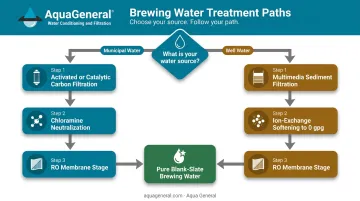
Source water type? Municipal water needs activated carbon or catalytic carbon filtration to neutralize chlorine and chloramines before reaching the membrane. Well water typically requires multimedia filtration plus ion-exchange softening (ideally to 0 gpg hardness) to prevent membrane scaling.
Source TDS and hardness levels? These numbers determine membrane selection, pre-treatment intensity, and expected recovery rates. Aqua General provides free on-site water testing for commercial clients to establish this baseline before any system is specified.
Wastewater discharge capacity? RO systems produce a continuous concentrate stream alongside permeate. Facilities in Harris County and surrounding Texas counties must account for TCEQ discharge requirements when designing the system.
Food-Grade Material Standards to Require
For any brewery RO system, insist on:
- NSF/ANSI 58 certified membranes and components
- Continuous-duty motors and high-pressure pumps rated for industrial use cycles
- Automated CIP (Clean-in-Place) flushing to prevent biological fouling between brew days
- Food-safe wetted materials throughout the system
Light commercial units built for offices or food-service counters aren't rated for the duty cycles or sanitation demands of production brewing. Specify industrial-grade from the start.
How We Chose the Best Industrial RO Systems
Systems were assessed on continuous-duty engineering quality, membrane rejection rate (target: 95–99%+), pre-treatment compatibility, NSF/ANSI food-grade certifications, scalability, and vendor support quality.
A critical mistake many breweries make is selecting based on price alone without verifying whether the system is engineered for their specific GPM requirements and water source conditions. An undersized or improperly matched system will foul membranes early and produce inconsistent water that compromises product quality — not just output, but your brand's consistency.
Getting sizing right requires hands-on water analysis before a system is ever specified. Aqua General — with over 32 years of commercial and beverage industry experience across the Greater Houston area — provides free on-site water testing for commercial clients and designs systems around actual source conditions, not catalog defaults. Their team services equipment from Pentair, Watts, 3M, and a wide range of other commercial brands.
Properly specified systems deliver measurable operational advantages:
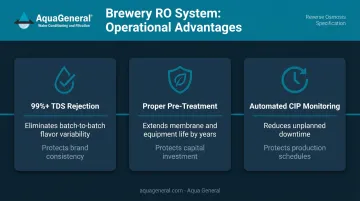
- 99%+ TDS rejection eliminates batch-to-batch flavor variability, protecting brand consistency
- Proper pre-treatment extends membrane and equipment life by years, protecting capital investment
- Automated monitoring and CIP protocols reduce unplanned downtime, protecting production schedules and profitability
Conclusion
For a commercial brewery, an industrial RO system is foundational infrastructure — it determines flavor consistency, protects capital equipment, and supports the ability to scale production without introducing water chemistry variables.
Selecting the right system means matching your specific source water, production volume, and beer style goals — not defaulting to a brand name or the lowest price point. Pentair, AXEON, Watts, 3M, and Kinetico each serve different brewery profiles and operating conditions. Getting that match right is where the real work happens, and where local expertise makes a measurable difference.
Houston-area breweries and commercial beverage producers evaluating industrial water treatment solutions can consult with Aqua General — a WQA-certified, TCEQ-licensed water treatment specialist with over 32 years of experience serving the Greater Houston metro area and surrounding counties — for guidance on system sizing, installation, and ongoing maintenance.
Frequently Asked Questions
How much water does a commercial brewery typically need from an RO system?
Water demand scales directly with brewhouse size and brew frequency. A 10-barrel system can require 15 or more barrels per brew cycle across mashing, sparging, and cleaning. System GPM requirements typically range from 5 to 50+ GPM depending on production volume, with most breweries using HLT storage tanks to buffer peak demand.
Does an industrial RO system remove all the minerals needed for brewing?
Yes — and that's by design. RO removes 95–99% of dissolved minerals including calcium, sulfates, and chlorides, creating a near-pure blank slate. Brewmasters then add back precise doses of brewing salts (calcium sulfate, calcium chloride, magnesium sulfate) to build the exact ionic profile required for each beer style, from Burton-on-Trent to Pilsen.
How long do industrial RO membranes last in a brewery environment?
With proper pre-treatment and daily flushing protocols, commercial RO membranes typically last several years, and some large installations document 10+ years of service life. Premature failure is almost always traced to chlorine breakthrough, failed pre-filters, or incorrect operating pressure.
What is the difference between a Point-of-Entry and Point-of-Use RO system for a brewery?
Point-of-Entry (POE) systems treat all facility water at the main supply line , which works for large macro-breweries but is often inefficient for craft operations. Point-of-Use (POU) systems treat water locally at the HLT, cold liquor tank, and boilers, delivering purified water exactly where brewing demands it. For most craft and commercial breweries, POU delivers significantly better ROI by treating only the water that actually affects beer quality.
Can a standard commercial RO system handle industrial brewery demands?
Light commercial systems rated for offices, cafes, or food-service counters are not built for continuous industrial duty cycles. Brewery-grade systems require continuous-duty pump motors, high-pressure housings, and PLC-based controls that support automated flushing and monitoring. Running production volumes through an undersized unit accelerates membrane failure and produces inconsistent water quality.
What pre-treatment does an industrial brewery RO system require?
Two main paths: activated carbon filtration for municipal water sources, to neutralize chlorine and chloramines before they degrade polyamide membranes; and multimedia filtration plus ion-exchange softening for high-hardness well water, to remove sediment and reduce hardness to near-zero before the RO stage. Skipping pre-treatment is not an option: a membrane exposed to chlorine or unfiltered hard water fails quickly, no matter how well the RO unit itself is built.