But "legally compliant" and "safe for long-term health" aren't the same thing — and that gap is exactly why thousands of Houston residents search this question every year.
Independent testing shows several contaminants in Houston's water that sit within legal limits yet exceed stricter health-based benchmarks used by scientists and health organizations. For most healthy adults, the daily risk is low. For households with children, pregnant women, or immunocompromised individuals, the picture is more complicated.
This guide covers where Houston's water comes from, what contaminants independent testing has identified, who faces the greatest risk, how to test your specific tap water, and which treatment solutions actually work for Houston's unique water chemistry.
Key Takeaways
- Houston tap water meets all EPA and TCEQ legal standards, but EWG's tap water database identifies 14 contaminants exceeding stricter health-based guidelines
- Roughly 90% of Houston's water comes from surface sources — Lake Livingston, Lake Houston, and Lake Conroe
- Houston water averages 135 ppm hardness (2025 data), causing scale buildup and appliance damage
- Children, pregnant women, and immunocompromised individuals face elevated long-term risk from low-level contaminant exposure
- A whole-house conditioner paired with a point-of-use reverse osmosis system addresses both Houston's hard water and its health-related contaminants
Is Houston Tap Water Safe to Drink in 2026?
The Legal vs. Health-Optimal Gap
Houston's 2025 Water Quality Report confirms the city's main system meets or exceeds all state and federal regulatory standards, earning TCEQ's "Superior Water Supply System" rating. There was no city-wide boil water notice in 2024 or 2025.
One notable exception: Houston issued a mandatory notice in June 2025 related to a turbidity excursion at the Northeast Water Purification Plant. Disinfection levels remained within required standards, and it wasn't classified as an MCL exceedance or boil water event — but it's a reminder that regulatory compliance doesn't guarantee seamless water quality.
The deeper concern is chronic, low-level exposure to contaminants that are legal under current rules but exceed health benchmarks set by independent researchers and health agencies.
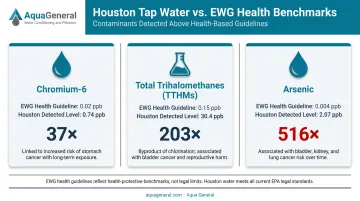
EWG's analysis of Houston's tap water identifies 14 contaminants above their health guidelines. Three stand out:
- Chromium-6: 37× above EWG's health-based benchmark
- TTHMs (disinfection byproducts): 203× above the health guideline
- Arsenic: 516× above the health-based benchmark
None of these are EPA violations. They reflect the gap between what's legally permitted and what independent researchers consider safe for long-term exposure.
Who Faces Greater Risk?
EPA drinking water standards are set based on feasibility and cost considerations, not purely on health outcomes. That means some sensitive groups deserve extra attention:
- Children — developing brains and bodies are more sensitive to lead, arsenic, and PFAS
- Pregnant women — PFAS and disinfection byproducts have been linked to reproductive effects
- Older adults — existing health conditions can reduce the body's ability to process chemical exposure
- Immunocompromised individuals — more vulnerable to pathogens and chemical exposure
The Honest Bottom Line
Most healthy adults won't get sick from Houston tap water. For households with children, pregnant women, or anyone concerned about long-term chromium-6, arsenic, or disinfection byproduct exposure, a certified filtration system — such as reverse osmosis or a whole-house carbon filter — directly addresses the contaminants EWG flags above legal limits.
Where Does Houston's Drinking Water Come From?
Houston's water system serves nearly 3 million customers across a vast service area. The 2025 Consumer Confidence Report breaks down sources:
- 90.3% surface water — Lake Livingston (Trinity River watershed), Lake Houston, and Lake Conroe (San Jacinto River watershed)
- 9.7% groundwater — drawn from the Evangeline and Chicot Aquifers via 104 wells
The Treatment Process
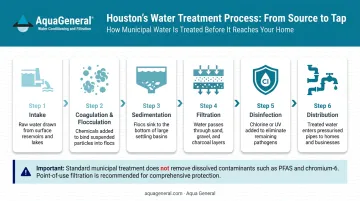
Houston Public Works runs water through a multi-step treatment process:
- Intake from surface water reservoirs
- Coagulation and flocculation — particles clump together
- Sedimentation — clumps settle out
- Filtration — removes remaining particles
- Disinfection — chlorine or chloramines kill pathogens
- Distribution — treated water travels through the pipe network
This process is effective at killing pathogens and removing sediment, but it doesn't eliminate dissolved contaminants like chromium-6, PFAS, arsenic, or the disinfection byproducts that form when chlorine reacts with organic matter in surface water.
Neighborhood Variation Matters
Where you live in Houston — and how old your home is — directly affects what comes out of your tap:
- Older inner-loop neighborhoods face additional risk from aging service lines and home plumbing — lead and copper can leach into water after it leaves the treatment plant
- Newer suburbs share the source-water concerns (chromium-6, PFAS, disinfection byproducts) regardless of when their homes were built
Your zip code and your home's age both factor into your actual exposure.
Key Contaminants Found in Houston's Tap Water
Chromium-6
Chromium-6 (hexavalent chromium) is a documented human carcinogen — chemically distinct from the safe chromium-3 form. There's no separate federal MCL for chromium-6; the EPA regulates only total chromium at 100 ppb.
EWG reports Houston's chromium-6 at 0.747 ppb (747 ppt) — 37 times higher than California's health-based public health goal of 0.02 ppb. The National Toxicology Program found that hexavalent chromium caused oral and intestinal cancers in animal studies. This level doesn't cause immediate harm, but it represents meaningful long-term cancer risk from decades of daily exposure.
PFAS ("Forever Chemicals")
EPA's April 2024 PFAS rule established enforceable limits for the first time: 4 ppt for PFOA and PFOS, with additional limits for other compounds. Water systems have until 2029 to comply, with initial monitoring required by 2027.
According to Texas Tribune reporting, 49 Texas public water systems reported PFAS levels above the new federal limits — including systems near Houston such as Baytown Area Water Authority and Deer Park. The City of Houston's main system wasn't identified in that list, but Houston is still phasing in PFAS monitoring across the full service area.
Health concerns linked to PFAS exposure include:
- Kidney and testicular cancer (IARC classifies PFOA as carcinogenic to humans)
- Reduced immune response, including lower vaccine effectiveness
- Hormone and endocrine disruption
PFAS aren't the only byproduct of Houston's water chemistry. Disinfection itself introduces a separate class of compounds worth understanding.
Disinfection Byproducts
Houston's heavy reliance on surface water — high in organic matter — combined with chlorine disinfection produces trihalomethanes (TTHMs) and haloacetic acids (HAA5s) throughout the distribution system.
2025 CCR data:
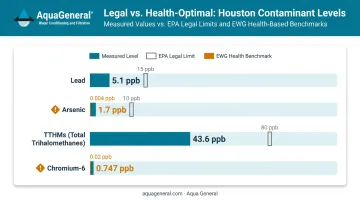
- TTHMs: highest LRAA 43.6 ppb (EPA limit: 80 ppb)
- HAA5s: highest LRAA 40.8 ppb (EPA limit: 60 ppb)
Both are within legal limits. But a 2025 systematic review found limited-suggestive evidence that THMs increase bladder and colorectal cancer risk even below current regulatory limits. The characteristic chlorine smell many Houston residents notice — particularly in summer — comes from this disinfection chemistry.
Lead and arsenic round out the contaminant picture, and both carry risks that legal compliance alone doesn't fully address.
Lead and Arsenic
Lead in Houston's water comes primarily from aging home plumbing, not the treated water itself. The 2025 CCR reports a 90th percentile lead level of 5.1 ppb, well below EPA's 15 ppb action level. But the CDC and American Academy of Pediatrics are clear: no level of lead is safe for children.
Homes built before 1986 carry the highest risk from lead solder and older fixtures.
Arsenic levels in Houston's 2025 CCR:
- Average: 1.7 ppb
- Maximum: 6.7 ppb
- EPA limit: 10 ppb (both within compliance)
- EWG health-based benchmark: 0.004 ppb — making Houston's average 516 times higher by that measure
NSF-certified reverse osmosis systems are among the most effective options for reducing both lead and arsenic at the tap.
Houston's Hard Water Problem
Houston tap water is hard. The 2025 CCR reports total hardness averaging 135.5 ppm, with a range of 43.5 to 229 ppm depending on location and season. That's firmly in the moderately hard to hard classification.
Real-World Household Impacts
Hard water doesn't pose direct health risks, but the practical consequences add up fast:
- White chalky scale builds up on faucets, showerheads, shower doors, and dishes
- Water heaters lose efficiency as scale insulates heating elements — scale acts as insulation that forces heating elements to work harder
- Dishwashers, washing machines, and coffee makers have shortened lifespans
- Skin feels dry and hair looks dull after showering — calcium and magnesium strip natural oils
The cumulative cost of appliance damage, higher energy bills, and excess detergent use adds up quickly for Houston homeowners. A water softener or whole-house conditioner can offset those costs through protected appliances, lower energy use, and reduced cleaning time.
How to Test Your Houston Tap Water
Three main options, each with different strengths:
1. Read Your Consumer Confidence Report (CCR)
Houston Public Works publishes an annual CCR as required by EPA. It covers all regulated contaminants and gives you a solid baseline. Limitation: it won't include separate chromium-6 data (EPA regulates total chromium only) or full PFAS results until monitoring is fully implemented by 2027.
2. Use a Certified Lab Test
For targeted testing — lead, arsenic, chromium-6, PFAS — a state-certified lab gives you the most accurate results. TCEQ maintains a searchable database of NELAP-accredited labs in Texas. This is the right move if your home was built before 1986, if you have young children, or if you've noticed unexplained changes in taste or color.
3. At-Home Test Kits
Quick, affordable, and useful for a baseline check of hardness, pH, chlorine, and iron. Cannot detect PFAS or very low chromium-6 levels. Good for a first look, not a complete picture.
Test beyond the CCR if:
- Your home was built before 1986
- There are children or pregnant household members
- You've had recent plumbing repairs or a local boil water advisory
- Water taste, odor, or color has changed unexpectedly
Aqua General offers free on-site water testing across the Greater Houston area. A TCEQ-licensed specialist can identify what's in your specific water and match a treatment system to your home's chemistry — something no test kit can do.
Best Water Filtration Solutions for Houston Homes
Matching Contaminants to Solutions
| Contaminant | Recommended Treatment |
|---|---|
| Chromium-6 | Reverse osmosis (NSF/ANSI 58) |
| PFAS | Reverse osmosis or certified GAC (NSF/ANSI 58) |
| Lead, Arsenic | Reverse osmosis (NSF/ANSI 58) or certified filters (NSF/ANSI 53) |
| TTHMs, HAA5s, Chlorine | Activated carbon filtration (NSF/ANSI 42/53) |
| Hard Water | Water softener or whole-house conditioner |
| Sediment | Pre-filtration sediment filter |
The Layered Approach Houston Homes Need
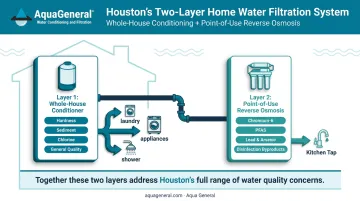
No single system solves everything. Most Houston households benefit from two layers:
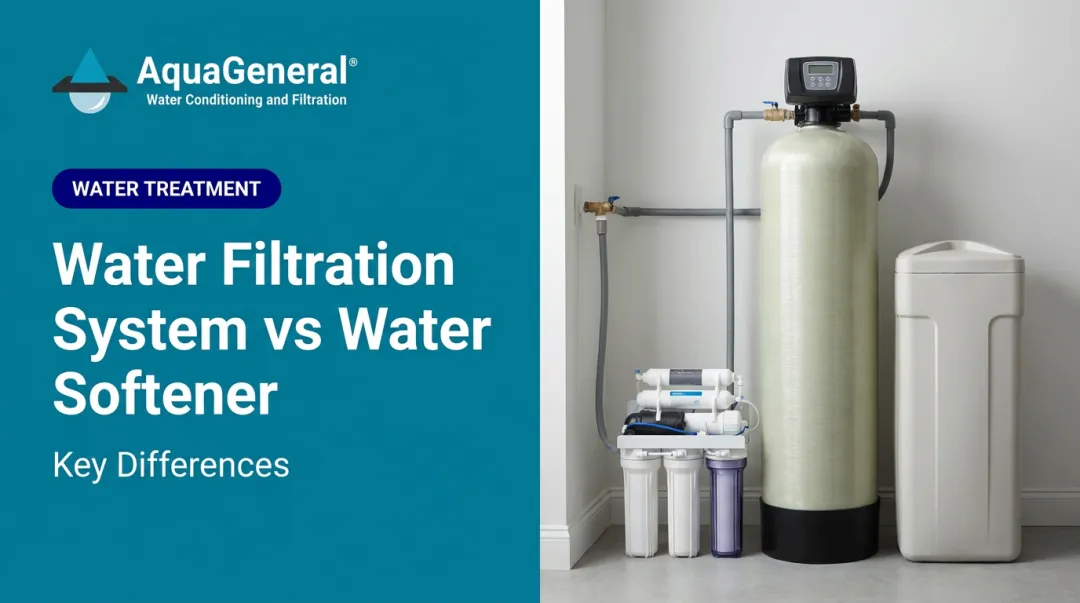
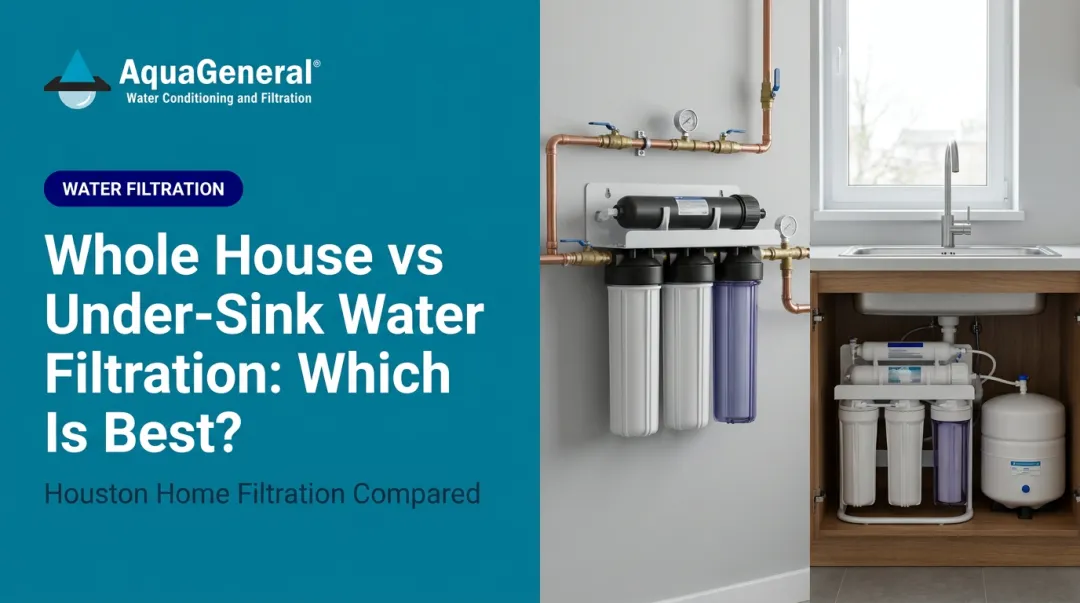
Layer 1 — Whole-house system at the point of entry: handles hardness, sediment, chlorine, and general water quality throughout every tap, shower, and appliance in the home.
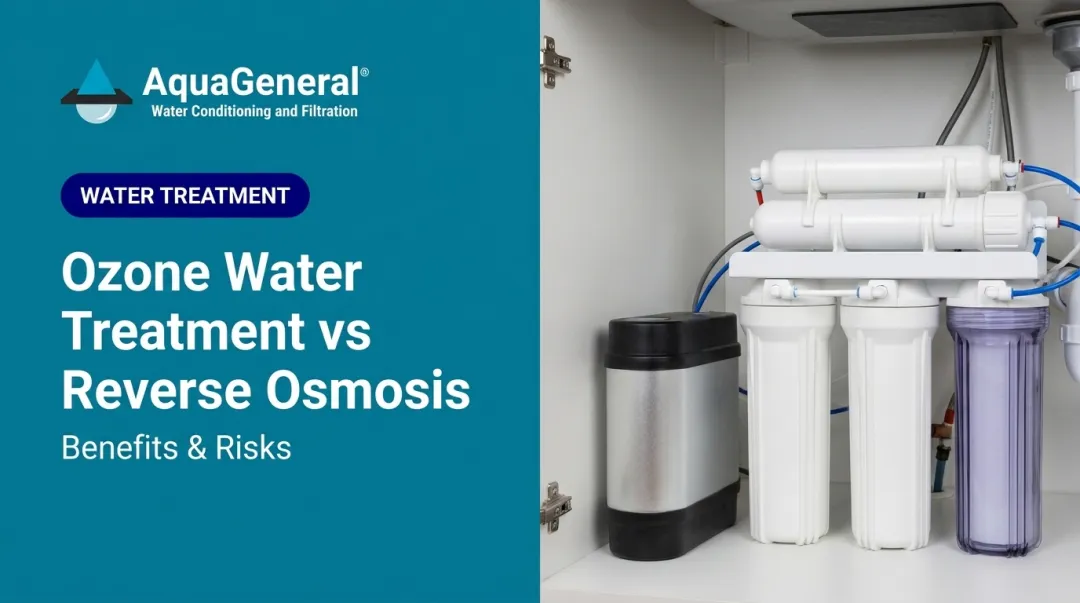
Layer 2 — Point-of-use RO system at the kitchen tap: provides the highest level of contaminant reduction for drinking and cooking water — chromium-6, PFAS, lead, arsenic, and dissolved contaminants that whole-house conditioning alone doesn't fully address.
Together, these two layers cover Houston's full range of water quality concerns — from hard water scaling your pipes to contaminants that require removal at the point of consumption.
What to Look for in Any System
- NSF/ANSI 58 certification for reverse osmosis systems (covers chromium-6, arsenic, lead, PFAS reduction)
- NSF/ANSI 53 for health-related contaminant reduction in filters
- NSF/ANSI 42 for aesthetic improvements like chlorine taste and odor
- WQA Gold Seal — independent third-party validation of performance claims
- Systems sized and configured for Houston's specific water chemistry, not generic off-the-shelf products
Why a Local Specialist Matters
Knowing which certifications to look for is one thing — knowing how to apply them to Houston's specific water chemistry is another. Aqua General has served the Greater Houston area across 8 counties for over 32 years, with systems tested and certified by both WQA and NSF.
Their AquaGuard® whole-house conditioner combines softening, anti-microbial media (inhibiting bacteria growth within the system), chemical reduction, and fine particle filtration down to 0.02–5 microns — capabilities not found in standard water softeners. Their AquaGuard® 9-Stage Reverse Osmosis system addresses chromium-6, arsenic, lead, PFAS, and disinfection byproducts at the point of use, removing over 98% of contaminants.
President David A. Davies was among the first in Texas to earn a TCEQ Class III Water Treatment Specialist License and holds the WQA Certified Water Specialist designation. Those credentials translate directly into accurate treatment recommendations based on your home's actual water test results. Aqua General offers free on-site water testing and can be reached at (713) 664-4601.
Frequently Asked Questions
Is it safe to drink tap water in Houston today?
Houston tap water currently meets all EPA and TCEQ legal standards and won't cause immediate illness for most healthy adults. However, independent testing shows several contaminants exceeding stricter health-based guidelines, making a certified water filter a smart precaution, particularly for households with children, pregnant women, or immunocompromised individuals.
Can I drink faucet water in Texas?
Texas tap water from public systems must meet EPA and TCEQ standards and meets safety standards, though quality varies significantly by city and neighborhood. Check your local Consumer Confidence Report and consider home filtration for long-term confidence in your water quality.
What contaminants are found in Houston tap water?
The primary contaminants of concern are chromium-6, PFAS (forever chemicals), disinfection byproducts (TTHMs and HAA5s), arsenic, and lead from aging home plumbing. These are generally within EPA legal limits, but several exceed stricter health-based benchmarks used by independent health organizations.
Does Houston have hard water?
Yes. Houston tap water is moderately hard to hard, averaging 135.5 ppm in 2025 (with some areas reaching 229 ppm). While not a direct health hazard, hard water causes scale buildup on fixtures and appliances, reduces appliance lifespan, and can leave skin feeling dry and hair looking dull.
How do I test my Houston tap water quality?
Start with your water utility's annual Consumer Confidence Report for regulated contaminants, then use a TCEQ-accredited lab test for specific concerns like lead, arsenic, or PFAS. For a home-specific assessment with actionable recommendations, consult a TCEQ-licensed water treatment specialist.
What is the best water filtration solution for Houston homes?
Most Houston homes benefit from combining a whole-house water conditioner with a reverse osmosis system at the kitchen tap. The conditioner handles hardness, sediment, and chlorine; the RO removes chromium-6, PFAS, lead, and arsenic. The right configuration depends on your water test results, so a certified local specialist can match the system to your home's actual water chemistry.