For Houston-area households, this distinction matters. Houston Water's 2024 quality report shows municipal water with TDS averaging 230 ppm, hardness averaging 110 ppm, and detectable levels of disinfection byproducts and trace lead. That water profile shapes which purification approach makes practical sense.
This article breaks down how each system works, what it removes (and what it misses), the real risks involved, and a clear decision framework — including when combining both makes sense.
Key Takeaways
- Ozone destroys bacteria, viruses, and organic compounds through oxidation but cannot remove dissolved solids, heavy metals, or salts
- Reverse osmosis physically filters out dissolved contaminants — lead, arsenic, nitrates, and chlorine byproducts
- For most Houston homeowners, RO is the stronger choice for drinking water purity given local TDS and hardness levels
- Standalone ozone systems are rarely practical for residential use — ozone + RO combinations are more common in commercial settings
- A free water test from a certified specialist is the most reliable starting point before choosing any system
Ozone vs. Reverse Osmosis: Quick Comparison
| Dimension | Ozone Treatment | Reverse Osmosis |
|---|---|---|
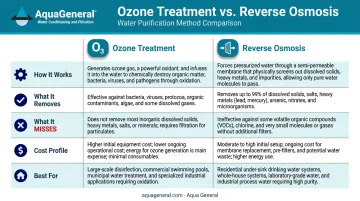
| How it works | Oxidizes and destroys microorganisms chemically; degrades back to oxygen | Forces water through a semi-permeable membrane that blocks dissolved solids and contaminants |
| What it removes | Bacteria, viruses, fungi, some organic compounds | Dissolved solids, heavy metals, nitrates, fluoride, chlorine byproducts, most microorganisms |
| What it misses | Dissolved minerals, heavy metals, salts, nitrates | Does not inactivate pathogens — relies on physical exclusion, not biological destruction |
| Upfront cost | Higher; requires on-site generation equipment | Moderate; under-sink systems widely available |
| Ongoing costs | Electricity, professional maintenance, generator parts | Periodic membrane and filter replacements every 6–24 months |
| Best for | Microbial disinfection, pre-treatment before RO, food/beverage processing, municipal pre-treatment | Residential drinking water, heavy metal reduction, broad dissolved-contaminant removal |
What Is Ozone Water Treatment?
Ozone (O₃) is an unstable molecule made of three oxygen atoms. When dissolved into water, it acts as a powerful oxidizing disinfectant — the EPA's Alternative Disinfectants and Oxidants Guidance Manual documents ozone's oxidation potential at 2.07 volts, compared to 1.36 volts for chlorine, roughly 52% higher. Because ozone is unstable, it cannot be stored. It must be generated on-site, typically via corona discharge — an electrical discharge through air or oxygen.
What Ozone Removes — and What It Doesn't
Ozone is effective against:
- Bacteria, viruses, and fungi
- Parasites and some organic compounds
- Certain dissolved metals like iron and manganese, which it oxidizes into filterable particles
Ozone does not remove dissolved minerals, salts, heavy metals in dissolved form, or nitrates. No EPA or NSF source characterizes ozone as a dissolved-solids removal process. For Houston homeowners dealing with hard water or trace lead, that's a significant limitation worth understanding upfront.
Key Benefits of Ozone
- No chemical residuals — ozone degrades back to oxygen, leaving no taste or odor
- Rapid action — effective disinfection within minutes
- Broad pH effectiveness — works across a wider pH range than chlorine
Real Risks to Understand
Ozone comes with risks that don't always get enough attention:
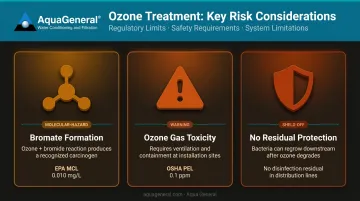
- Bromate formation — when ozone reacts with naturally occurring bromide in water, it produces bromate, a recognized carcinogen. The EPA regulates bromate at a maximum contaminant level of 0.010 mg/L, with an MCLG of zero
- Gas toxicity — ozone gas is hazardous; OSHA sets a permissible exposure limit of just 0.1 ppm for an 8-hour workday
- No residual disinfection — once ozone degrades, there is no ongoing protection. Bacteria can regrow in pipes or storage tanks downstream
Where Ozone Is Actually Used
Ozone fits well in specific contexts:
- Municipal water treatment plants
- Commercial food and beverage processing (bottlers commonly use ozone rather than chlorine to disinfect bottled water)
- Swimming pools
- Pre-treatment upstream of industrial RO systems to reduce organic load
For standalone residential use, ozone systems are uncommon. The equipment cost, safety requirements, and the inability to address dissolved solids make them a poor fit for most homes. In the Houston area, where hard water and elevated TDS are routine findings, that gap matters.
What Is Reverse Osmosis?
Reverse osmosis works differently from the start. Instead of a chemical reaction, RO uses applied pressure to push water through a semi-permeable membrane with extremely small pores — small enough to block dissolved salts, heavy metals, organic chemicals, and most microorganisms while allowing water molecules to pass through. The filtered output is called the permeate.
What RO Removes
The EPA confirms that RO can remove a broad range of inorganics, dissolved solids, radionuclides, and synthetic organic chemicals. Systems certified under NSF/ANSI 58 — the standard specifically governing point-of-use RO systems — are validated for contaminant reduction claims including:
- Lead and arsenic
- Nitrates and nitrites
- Fluoride
- Hexavalent and trivalent chromium
EPA WaterSense sets a minimum 75% TDS reduction benchmark for labeled point-of-use RO systems. Certified products frequently exceed this threshold, performing well above this floor, though specific rejection rates vary by model and water conditions.
A 2023 peer-reviewed review found that RO removes 94–98% of calcium and magnesium — the minerals responsible for Houston's characteristic hard water.
Key Benefits for Homeowners
- High-purity drinking water with noticeably better taste
- Removes contaminants relevant to Houston's supply, including disinfection byproducts and hard minerals
- Eliminates the ongoing cost of bottled water
- WQA and NSF-certified systems provide independently validated performance — not just manufacturer claims
Trade-offs Worth Knowing
- Mineral removal — RO removes beneficial calcium and magnesium alongside contaminants. Remineralization filter stages can add these back; Aqua General's AquaGuard® 9-Stage RO system addresses this directly through a Bio-Sure filter stage that restores beneficial minerals and raises pH after purification
- Water waste — standard point-of-use RO systems can generate 5 gallons or more of reject water per gallon treated. EPA WaterSense-labeled systems cap this at 2.3 gallons or less
- Membrane replacement — membranes require periodic replacement to maintain performance (more on this in the FAQ)
Aqua General's RO Solutions
Aqua General offers WQA and NSF-certified RO systems built for Houston-area water conditions, with over 32 years of installation experience across Harris, Fort Bend, Montgomery, Brazoria, Galveston, and surrounding counties. Their residential flagship, the AquaGuard® Undersink 9-Stage RO System, removes over 98% of contaminants. Key targets include:
- Chlorine, chloramines, and disinfection byproducts
- Lead, arsenic, and hexavalent chromium
- Pesticides, pharmaceuticals, and viruses
A catalytic carbon filter stage handles chloramine removal specifically — relevant because Houston's municipal system uses chloramines rather than straight chlorine. A Bio-Sure remineralization stage then restores beneficial minerals and raises pH after purification.
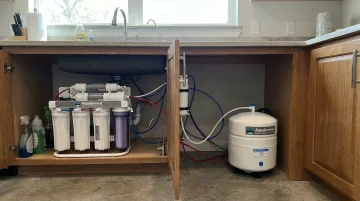
For commercial customers (restaurants, dental offices, medical offices, and ice-making facilities), Aqua General's AQRO commercial RO line uses a high-rejection Filmtec TFC membrane with double pre-filtration stages and full automation controls.
Which Is Better for Your Home? A Decision Framework
The answer depends on what's actually in your water. Neither system is universally superior; they address different problems.
Start With a Water Test
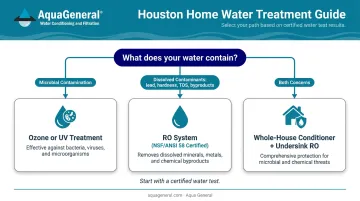
Before spending money on any system, identify your primary concern:
- Microbial contamination (bacteria, viruses)? Ozone or UV addresses this most directly
- Dissolved contaminants (lead, hardness, nitrates, TDS, chlorine byproducts)? RO is the right tool
- Both? A combined or multi-stage approach makes sense
When Ozone Makes Sense
Ozone is most appropriate as a supplemental disinfection layer — particularly for well water with bacterial concerns, or as pre-treatment ahead of a commercial RO system. Research confirms that pre-ozonation can reduce biofouling and organic load on RO membranes, potentially extending membrane life in high-demand installations.
For most residential users, standalone ozone doesn't cover the full range of contaminants that matter — which is where RO steps in.
When RO Is the Right Choice
RO is the stronger solution when drinking water purity is the priority. Given Houston's municipal water profile: average TDS of 230 ppm, average hardness of 110 ppm, detectable HAA5 and TTHM disinfection byproducts, and lead detected at the 90th percentile at 4.4 ppb, a properly specified RO system addresses the most relevant local concerns directly.
Choose RO if you want:
- Verified reduction of dissolved heavy metals, nitrates, and fluoride
- Improved taste and elimination of chlorine/chloramine byproducts
- Independent certification (NSF/ANSI 58 or WQA Gold Seal) confirming what the system actually removes
When Combining Both Makes Sense
The ozone + RO combination is well-established in commercial water treatment. Bottled water producers rely on it, and peer-reviewed research supports ozone pre-treatment for reducing RO membrane fouling. In practice, ozone handles microbial disinfection and organic load; RO handles the dissolved contaminants ozone cannot touch.
For most Houston homeowners, a well-specified RO system paired with a whole-house conditioner that includes anti-microbial media covers both concerns without the added complexity and cost of a dedicated ozone unit. Aqua General's point-of-entry AquaGuard® conditioner — with five-stage filtration including silver-impregnated anti-microbial media — combined with Aqua General's undersink 9-stage RO system is built for exactly this type of application.
The Practical Takeaway
Get your water tested before investing in any system. A certified water specialist can identify what's actually present in your specific water supply and recommend whether an RO system, a whole-house conditioner, or a combined approach fits your home. Aqua General offers free on-site water testing across their entire service area — call (713) 664-4601 to schedule.
Conclusion
Ozone excels at chemical-free disinfection but cannot address dissolved contaminants. Reverse osmosis delivers the broadest contaminant removal for drinking water but relies on physical filtration rather than biological inactivation. For Houston-area homeowners dealing with hard water, trace metals, and chlorine byproducts, RO is typically the stronger starting point — with whole-house conditioning addressing everything upstream.
Your water's specific chemistry determines which system — or combination — makes sense. Aqua General's specialists are TCEQ licensed, WQA certified, and have served the Greater Houston area for over 32 years. They can test your water on-site and recommend a solution that actually fits. Call (713) 664-4601 or visit aquageneral.com to schedule a free water quality consultation.
Frequently Asked Questions
Is ozonation or reverse osmosis better?
Neither is universally better — they solve different problems. Ozone is superior for microbial disinfection without chemical residuals; RO is superior for removing dissolved contaminants like heavy metals, nitrates, and salts. The right choice depends on what your water actually contains, which is why a water test should come first.
Is it healthy to drink ozonated water?
Ozonated water is generally considered safe when properly treated, since ozone reverts to oxygen and leaves no chemical residual. Bromate formation is a genuine concern, though. The EPA sets an MCL of 0.010 mg/L for bromate with an MCLG of zero, so proper system design, water chemistry assessment, and ongoing monitoring are all required.
Does ozone water treatment remove heavy metals?
Ozone does not directly remove dissolved heavy metals like lead or arsenic. It can oxidize certain metals — iron and manganese, for example — into insoluble particles that can then be filtered out. For broad heavy metal reduction, reverse osmosis certified under NSF/ANSI 58 is the recommended approach.
Can ozone treatment and reverse osmosis be used together?
Yes, and this combination is common in commercial water treatment. Ozone handles microbial disinfection and reduces organic load, which can extend RO membrane life by reducing biofouling. RO then removes the dissolved contaminants ozone cannot address — together they provide more complete purification than either system alone.
What are the main risks of ozone water treatment at home?
There are two primary risks. First, bromate can form when ozone reacts with naturally occurring bromide in the water, which the EPA regulates as a health concern. Second, ozone gas is hazardous at low concentrations (OSHA PEL: 0.1 ppm), so proper installation, containment, and ventilation are required for any residential system.
How often do reverse osmosis filters need to be replaced?
Pre-filters and post-filters typically need replacement every 6–12 months; the semi-permeable membrane itself generally lasts 2–5 years depending on water quality and usage volume. In Houston, where TDS and hardness are moderate, a certified technician can assess and schedule replacements based on your actual water conditions.