The problem is that "how much does an RO system cost?" doesn't have a clean answer. The same core technology packaged as a countertop unit versus a whole-house system can range from a few hundred dollars to well over $10,000 — and that gap isn't arbitrary. System type, household size, source water conditions, and installation complexity all shape the final number.
This guide breaks down verified 2026 pricing by system type, identifies the variables that move costs up or down, and maps out what ongoing maintenance actually adds to your five-year total. By the end, you'll know what a realistic budget looks like — and what most homeowners get wrong when they first start pricing RO systems.
Key Takeaways
- Under-sink RO systems run $300–$1,900+ installed; whole-house systems can reach $8,000–$25,000+ depending on complexity
- Houston-area water hardness (up to 280 mg/L in some Fort Bend County zones) often makes pre-treatment a required cost, not optional
- Annual maintenance — pre-filter changes and eventual membrane replacement — adds real ongoing costs that belong in your budget from day one
- Skipping a professional water test before buying is one of the most common and costly budgeting mistakes
- NSF/WQA-certified systems provide documented contaminant removal performance that uncertified claims can't match
How Much Does a Reverse Osmosis System Cost? (2026 Pricing Overview)
RO systems don't carry a single price tag — the technology is identical in concept, but the packaging, output capacity, and installation requirements vary enormously. According to HomeAdvisor's 2026 cost guide, the broad installed cost range for residential RO runs $1,000–$4,800, with a national average near $2,200. That range covers most under-sink installations but doesn't capture the full span of whole-house projects.
Here's how each system type breaks down:
Countertop RO Systems
Unit cost: $200–$700 | No plumbing labor required
Countertop units sit on the counter and connect directly to your faucet. No drilling or plumbing modifications are needed, so there's no installation fee. They typically include basic to mid-range filtration stages and a storage or flow-through design.
What's not included:
- Dedicated filtered water faucet
- Permanent plumbing integration
- Throughput capacity for larger households
Best fit: Renters, apartments, small households, or anyone wanting a low-commitment option before investing in a permanent installation.
Under-Sink RO Systems
Installed cost (unit + professional labor): $500–$1,900+
Under-sink systems mount inside the cabinet below your kitchen sink, connect to the cold water line, and deliver filtered water through a dedicated faucet. Tank-based units store filtered water in a pressurized reservoir. Tankless (on-demand) units filter continuously and carry a premium: $300–$1,300 for the unit alone versus $178–$630 for tank-based equivalents.
Professional installation typically adds $100–$300 in labor for a standard setup. Granite or quartz countertops requiring drilling, hard-to-reach drain lines, or specialty faucet finishes push that number up.
What's not included at the base price:
- Pre-treatment equipment for hard or contaminated water
- Premium faucet finishes
Best fit: Homeowners wanting clean drinking and cooking water at one dedicated kitchen tap.
Whole-House RO Systems
Installed cost: $6,700–$25,000+
Whole-house (point-of-entry) systems treat every water outlet in the home. The unit itself runs $6,700–$10,000+ before installation, and complex projects involving pre-treatment, booster pumps, storage tanks, and severe source water issues can reach $8,000–$25,000+, according to National Water Service's 2026 regional guide.
What drives the wide range:
- Storage tank size: Whole-house systems require pressurized storage to meet peak demand
- Booster pump: Required when municipal pressure is insufficient to drive the membrane effectively, plus a dedicated electrical circuit
- Pre-treatment stack: Sediment pre-filters and water softeners are often mandatory before the RO membrane to prevent premature scaling
In the Greater Houston area, where hardness readings across Fort Bend, Montgomery, and Brazoria counties frequently reach 150–280 mg/L, pre-treatment is rarely optional for whole-house installations.
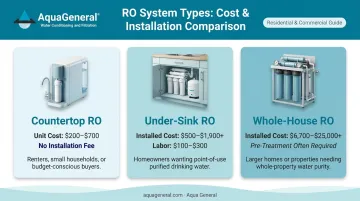
Best fit: Well water users, homes with heavily contaminated municipal water, or homeowners who want purified water at every fixture.
Key Factors That Affect the Cost of an RO System
Pricing depends on a mix of technical, water quality, and site-specific variables. Understanding them before you buy prevents the most common and expensive mistakes.
System Type and Configuration
The choice between countertop, under-sink (tank vs. tankless), and whole-house systems sets your fundamental price tier. Tankless under-sink systems carry a modest premium over tank-based units — typically $100–$400 more for the unit — because on-demand filtration eliminates the storage tank and delivers fresher water without pressurization cycles.
Household Size and Daily Water Demand
RO systems are rated in gallons per day (GPD), and sizing matters. An undersized system runs continuously, shortening membrane life and reducing water pressure at the faucet.
| Household Size | Recommended GPD |
|---|---|
| 1–2 people | 75 GPD |
| Family of 3–4 | 500 GPD |
| 5+ people | 1,000 GPD |
Note that actual output is typically 50–75% of the rated GPD — a 75 GPD system may deliver 40–55 gallons on a real usage day.
Water Quality and Pre-Treatment Needs
Water chemistry is often the single biggest cost variable — and Houston's supply makes this especially relevant.
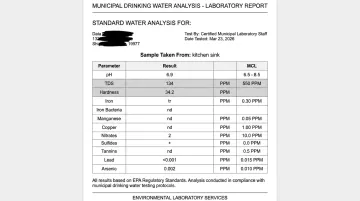
Houston's 2024 water quality report shows main-system hardness averaging 110 mg/L as CaCO3, with Sugar Land reaching 280 mg/L and Montgomery County MUDs running 150–200 mg/L. The USGS classifies water above 180 mg/L as "very hard", and Watts' technical guidance confirms hardness above 170 mg/L (10 GPG) shortens RO membrane life — potentially cutting replacement intervals from 5 years down to 2.
The same report also detected:
- Lead at 4.4 ppb (90th percentile), with 9 samples above the 15 ppb action level
- Arsenic averaging 1.8 ppb
- TTHMs at 45 ppb highest LRAA
- TDS averaging 230 ppm
Each of these contaminants may require specific filtration stages or pre-treatment equipment, adding to the total system cost.
Number of Filtration Stages and Certifications
Every additional stage — sediment pre-filter, carbon block, RO membrane, post-carbon, UV sterilization, remineralization — adds to the unit price. Systems certified under NSF/ANSI 58 have documented contaminant reduction performance verified by an independent lab. WQA- and NSF-certified systems command a modest premium but provide verified claims, not just marketing copy.
That distinction matters when shopping by spec sheet alone. Aqua General's AquaGuard® 9-Stage Reverse Osmosis system, for example, documents removal of PFAS, arsenic, hexavalent chromium, alpha particle radioactivity, lead, and disinfection byproducts — with components tested and validated by WQA and NSF.
Installation and Setup Complexity
Labor costs rise with complexity. Common cost adders include:
- Granite or quartz countertops requiring professional drilling
- Inaccessible or non-standard drain lines
- Booster pump installation requiring a dedicated electrical circuit
- Main water line integration for whole-house systems
- Pre-treatment equipment (water softener, sediment filter) installed alongside the RO unit
For whole-house installations, a TCEQ-licensed, WQA-certified water treatment specialist will assess your plumbing layout, water chemistry, and space constraints before recommending a system size. Aqua General's team conducts this on-site evaluation at no charge — catching issues like inadequate line pressure or incompatible drain configurations before they become expensive surprises.
Cost Breakdown: One-Time vs. Recurring Expenses
The purchase price is only the starting point. Here's what the full cost of ownership actually looks like:
| Expense | Type | Typical Cost |
|---|---|---|
| RO unit purchase | One-time | $200–$10,000+ depending on type |
| Professional installation | One-time | $100–$300 (under-sink); $1,000–$5,000+ (whole-house) |
| Sediment + carbon pre-filter set | Recurring (every 6–12 months) | $22–$45 per set |
| Full 5-stage replacement kit | Recurring (annual) | $51–$192 |
| RO membrane replacement | Recurring (every 2–5 years) | ~$40–$75 for membrane alone |
| Periodic repairs/upgrades | As needed | Varies |
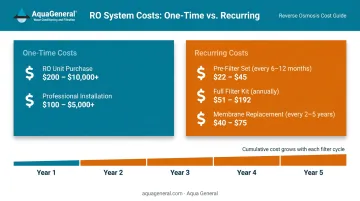
Two line items deserve extra attention:
Pre-filter replacements are the most frequent maintenance task. Skipping them is the fastest way to foul an RO membrane prematurely — which can turn a $45 filter set into a premature $75+ membrane replacement.
Membrane Lifespan in the Houston Area
Local water hardness directly affects how long your membrane lasts. In areas where hardness exceeds 170 mg/L — common across much of the Greater Houston region — plan for replacement closer to the 2-year mark rather than 5.
Parts availability matters here too. Older systems sometimes can't be serviced simply because components are discontinued. Aqua General stocks replacement parts for a wide range of brands — including Pentair, Pelican, Watts, 3M, and Fleck — as well as discontinued Pentair models, which helps keep aging systems running without extended downtime.
What Most People Miss When Budgeting for an RO System
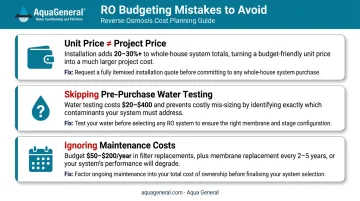
Three budgeting mistakes come up repeatedly:
Unit price isn't the project price. Installation can represent 20–30% or more of a whole-house project total. A $7,000 whole-house unit with $3,000–$5,000 in installation and pre-treatment equipment is a $10,000–$12,000 project — not a $7,000 purchase.
Skipping pre-purchase water testing. Without knowing what's in your water, you might buy an undersized system, skip necessary pre-treatment, or pay for filtration stages you don't need. A professional water quality test in Texas ranges from $20 for a basic coliform presence test to $400 for a full drinking-water standards analysis, according to the Texas Water Development Board. Aqua General provides free on-site water testing as a practical starting point before committing to any system.
Leaving maintenance out of the initial budget. Annual pre-filter replacements and periodic membrane changes are predictable costs, yet they're routinely omitted from initial price comparisons. For a standard under-sink system, plan on $50–$200 per year for filters, with membrane replacement adding $40–$75 every 2–5 years.
Conclusion
RO system costs in 2026 span a wide range — from a few hundred dollars for a countertop unit to $25,000 or more for a fully configured whole-house installation with pre-treatment. The right budget for your home depends on system type, how many people you're serving, your source water conditions, and what installation complexity actually looks like on-site.
The homeowners who make the best decisions treat this as a total cost of ownership question, not a unit price comparison. That means factoring in installation, pre-treatment, and the ongoing maintenance schedule before choosing a system — not after.
Greater Houston homeowners have an added layer of complexity: water hardness, TDS levels, and detected contaminants vary significantly across Harris, Fort Bend, Montgomery, Galveston, Brazoria, and surrounding counties. What works in one ZIP code may be undersized or misconfigured for another. That's where a licensed specialist's assessment pays for itself.
Aqua General's TCEQ-licensed, WQA-certified specialists have been helping Houston-area families and businesses find the right water treatment solution for over 32 years. President David A. Davies was among the first in Texas to earn a TCEQ Class III Water Treatment Specialist License. A free on-site water test is a practical first step toward understanding what your water contains and what a properly sized system would cost.
Frequently Asked Questions
How much does it cost to install a reverse osmosis system?
Under-sink systems typically run $500–$1,900 installed (unit plus professional labor of $100–$300). Whole-house systems carry significantly higher costs — often $8,000–$25,000+ — due to plumbing complexity, storage tank placement, booster pump requirements, and pre-treatment needs. Final costs vary by home setup, water quality, and local labor rates.
Is it worth it to install a reverse osmosis system?
For households currently spending on bottled water — which retails at roughly $3.09 per gallon nationally — most under-sink systems pay for themselves within one to two years. RO systems also reduce exposure to lead, arsenic, and disinfection byproducts, extend appliance life by reducing scale, and eliminate single-use plastic.
Can reverse osmosis remove radon?
Standard RO membranes aren't primarily designed to remove radon, which is a dissolved gas rather than a particulate contaminant. Point-of-use RO can reduce radon in drinking water partially, but the EPA recommends granular activated carbon or aeration systems for dedicated radon treatment in private well water. A professional water test is the best starting point if radon is a concern.
What is the annual maintenance cost for a residential RO system?
Pre-filter sets (sediment and carbon) run $22–$45 and need replacement every 6–12 months. Full 5-stage replacement kits run $51–$192 annually. RO membranes cost $40–$75 and typically last 2–5 years, though Houston's hard water can shorten that interval.
How long does a reverse osmosis system last?
The RO unit housing and frame can last 10–15 years with proper maintenance. Filters need replacement every 6–12 months and membranes every 2–5 years. Using certified replacement components and scheduling professional servicing extend system life — deferred maintenance is the primary reason systems fail prematurely.
Should I get an under-sink or whole-house RO system?
Under-sink is the right choice for most households that want clean drinking and cooking water at one tap — it's cost-effective and straightforward to maintain. Whole-house RO makes sense when contamination is severe, the source is a private well, or you want purified water at every fixture. A professional water quality assessment is the most reliable way to determine which configuration your home actually needs.