Introduction
You run a regeneration cycle, and your water still feels hard. Or you notice a slow drip forming around the valve head that wasn't there last week. Before you assume the worst, check the O-rings.
Water softener O-rings are small rubber seals inside the valve and distributor assembly. They degrade over time from repeated pressure cycles, prolonged mineral contact, and heat exposure. When they fail, they cause exactly the symptoms above. The good news: replacing them is one of the least expensive repairs you can make to a softener.
What follows walks you through identifying a failing O-ring, replacing it correctly, and choosing the right part — plus how to tell when the problem runs deeper than a seal can solve.
Key Takeaways
- A failing O-ring causes hard water after regeneration, valve head leaks, and mineral residue around the valve neck
- O-ring count and configuration vary by brand — Whirlpool, Morton, and Rheem use a 3-O-ring distributor kit, while other brands may require different kits
- Always lubricate new O-rings with food-grade silicone grease before installation; petroleum-based products will degrade the rubber
- If hard water or leaks persist after O-ring replacement, check the distributor tube, piston seals, or resin bed for damage
What Is a Water Softener O-Ring?
An O-ring is a circular rubber gasket that creates a watertight seal between components in your softener's valve and distributor assembly. In practical terms, it prevents two things: water bypassing the resin bed internally, and water escaping externally around the valve-to-tank connection.
How Many O-Rings Does a Softener Have?
This varies by brand and valve design. For Whirlpool, Morton, and Rheem-branded softeners, the distributor O-ring kit contains three seals:
- A small O-ring at the top of the riser tube
- A larger O-ring around the top distributor
- A third O-ring beneath the top distributor
Fleck, Clack, and Autotrol valves have their own configurations. The Fleck 5600 service manual specifies lubricating both a distributor O-ring seal and a tank O-ring seal before mounting the control valve — a different arrangement than the Whirlpool/Morton configuration above.
Always check your specific brand's documentation before ordering replacement seals.
Regardless of the count, all O-rings are wear items with a finite lifespan. Pressure cycling during regeneration, mineral-rich water, and heat cause rubber to harden, compress, or crack — typically within 5–10 years depending on water chemistry and usage.
Signs Your Water Softener O-Ring Is Failing
Four symptoms point to a failing O-ring before any visible damage appears. Catching them early prevents wasted salt, water damage, and hard water creeping back into your home.
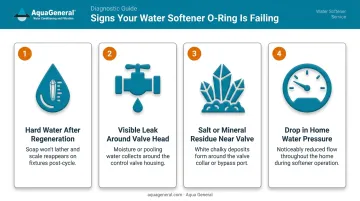
Hard Water Returning After Regeneration
A nicked or pinched distributor O-ring allows untreated water to bypass the resin bed entirely. The softener completes a full cycle, but hard water still reaches your fixtures.
To check, use hardness test strips on your tap water after a completed regeneration cycle. If the reading is consistently high, a failed distributor O-ring is a likely culprit — though a cracked distributor tube or worn valve seals can cause identical symptoms.
Note: Don't rely on a TDS meter for this test. As Morton's support documentation points out, softened water can have a similar TDS reading to hard water because ion exchange trades calcium and magnesium for sodium rather than reducing total dissolved solids. Use hardness test strips instead.
Visible Leak Around the Valve Head
A deteriorated external O-ring at the valve head/tank neck connection causes dripping or seepage. This is most noticeable right after a regeneration cycle, when the pressure changes inside the system are most pronounced.
Salt or Mineral Residue Around the Valve Area
Brine solution escaping through a failing O-ring leaves white crystalline deposits around the valve neck. This often appears before a visible leak develops — worth treating as an early warning.
Drop in Water Pressure Throughout the Home
A compromised seal can allow internal bypassing of flow, reducing effective pressure at fixtures. Before calling a plumber, run a regeneration cycle and recheck pressure — if it improves temporarily, the O-ring is the more likely cause.
Why O-Rings Fail
Per the Parker O-Ring Handbook, common failure modes include compression set (permanent deformation), extrusion from high pressure, abrasion, installation damage, and chemical attack. For water softeners, the main contributors are pressure surges during regeneration, installation without lubrication, and age-related hardening.
How to Replace a Water Softener O-Ring (Step-by-Step)
Before starting, confirm your softener's brand and model number and source the correct O-ring kit. O-ring dimensions vary across Fleck, Clack, Autotrol, Whirlpool, and other brands — a wrong size will leak or fail prematurely. Gather these supplies first:
- Food-grade silicone grease
- Flathead screwdriver
- Replacement O-ring kit (model-specific)
- Clean towels
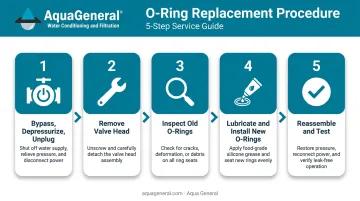
Step 1: Bypass, Depressurize, and Unplug
Engage the bypass valve (push the handle in on most units) to stop water flow. Then run a manual recharge cycle to depressurize the system. Do not skip this step: pressurized water will spray when the valve head is removed. Unplug the power cord.
Step 2: Remove the Valve Head
Locate the C-clips or tank clamps connecting the valve head to the tank neck. Gently pry the clip tabs outward to release them. If clips are difficult to remove, check that the unit is level — gently rocking it can help. Once clips are off, wiggle the valve head straight up and off the riser tube. Don't pull the riser tube itself out of the resin tank.
Step 3: Remove and Inspect the Old O-Rings
Locate each O-ring per your model's documentation and inspect for cracking, flattening, or nicks. An O-ring can look intact while still harboring micro-cuts that cause slow leaks. When in doubt, replace it.
Step 4: Lubricate and Install the New O-Rings
This is the most important step. Apply a small amount of food-grade silicone grease to each new O-ring before installation. The Autotrol 255/400 service manual specifies 100% silicone lubricants only — petroleum-based products damage rubber and plastic components. Clack's manual confirms silicone lubricant is appropriate for black O-rings but notes that clear silicone lip seals already have a slippery coating and don't require additional lubricant.
Install in reverse order from removal. Skipping lubrication causes immediate micro-abrasion on the seal surface, cutting its service life short.
Step 5: Reassemble and Test
- Push the valve head straight down until it seats firmly against the tank
- Secure the tank clamps or C-clips
- Reconnect any wire harnesses and motor connectors
- Plug in the power cord
- Slowly pull the bypass valve out to restore water flow
- Monitor the valve head and tank neck closely for seepage over the next several hours
How to Choose the Right Replacement O-Ring
O-rings are not universal. The correct replacement must match the original in both inner diameter and cross-section thickness. A loose fit leaks; an over-compressed fit cracks early. Cross-reference your softener's model number with the manufacturer's O-ring kit part number — don't guess from visual inspection alone.
EPDM vs. Buna-N: Which Material to Use
| Material | Best For | Avoid With |
|---|---|---|
| EPDM | Hot/cold water, general water contact | Mineral oils, petroleum products |
| Buna-N (NBR) | Water applications, moderate temperatures | Strong acids, some solvents |
Most residential softener O-rings use EPDM or Buna-N. For potable water applications, look for compounds that meet NSF/ANSI 61, which covers sealing materials in contact with drinking water systems. Avoid generic hardware store O-rings — they may not be rated for the continuous water contact or pressure ranges inside a control valve.
Getting the right part starts with knowing your valve model — and that's where a knowledgeable supplier helps. Aqua General carries replacement O-ring kits for a wide range of softener brands, including Fleck, Clack, Autotrol, GE, and Pentair. Houston-area homeowners can call (713) 664-4601 to confirm the correct kit for their specific valve before ordering.
Fix or Replace? When a New O-Ring Isn't Enough
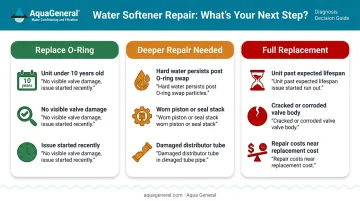
Not every leak or hard water problem traces back to an O-ring. Use these indicators to decide:
O-ring replacement is likely sufficient when:
- The softener is under 8–10 years old
- The valve body shows no visible cracks or scoring
- Hard water or leaking started recently after a period of normal operation
Deeper repair is needed when:
- Hard water persists after O-ring replacement. Inspect the distributor tube for nicks or distortion at the top — a damaged tube lets treated and untreated water mix, and no O-ring corrects that
- The piston or seal stack inside a Fleck or Clack-style valve is worn. The Fleck 5600 manual distinguishes distributor tube/O-ring issues from internal valve leaks that require seals, spacers, and piston replacement
Full replacement may make more sense when:
- The unit is past its expected lifespan — typically 8–10 years, though units with consistent maintenance often run longer
- The valve body itself is cracked, corroded, or repeatedly leaking despite new O-rings
- Repair costs approach or exceed replacement cost
When it's not clear whether the issue is the O-ring, the valve internals, or the resin bed, a professional assessment saves time and avoids repeat repairs. Aqua General's service team is TCEQ Class III licensed and WQA certified, covering the full diagnostic range — from control valve heads to resin bed evaluation — across the Greater Houston area.
Preventing Future O-Ring Failures
A few habits reduce the chance of needing another emergency O-ring replacement:
- Use only silicone lubricant during any service involving O-rings — Clack, Autotrol, and Fleck all prohibit petroleum jelly, WD-40, and hydrocarbon-based lubricants. These attack rubber and plastic components directly.
- Inspect the valve neck area during your annual brine tank cleanout — look for early mineral deposits or rubber deterioration before they become a leak
- Reapply a thin coat of silicone grease to any accessible O-rings during routine servicing to maintain pliability
Houston's water sits in a wide hardness range — the City of Houston's 2024 Water Quality Report shows the main system averaging 110 ppm (moderately hard by USGS standards), with some areas like Willow Chase averaging 175 ppm (hard). Systems working against higher mineral loads benefit from more frequent valve inspections.
That higher mineral load accelerates O-ring wear, which is why routine professional inspections matter in Houston more than in softer-water markets. For homeowners who'd rather not track this themselves, Aqua General provides routine water softener maintenance across Harris, Fort Bend, Montgomery, and surrounding Houston-area counties, catching wear before it becomes an active leak.
Frequently Asked Questions
How do I know if my water softener O-ring needs replacing?
The main signs are a visible leak around the valve head, hard water returning after regeneration cycles, or white mineral deposits forming around the valve neck. Any of these warrants pulling the valve head and inspecting the O-rings directly.
What type of lubricant should I use on water softener O-rings?
Use only food-grade silicone grease. Petroleum-based products — including WD-40, petroleum jelly, and standard plumber's grease — degrade rubber O-rings and damage plastic valve components; Clack and Autotrol both explicitly prohibit hydrocarbon lubricants in their service manuals.
How often should water softener O-rings be replaced?
There's no fixed schedule. Inspect them annually during routine brine tank maintenance and replace at the first sign of cracking, flattening, or leaking. Systems in areas with higher water hardness may benefit from more frequent checks.
Can a bad O-ring cause hard water even after regeneration?
Yes. A nicked or pinched distributor O-ring allows water to bypass the resin bed, so the softener can complete a full regeneration cycle and still deliver hard water. The resin may be fully charged — the water just isn't contacting it properly.
What's the difference between a distributor O-ring and a valve O-ring?
Distributor O-rings seal the internal riser tube and distributor assembly, preventing water from bypassing the resin bed inside the tank. Valve O-rings seal the external connection between the valve head and the tank neck, preventing water from leaking outside the system.
When should I call a professional instead of replacing the O-ring myself?
Call a professional if hard water or leaking persists after O-ring replacement, the distributor tube looks cracked or distorted, or the unit is over 10 years old with multiple issues. If you're not comfortable working around pressurized plumbing, it's worth having a licensed water treatment specialist take a look — Aqua General's service team covers the Greater Houston area and can diagnose the problem on-site.