Introduction
Tens of millions of Americans rent their homes — and many deal with a water quality problem they can't fully solve. Aging building pipes, chloramine disinfection, and minerals leaching from deteriorating infrastructure all affect what comes out of the tap. Lease agreements typically prohibit drilling or permanent plumbing modifications, which narrows your options considerably.
Several filter categories are designed specifically for that constraint — no tools, no landlord approval, no permanent changes required. This guide covers the five best no-install options, explains how to match each type to your specific water concerns, and breaks down the certification standards that separate genuinely protective filters from ones that only address taste and odor.
Houston-area renters will find locally relevant context throughout. The city's chloramine-treated water and variable hardness levels make filter media selection more consequential than it might seem.
Key Takeaways
- Focus on no-install or fully reversible filter types: countertop, pitcher, faucet mount, gravity-fed, and shower filters
- Countertop RO systems offer the highest contaminant removal of any renter-friendly option
- NSF/ANSI certifications (42, 53, 58, 401) are the only reliable way to verify performance claims
- Cost per gallon matters more than sticker price — factor in filter replacement frequency
- Test your water first: Houston renters commonly face chloramines and hard water that demand specific filter media
Why Apartment Tap Water Needs Extra Filtration
Municipal treatment plants meet EPA standards — but that's where the guarantee ends. Water travels through miles of distribution pipes, then through your building's internal plumbing, before reaching your faucet. Those final miles introduce contamination risks the treatment plant never sees.
The Lead Pipe Problem
EPA currently estimates approximately 4 million lead service lines still serve U.S. properties. NRDC notes the agency's prior estimate was closer to 9.2 million, and 24 million+ service lines are classified as unknown material — meaning no one knows whether they're safe. Buildings constructed before 1986 may have copper pipes joined with lead solder. The older the building, the higher the risk.
What Houston Renters Are Actually Dealing With
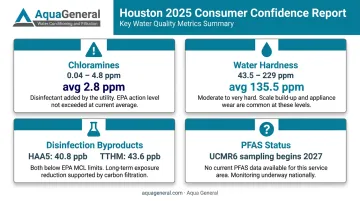
Houston's 2025 Consumer Confidence Report reveals several relevant data points:
- Chloramines: Houston's Main System uses chloramines as the primary disinfectant, measured at 0.04–4.8 ppm, averaging 2.8 ppm. This matters because chloramine requires different filter media than free chlorine — not all carbon filters handle it equally
- Hard water: Total hardness ranges from 43.5–229 ppm (averaging 135.5 ppm as CaCO3), which leaves scale on fixtures and affect skin and hair
- Disinfection byproducts: HAA5 at 40.8 ppb and TTHM at 43.6 ppb — both within legal limits but relevant for health-conscious renters
- PFAS: Houston's report doesn't include PFAS detection values yet; UCMR6 sampling begins in 2027
Why Common Workarounds Fall Short
- Bottled water is a significant ongoing expense that generates plastic waste and doesn't address cooking water or shower exposure
- Basic carbon pitchers (NSF 42 only) improve taste and reduce chlorine odor but provide no verified protection against lead, PFAS, nitrates, or dissolved solids
EWG's analysis of EPA UCMR5 monitoring data found approximately 176 million Americans are served by water systems with detectable PFAS levels across 3,539 sites. For Houston renters, that context matters: taste-only filtration leaves the contaminants you can't smell or see completely unaddressed.
Best No-Install Water Filters for Apartment Renters
Filters below were selected based on contaminant removal performance, third-party certification status, ease of setup, and full renter-compatibility (zero permanent modifications required).
Countertop Reverse Osmosis System
Countertop RO is the highest-performing renter-friendly option available. These units connect to a standard faucet via a diverter valve, or operate as a self-contained fill tank — no drilling, no plumber, and fully packaged for move-out day in minutes.
Multi-stage filtration (sediment → activated carbon → RO membrane → post-carbon polish) handles lead, PFAS, nitrates, arsenic, hexavalent chromium, and 80+ additional contaminants. For certifications, look for NSF/ANSI 58 at minimum for the RO membrane. The best models carry NSF/ANSI 42, 53, 58, and 401 combined.
One efficiency factor worth checking: EPA WaterSense data shows traditional point-of-use RO systems produce 5+ gallons of reject water per gallon treated. WaterSense-labeled models must achieve a reject ratio of 2.3:1 or better — a meaningful upgrade from the standard.
| Filter Type | Key Certifications | Best For | Renter Suitability |
|---|---|---|---|
| Countertop Reverse Osmosis | NSF/ANSI 42, 53, 58, 401 | Maximum removal: lead, PFAS, nitrates, arsenic | Excellent — plug-and-play, fully portable |
Water Filter Pitcher
Pitchers are the zero-barrier entry point: insert a filter, fill with tap water, refrigerate. They're ideal for 1–2 person households with general water quality concerns and tight budgets.
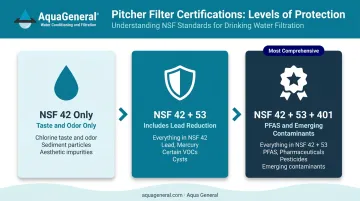
The critical distinction is certification level. Not all pitchers are created equal:
- NSF/ANSI 42 only → reduces chlorine taste and odor, nothing more
- NSF/ANSI 53 → verified lead reduction (look for pitcher filters certified to both NSF 53 and 401)
- NSF/ANSI 401 → covers emerging contaminants including PFAS and pharmaceuticals
Filter lifespan varies considerably by model: basic pitcher filters often last 40 gallons (~2 months), while higher-capacity models reach 120 gallons (~6 months). Higher-capacity filters offer a lower cost per gallon over time.
| Filter Type | Key Certifications | Best For | Renter Suitability |
|---|---|---|---|
| Water Filter Pitcher | NSF/ANSI 42, 53 (minimum); 401 for PFAS | Budget-conscious renters, 1–2 person households | Excellent — zero installation |
Faucet Mount Filter
Faucet mount filters deliver on-demand filtered water without consuming counter space or requiring pitchers to refill. They sit at the faucet aerator connection and toggle between filtered and unfiltered flow — making them one of the most practical point-of-use options for renters.
NSF 42 + 53 certified faucet mount models — which can filter up to 100 gallons (approximately 3 months) and may be certified for dozens of contaminants including lead — handle chlorine, lead, cysts, and some VOCs effectively. They don't remove PFAS, nitrates, or dissolved solids at the level of RO systems — that's a real ceiling to understand before buying.
Faucet compatibility varies by model and faucet type. Before purchasing, Aqua General can assess your specific setup during a free on-site water analysis and recommend the right faucet-compatible solution — or a countertop RO alternative if your faucet isn't compatible. Call (713) 664-4601 or visit aquageneral.com to schedule.
| Filter Type | Key Certifications | Best For | Renter Suitability |
|---|---|---|---|
| Faucet Mount Filter | NSF/ANSI 42, 53 | On-demand filtered water, no counter space used | Very Good — fully reversible, no drilling |
Gravity-Fed Countertop Dispenser
Gravity-fed dispensers require no faucet connection and no electricity. Water is poured manually into the upper chamber and flows through ceramic and activated carbon media into a lower tank. Stainless steel construction eliminates plastic contact concerns.
Key strengths:
- Removes chlorine, lead, cysts, turbidity, and some heavy metals
- NSF/ANSI 42, 53, and 401 certified options are available
- Long filter lifespan — quality ceramic candle filters can reach hundreds of gallons per set
- Works during power outages — particularly relevant given Houston's history of extended outages
Flow rate is slower than RO or faucet filters, and gravity filtration doesn't remove nitrates or dissolved solids the way an RO membrane does. For households prioritizing independence from infrastructure, though, it's a hard option to beat.
| Filter Type | Key Certifications | Best For | Renter Suitability |
|---|---|---|---|
| Gravity-Fed Dispenser | NSF/ANSI 42, 53, 401 | Zero-dependency filtration; emergency backup use | Excellent — completely standalone |
Shower Filter
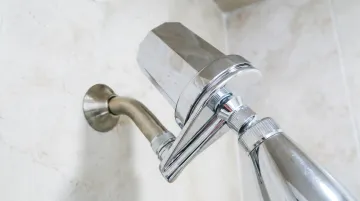
Shower filtration is the most overlooked piece of the apartment water quality puzzle. Peer-reviewed research confirms that disinfection byproducts including trihalomethanes are absorbed dermally and inhaled as steam during hot showers — contributing to skin dryness and irritation.
NSF/ANSI 177 certification verifies free available chlorine reduction, but Houston renters should note one important caveat: NSF 177 covers free chlorine only, not chloramines. Houston's water uses chloramines as the primary disinfectant, so the right media selection matters significantly — look for filters that specifically address chloramine reduction. Vitamin C/ascorbic acid-based media does reduce chloramines; KDF media addresses free chlorine only.
Getting the wrong product means no meaningful protection despite the expense. Aqua General carries shower filtration products specifically suited to Houston's chloramine-treated water and can guide you to the correct solution — including professional installation advice so your renter setup is done right the first time. Call (713) 664-4601 or contact Aqua General at service@aquageneral.com to discuss your options.
| Filter Type | Key Certifications | Best For | Renter Suitability |
|---|---|---|---|
| Shower Filter | NSF/ANSI 177 | Reducing chlorine/chloramine exposure through skin and steam | Excellent — tool-free, fully reversible |
How to Choose the Right Water Filter for Your Apartment
Step 1: Know Your Water First
Before selecting any filter, look up your utility's annual Consumer Confidence Report (CCR) — the EPA requires every public water system to publish one. Houston's report is available through Houston Public Works.
That report covers municipal treatment, but it won't tell you what's happening inside your building's plumbing. For that, get a professional water test. Aqua General offers a free on-site water analysis, and their Free Water Analysis request form specifically includes "Apartment" as an option — so renters are explicitly accommodated.
Step 2: Match Filter to Your Primary Concern
| Primary Concern | Recommended Filter Type |
|---|---|
| Lead, PFAS, nitrates, arsenic (maximum protection) | Countertop RO system |
| Chlorine taste, basic lead reduction (budget) | Certified pitcher (NSF 42 + 53) or faucet mount |
| Power-free or emergency filtration | Gravity-fed dispenser |
| Skin, hair, steam inhalation | Shower filter (as an add-on) |
A filter certified only to NSF 42 provides no verified protection against lead — regardless of what the packaging claims. Match the filter to your actual contaminant concern before price-shopping.
Step 3: Understand What NSF Certifications Actually Mean
| Standard | What It Covers |
|---|---|
| NSF/ANSI 42 | Aesthetic contaminants: taste, odor, chlorine, chloramine |
| NSF/ANSI 53 | Health-effect contaminants: lead, cysts, VOCs, chromium |
| NSF/ANSI 58 | Reverse osmosis membrane performance |
| NSF/ANSI 401 | Emerging contaminants: PFAS, pharmaceuticals, herbicides |
| NSF/ANSI 177 | Shower filters: free available chlorine reduction |
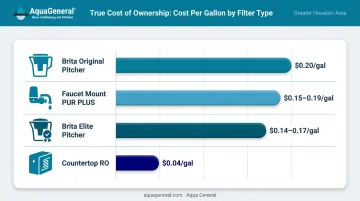
Step 4: Calculate True Cost of Ownership
| Filter Type | Notes |
|---|---|
| Basic pitcher filter | 40 gallons per filter |
| High-capacity pitcher filter | 120 gallons per filter, NSF 53 certified |
| Countertop RO system | Full annual cost varies; filters last 6–24 months |
| Certified faucet mount filter | 100 gallons per filter |
Step 5: Get Professional Guidance Before You Buy
Choosing the right filter for your specific apartment situation is harder than it looks. Filter media compatibility with Houston's chloramine chemistry, faucet type limitations, under-sink options that don't require permanent plumbing modifications, and portable countertop RO systems that can handle whole-household drinking water needs — these are decisions where professional input pays off.
Aqua General offers a free on-site water analysis specifically for apartment renters. Their water treatment specialists will assess what's actually in your tap water, identify which filter types and certifications address your specific contaminants, and recommend professional-grade solutions that work within a rental setup — no permanent modifications required. This is the most reliable way to avoid spending money on filtration that doesn't match your actual water chemistry.
Call (713) 664-4601 or email service@aquageneral.com. Their Free Water Analysis request form includes "Apartment" as an explicit option — renters are directly accommodated.
Conclusion
Apartment renters have strong water filtration options that require no permanent plumbing modifications and no landlord approval — but picking the right one requires matching filter media and certification levels to your actual water chemistry. Whether you need maximum contaminant removal from a countertop RO system, everyday convenience from a certified pitcher, or chloramine protection from a properly specified shower filter, there's a professional-grade solution at every price point.
The most important first step is knowing what's actually in your water. A filter built for chlorine reduction alone won't protect against lead or PFAS. Houston renters deal with specific water quality factors — chloramines, variable hardness, and emerging contaminants — that make generic filter choices risky.
That's where a professional assessment makes a real difference. Aqua General has served the Greater Houston area for over 32 years as a WQA Certified and TCEQ Licensed water treatment specialist. They offer free on-site water analysis for apartment renters — so you know exactly what you're filtering before you buy, and which professional-grade solution fits your space. Call (713) 664-4601 or email service@aquageneral.com.
Frequently Asked Questions
Can you put a water filtration system in an apartment?
Yes. Pitchers, countertop units, gravity-fed dispensers, faucet mounts, and shower filters are all viable for renters — none require permanent plumbing changes. For renters who want a more comprehensive solution, Aqua General can advise on professional portable and countertop options that deliver high-performance filtration without any modification to building plumbing. Call (713) 664-4601 to discuss what's right for your apartment setup.
Which filtration system is best for drinking water?
NSF/ANSI 58-certified reverse osmosis systems offer the most comprehensive contaminant removal. Certified pitchers (NSF 42 + 53) and faucet mounts are effective for chlorine and lead reduction at a lower price point. Your best option depends on which contaminants are present in your water.
What water filters remove Cryptosporidium?
Cryptosporidium oocysts are 4–6 microns in size. Filters certified to NSF/ANSI 53 for cyst reduction, or those with an absolute pore size of 1 micron or smaller, are effective. Basic carbon pitcher filters without cyst certification are not adequate protection.
Do I need my landlord's permission to install a water filter?
Pitchers, countertop units, and gravity-fed dispensers require no landlord involvement and no modifications to the apartment. For faucet mount or shower filter options, or if you want a professional recommendation on the most effective setup for your specific apartment and water quality concerns, contact Aqua General at (713) 664-4601 — they can identify renter-appropriate solutions that avoid any lease complications entirely.
Are pitcher filters good enough for apartment renters?
Pitchers certified to NSF 42 + 53 are effective for chlorine, taste, and lead reduction — sufficient for renters with general water quality concerns. Pitchers certified only to NSF 42 do not address lead, PFAS, or nitrates. Renters with elevated lead, PFAS, or nitrate levels should consider a countertop RO system instead.