The honest answer: there's a significant gap between "legally compliant" and "health-optimal." According to the EWG's tap water database for Houston (PWS ID TX1010013), 51 contaminants have been detected in Houston's water supply — with 14 exceeding independent health-based guidelines, even though none currently violate EPA legal limits.
This guide cuts through the city's standard "we're in compliance" answer. You'll find what's actually in Houston's tap water, what those levels mean for long-term health, who faces the greatest risk, and what filtration options Houston homeowners can realistically use.
Key Takeaways
- Houston tap water is legally compliant but has 14 contaminants above EWG health guidelines, including chromium-6, PFAS, arsenic, disinfection byproducts, and lead
- Houston water averages 110 ppm hardness, which is hard enough to damage appliances, dry out skin, and leave mineral scale throughout your home
- Vulnerable populations (children, pregnant women, elderly) face elevated risk from long-term contaminant exposure
- Pairing a reverse osmosis system at the kitchen tap with a whole-house water conditioner offers the most comprehensive protection for Houston homes
Is Houston Tap Water Safe to Drink in 2026?
The short answer depends entirely on how you define "safe."
The Legal vs. Health-Optimal Gap
Houston's water meets all EPA Maximum Contaminant Levels (MCLs) and Texas Commission on Environmental Quality (TCEQ) standards — meaning it won't cause acute illness for most healthy adults. This compliance is real and meaningful. But MCLs are enforceable legal thresholds, not health guarantees. The EPA also sets non-enforceable health goals (MCLGs), and independent organizations like the EWG apply their own stricter science-based benchmarks.
The EWG's analysis of Houston's water (data years 2013–2024) found:
- 51 total contaminants detected
- 14 contaminants above EWG health guidelines
- 0 contaminants above legal limits
Houston's water clears every legal bar. The open question is whether clearing legal bars equals safe for long-term daily consumption — and on that, the EWG data suggests reason for a closer look.
The Bottom Line for Houston Residents
For most healthy adults, Houston tap water is safe to drink and won't cause immediate harm. For families with young children, pregnant women, or anyone drinking unfiltered tap water daily over many years, health experts widely recommend an additional filtration layer. The concern isn't legal violation — it's cumulative exposure to contaminants that sit below enforceable limits but above the thresholds health researchers consider optimal.
Where Does Houston's Water Come From?
Houston draws from two source types, with a heavy lean toward surface water:
- 86.5% surface water — primarily Lake Livingston (via the Trinity River), Lake Conroe, and Lake Houston (via the San Jacinto River)
- 13.5% groundwater — from 104 wells in the Evangeline and Chicot aquifers
The San Jacinto River comes with a relevant history. The San Jacinto River Waste Pits, constructed in the 1960s to dispose of pulp and paper mill waste containing dioxins and furans, became an EPA Superfund site in 2008. In 2026, the EPA ordered remediation of the northern impoundments, with costs estimated above $262 million.
Current research has not confirmed contamination at Houston's municipal intake or treated water supply. Even so, the proximity of industrial pollution to a primary source is worth keeping in mind.
Treatment Process and Its Limits
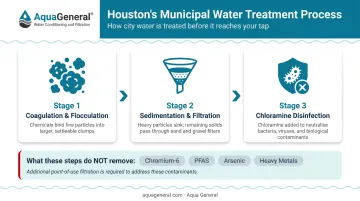
Houston Water Operations runs incoming water through a multi-step treatment process before it reaches your tap:
- Coagulation and flocculation — clump suspended particles together for easier removal
- Sedimentation and filtration — physically remove those clumped solids
- Chloramine disinfection — kill bacteria and pathogens
These steps handle sediment and biological contamination effectively. What they don't fully eliminate: dissolved contaminants like chromium-6, PFAS, arsenic, and heavy metals.
Chloramine disinfection also creates a new problem : disinfection byproducts (DBPs) form when the disinfectant reacts with natural organic matter in the surface water.
Beyond treatment limitations, water quality varies depending on where you live. Homes with pre-1986 plumbing carry a higher lead risk due to older pipes and fixtures. Contaminants like chromium-6 and PFAS, by contrast, are city-wide concerns that affect all areas drawing from the main surface water supply.
Key Contaminants Found in Houston Tap Water
Houston's 2024 Consumer Confidence Report and EWG data both confirm several contaminants worth understanding in detail.
Contaminant Summary Table
| Contaminant | Houston Detected Level | EPA Legal Limit (MCL) | EWG Health Guideline |
|---|---|---|---|
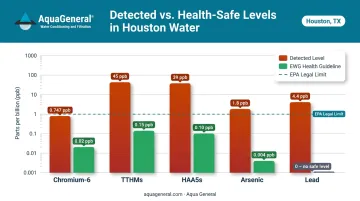
| Chromium-6 | 0.747 ppb (747 ppt) | No standalone MCL (total chromium: 100 ppb) | 0.02 ppb |
| TTHMs | 30.4 ppb (highest LRAA: 45 ppb) | 80 ppb | 0.15 ppb |
| HAA5 | 21.2 ppb (highest LRAA: 39 ppb) | 60 ppb | 0.10 ppb |
| Arsenic | 2.06 ppb (avg 1.8 ppb; range ND–9.9 ppb) | 10 ppb | 0.004 ppb |
| Lead | 90th percentile: 4.4 ppb | Action level: 15 ppb | No safe level (children) |
| PFAS | Multiple compounds detected at ppt levels | 4–10 ppt (2024 rule; compliance by 2029) | As low as possible |
Sources: Houston 2024 Water Quality Report; EWG Tap Water Database TX1010013
Chromium-6
Chromium-6 (hexavalent chromium) is a known carcinogen — the "Erin Brockovich chemical" — with no current federal MCL as a standalone contaminant. Houston's detected level is 0.747 ppb (747 ppt), compared to the independent health benchmark of 0.02 ppb established by California's OEHHA at the one-in-one-million lifetime cancer risk level. That's roughly 37 times the health-based guideline.
The risk is cumulative, building over years of exposure — not from a single glass. EPA finalized its IRIS toxicological review of chromium-6 in 2024 and is now evaluating whether to establish a separate federal standard, which would make it one of several emerging contaminants moving toward stricter regulation.
PFAS ("Forever Chemicals")
PFAS have been detected in Houston's water system, with compounds including 6:2 FTSA (1.69 ppt), PFBA (0.685 ppt), and PFHxA (0.632 ppt) identified in EWG data. In 2024, the EPA finalized enforceable limits of 4 ppt for PFOA and PFOS and 10 ppt for several other compounds. Texas public water systems must complete initial monitoring by April 2027 and comply fully by April 2029.
49 Texas water utilities reported PFAS levels above EPA's new limits as of April 2024. Whether Houston's main system (TX1010013) exceeds those specific thresholds is still being monitored under UCMR5.
Disinfection Byproducts (TTHMs & HAA5)
This is where Houston residents notice the most obvious sign of a water quality issue: that faint chlorine smell or taste from the tap.
TTHMs and HAA5 form when chloramine disinfectants react with natural organic matter in Houston's surface water. Houston's 2024 CCR shows:
- TTHM highest LRAA: 45 ppb (MCL: 80 ppb)
- HAA5 highest LRAA: 39 ppb (MCL: 60 ppb)
Both are within legal limits. But long-term THM exposure has been consistently associated with increased bladder cancer risk in epidemiological studies. EWG's health guideline of 0.15 ppb for TTHMs reflects just how wide the gap between legal limits and health-protective levels actually is.
Arsenic and Lead
Arsenic occurs naturally in Houston's source water. The 2024 CCR reports an average of 1.8 ppb (range: ND–9.9 ppb) against an EPA MCL of 10 ppb. Health-protective organizations recommend levels below 0.004 ppb — meaning even Houston's average level is roughly 450 times higher than what independent science considers safe over a lifetime.
Lead enters tap water after it leaves the treatment plant — picked up from older service lines and home plumbing, not from the source water itself. The 2024 CCR puts the 90th percentile at 4.4 ppb (action level: 15 ppb), with 9 monitored sites above the action level.
Homes built before 1986 carry the highest risk. The CDC is unequivocal: there is no safe level of lead for children.
Houston's Hard Water Problem
Houston water averages 110 ppm hardness (range: 43.4–137 ppm as CaCO3), placing it in the moderately hard to hard category. Hardness isn't a direct health hazard — but it creates real, costly problems throughout the home.
Practical effects of Houston's hard water:
- White scale deposits on faucets, shower glass, and dishes
- Faster wear on water heaters, dishwashers, and washing machines
- Reduced soap and shampoo lather, requiring more product
- Dry, itchy skin and dull, brittle hair
Scale buildup forces appliances to work harder, driving up energy bills and shortening equipment lifespan. For Houston homeowners, a water softener is a practical investment in protecting expensive appliances.

Aqua General's AquaGuard® Whole-House Anti-Microbial Water Conditioner uses true ion exchange softening to physically remove calcium and magnesium from the water — unlike salt-free "scale prevention" systems, which leave hardness levels unchanged.
Who Is Most at Risk from Houston Tap Water Contaminants?
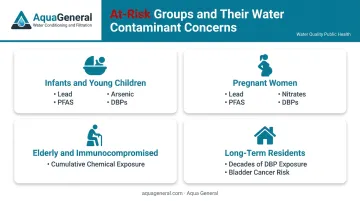
EPA safety standards are designed to protect average healthy adults. Several groups fall outside that baseline:
| Group | Primary Contaminant Concerns |
|---|---|
| Infants and young children | Lead (neurological development), PFAS, arsenic, DBPs |
| Pregnant women | Lead (crosses placenta), PFAS (linked to preeclampsia, low birth weight), nitrates, DBPs |
| Elderly and immunocompromised | Reduced tolerance to cumulative chemical exposure |
| Long-term Houston residents | Decades of DBP exposure and associated bladder cancer risk |
For baby formula preparation, pediatric health organizations strongly recommend using filtered or certified bottled water. The CDC notes that infants consuming formula made with lead-contaminated water face far higher exposure relative to body weight.
If you fall into any of these groups, water testing and certified filtration are a reasonable precaution — Houston's own annual water quality reports confirm the presence of lead, PFAS, and elevated DBPs that pose greater risks to vulnerable populations.
How to Improve Houston Tap Water Quality
Municipal treatment handles the bulk of contamination, but what reaches your tap depends on your home's pipes, your neighborhood's infrastructure, and how you filter at the point of use. Here's how to take control of that last stretch.
Test Your Water First
City-wide averages don't capture what's happening inside your specific home's pipes. Two main testing approaches:
- At-home test kits — useful for hardness, pH, chlorine, and basic metals. Good for a quick snapshot.
- Certified lab testing — necessary for accurate PFAS, chromium-6, arsenic, and lead readings. TCEQ maintains a list of NELAP-accredited laboratories in Texas.
Homeowners in older homes or those with young children should prioritize lab-grade testing before selecting a system. Aqua General also offers free on-site water testing as a starting point for assessing home-specific conditions across their service area in Harris, Fort Bend, Montgomery, Galveston, and surrounding counties.
Reverse Osmosis Systems
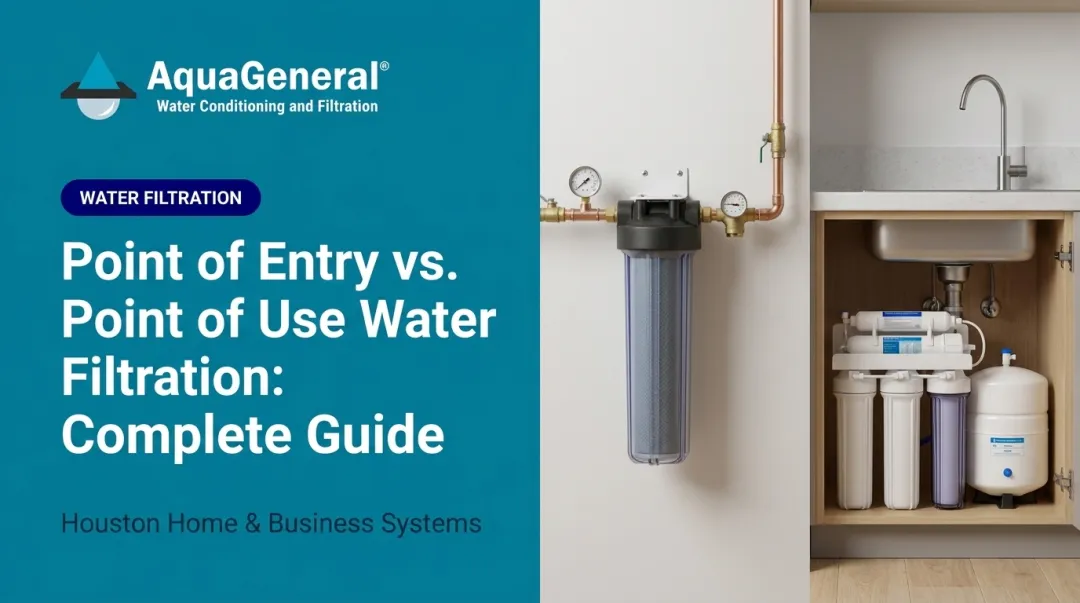
Reverse osmosis is the most effective point-of-use option for Houston drinking water. An RO system installed under the kitchen sink reduces:
- Chromium-6
- Arsenic
- Lead
- PFAS
- Nitrates
- Disinfection byproducts
Look for systems carrying NSF/ANSI 58 certification for the specific contaminants you need addressed. According to EPA, properly maintained GAC, ion exchange, and RO point-of-use systems can substantially reduce PFAS levels.
If you want treated water beyond one tap — at every shower, appliance, and fixture — a whole-house system is the next step up.
Whole House Water Conditioners
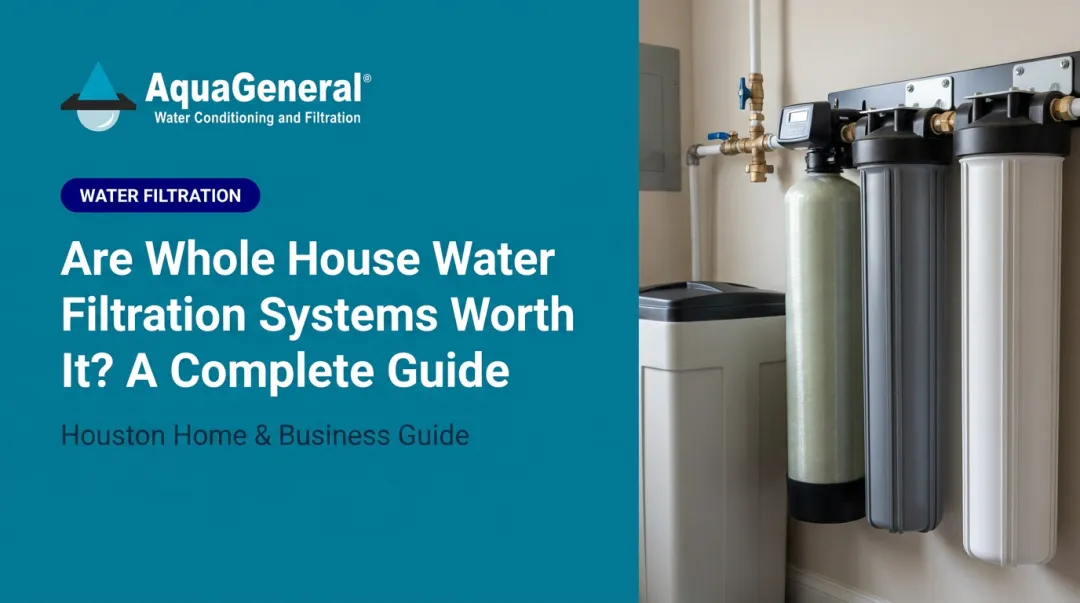
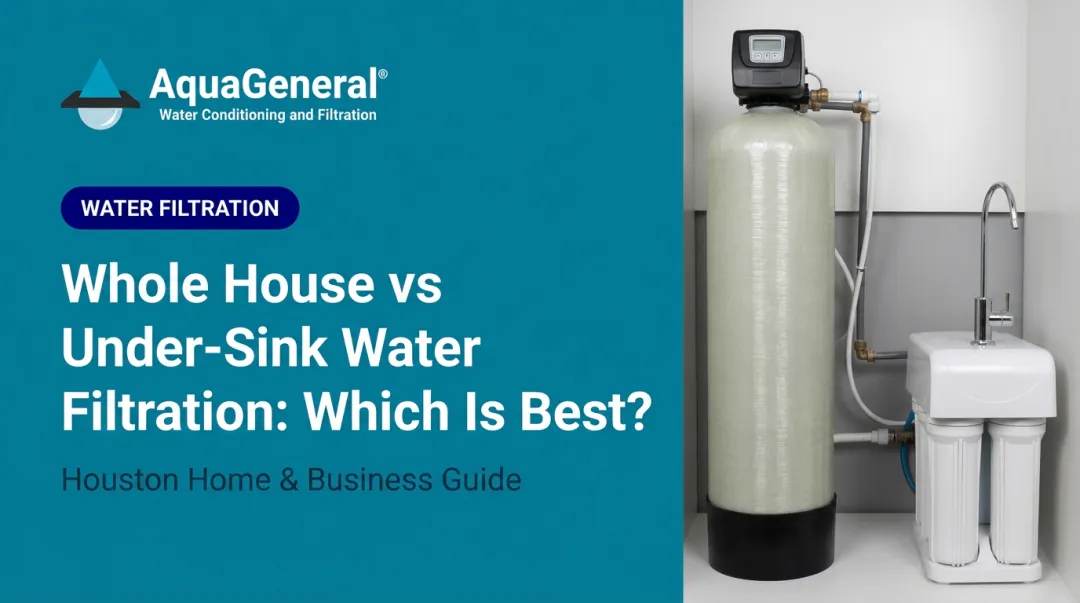
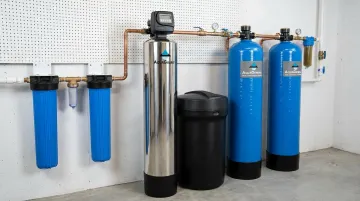
For treated water at every tap in the home, a whole-house system makes sense. Aqua General's AquaGuard® system integrates five treatment stages into a single unit:
- Ion exchange softening to remove calcium and magnesium
- Silver-impregnated anti-microbial media to inhibit bacteria growth within the system itself
- Filtrex® activated carbon for chlorine, DBPs, and organic chemical reduction
- Fine particle filtration down to 0.02–5 microns (smaller than a red blood cell)
- Contaminant reduction for lead, arsenic, hexavalent chromium, and alpha particle radioactivity
Frequently Asked Questions
Is Houston tap water safe to drink?
Houston tap water meets all current EPA and TCEQ legal standards and won't cause acute illness for most healthy adults. However, independent health analyses flag 14 contaminants above stricter health-based guidelines, making filtration a widely recommended step for long-term daily consumption — particularly for families with children.
What contaminants are found in Houston tap water?
The primary contaminants of concern are chromium-6, PFAS ("forever chemicals"), arsenic, disinfection byproducts (TTHMs and HAA5), and lead — especially in older homes. Most detected levels fall within legal limits but exceed independent health benchmarks in several cases.
Does Houston have hard water?
Yes — Houston water averages 110 ppm (range: 43.4–137 ppm), putting it in the moderately hard to hard range. Naturally occurring calcium and magnesium cause scale buildup and appliance wear throughout the home, and can leave skin and hair feeling dry after bathing.
Is Houston tap water safe for babies and pregnant women?
Legally compliant, but health experts recommend filtered water for both groups. The no-safe-level consensus around lead, the presence of PFAS, and known developmental risks from disinfection byproducts all point toward using certified filtration — particularly for formula preparation.
How can I test my Houston tap water at home?
You have three options: at-home kits for basic parameters (hardness, chlorine, pH); certified lab testing through a TCEQ NELAP-accredited lab for a full contaminant panel; or a free on-site water consultation with a licensed specialist. Aqua General offers complimentary on-site testing to assess your home's specific conditions across the Greater Houston area.
What is the best water filtration system for Houston tap water?
Most Houston homes benefit from a two-part approach: a whole house water conditioner (such as Aqua General's AquaGuard®) handles hardness and broad contaminants at every tap, while a reverse osmosis system at the kitchen sink covers drinking and cooking water. Look for WQA and NSF certification on all components for the contaminants you're targeting.