That knowledge gap matters. Homeowners evaluating water quality options frequently encounter ozone treatment as a term without understanding how it actually works, which makes it difficult to assess whether it's the right fit for their home. This guide explains what ozone water treatment is, how the process works, what it removes, and where it's used — so you can make a more informed decision.
Key Takeaways
- Ozone (O3) destroys bacteria, viruses, organic compounds, and dissolved metals through oxidation — without leaving chemical residues
- Ozone is generated, injected into water, reacts with contaminants, and breaks down into oxygen — no byproducts remain
- Ozone outperforms chlorine against tough pathogens like Cryptosporidium, which resists standard chlorination
- It leaves no lasting disinfectant in pipes, so it's typically paired with other treatment methods
- Applications range from municipal water systems to residential filtration and commercial food processing
What Is Ozone Water Treatment?
Ozone water treatment is a purification method that dissolves ozone gas (O3) into water to destroy contaminants through oxidation. It eliminates pathogens, organic pollutants, and unwanted compounds without introducing chemicals that leave residues or byproducts behind.
Before going further, it helps to clarify what ozone treatment doesn't do:
- It is not a water softener — it doesn't remove hardness minerals like calcium and magnesium
- It is not the same as ozone air purifiers, which operate on a completely different principle
- It does not filter sediment or dissolved solids on its own
What keeps ozone relevant after more than a century of use is a single chemical property: it decomposes naturally back into oxygen, leaving nothing behind in treated water. That decomposition typically happens within 20–30 minutes, which means no chemical residue accumulates in the water supply.
How Ozone Is Generated
Three generation methods exist, each suited to different scales of application:
| Method | How It Works | Typical Use |
|---|---|---|
| Corona discharge | High-voltage electrical discharge splits O2 molecules | Municipal and large-scale systems |
| UV light | UV irradiation converts oxygen to ozone | Lower concentration applications |
| Electrolytic | Electrochemical oxidation of water produces ozone | Smaller or specialized systems |
The generation method affects ozone concentration and system scale, but the treatment principle is identical across all three.
How Does Ozone Water Treatment Work?
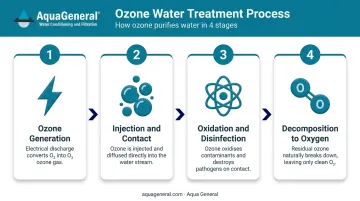
Ozone treatment follows a defined four-stage sequence: generation, injection, reaction, and decomposition. Each stage plays a distinct role.
Stage 1: Ozone Generation
An ozone generator exposes oxygen molecules (O2) to an energy source — typically electrical discharge or UV light — which splits the molecules. Individual oxygen atoms then recombine into ozone (O3).
One critical constraint: ozone cannot be stored or transported. It degrades within minutes of generation, which is why every ozone treatment system includes an integrated on-site generator. That's a fundamental requirement of the chemistry, not a design limitation.
Stage 2: Injection and Contact
Once generated, ozone is introduced into water through one of several methods:
- Fine-bubble diffusion: porous diffusers release tiny ozone bubbles
- Venturi injection: negative pressure draws ozone into the water stream
- Turbine-agitated contactors: mechanical mixing maximizes ozone-water contact
The injection method affects how efficiently ozone dissolves and contacts contaminants. Finer bubbles mean more surface area and faster dissolution.
Stage 3: Oxidation and Disinfection
This is where the actual treatment happens. Dissolved ozone reacts rapidly and directly with contaminants through two mechanisms:
- Direct oxidation — ozone molecules attack the outer membranes of bacteria and viruses, causing cell rupture (lysis)
- Hydroxyl radical formation — as ozone decomposes in water, it generates hydroxyl radicals that further break down contaminants at the molecular level
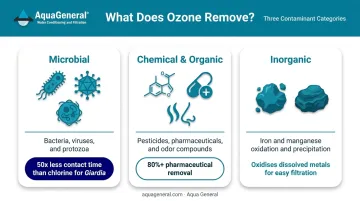
This two-pronged attack is why ozone outperforms chlorine against many pathogens. EPA data illustrates the difference clearly: achieving 3-log Giardia inactivation at 10°C requires a CT (concentration × time) of just 1.43 mg-min/L with ozone, compared to 73 mg-min/L with free chlorine under equivalent conditions — roughly 50 times less contact time needed.
Stage 4: Decomposition
After ozone reacts with contaminants, unused ozone molecules break down into ordinary oxygen (O2). In clean water near room temperature, dissolved ozone has a half-life of roughly 28 minutes — though pH, temperature, and dissolved constituents can shift that range considerably.
The outcome: no ozone residual, no chemical trace left behind. For drinking water, the most noticeable differences are improved clarity, better taste, and the absence of chlorine-like odor.
What Does Ozone Water Treatment Remove?
Ozone's high oxidative potential makes it effective against a wide range of contaminants. That's why it's used in both municipal systems and private water treatment.
Microbial Contaminants
Ozone inactivates a broad spectrum of pathogens:
- Bacteria — including E. coli and Salmonella (EPA reports 99% inactivation of Salmonella typhi at very low ozone doses)
- Viruses — including hepatitis A and norovirus surrogates; 4-log viral inactivation requires only 1.0 mg-min/L CT with ozone
- Protozoa — including Giardia and Cryptosporidium
The Cryptosporidium point deserves emphasis. EPA's assessment describes Cryptosporidium oocysts as highly resistant to standard chlorination — ordinary chlorine doses provide essentially no inactivation credit. Ozone is identified as the best chemical disinfectant evaluated for Cryptosporidium, making it the treatment of choice when this pathogen is a concern.
Chemical and Organic Contaminants
Ozone oxidizes and breaks down:
- Pesticides and industrial pollutants (though performance varies by compound)
- Pharmaceuticals and endocrine-disrupting compounds — research shows greater than 80% removal at an ozone CT of approximately 2 mg-min/L
- Taste- and odor-causing compounds like geosmin, with studies showing more than 50% oxidation of most taste-and-odor compounds under typical drinking water conditions
- Precursors to chlorination disinfection byproducts (THMs and HAAs)
One limitation worth noting: in water containing bromide, ozone can produce bromate, a regulated disinfection byproduct with an EPA maximum contaminant level of 0.010 mg/L.
Inorganic and Physical Contaminants
Ozone handles inorganic contaminants through oxidation:
- Converts dissolved iron and manganese into particles captured by downstream filtration
- Coagulates suspended particles, improving overall water clarity
Because ozone transforms metals rather than removing them directly, it's almost always paired with a filtration stage. The ozone creates the particles; the filter removes them.
Benefits and Limitations of Ozone Water Treatment
Benefits
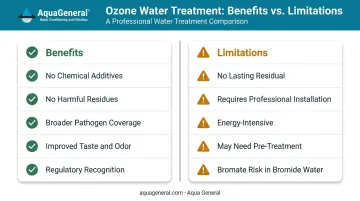
- No chemical additives — nothing is introduced into the water that doesn't belong there
- No harmful residues — ozone reverts to oxygen; the treated water carries no chemical trace
- Broader pathogen coverage than chlorine, particularly against Cryptosporidium
- Improved taste and odor — the absence of chlorine smell is the most noticeable difference for drinking water
- Regulatory recognition — FDA affirms ozone as GRAS for bottled water (21 CFR 184.1563) and as an approved antimicrobial in food processing (21 CFR 173.368, 2001)
Limitations
- No lasting residual — ozone doesn't continue protecting water after it leaves the treatment point. Municipal systems using ozone typically add chlorine or chloramine as a secondary disinfectant for this reason
- Requires professional installation and sizing — ozone systems are not DIY equipment
- Energy-intensive generation — producing ozone requires dedicated electrical input
- Pre-treatment may be needed — in turbid or high-iron water, sediment filtration or other pre-treatment is often necessary before ozone can work effectively
- Bromate risk in bromide-containing water — requires monitoring and system design attention
This is why water treatment professionals, including the team at Aqua General with over 32 years serving the Greater Houston area, don't recommend ozone as a standalone solution. It works best as one layer in a multi-barrier approach — paired with carbon filtration, UV, reverse osmosis, or softening based on what the water test reveals.
Where Ozone Water Treatment Is Used
Municipal Water Systems
Ozone has been used in large-scale public water treatment since the early 20th century. A 2015 Journal AWWA database documented original ozone installations at 293 U.S. water treatment plants, with an additional 84 projects recorded — and those numbers reflect a point-in-time snapshot, not a current census. An AWWA 2017 disinfection survey found that among ozone-using systems, 85% cited taste-and-odor control as a primary motivation.
Commercial and Industrial Applications
Ozone is widely used across several industries:
- Food and beverage processing: FDA-authorized for produce washing and equipment sanitization (66 FR 33829)
- Bottled water production: FDA notes bottled water producers commonly use ozone instead of chlorine because chlorine affects taste
- Aquaculture: maintains water quality in fish production operations
- Dental waterlines: peer-reviewed studies document ozone activity against biofilms in dental unit water systems
Residential Use
Residential ozone systems are a practical option for chemical-free disinfection and for targeting specific contaminants like iron, sulfur, and bacteria — particularly in well water. Houston-area homeowners dealing with taste, odor, or disinfection byproducts from municipal chlorination can benefit from a water evaluation with a WQA-certified specialist like Aqua General to determine whether an ozone system, or a combination of treatment technologies, best fits their home's water conditions.
Conclusion
Ozone water treatment works because of a straightforward chemical reality: ozone's instability makes it a highly reactive oxidizer that destroys contaminants on contact, then reverts harmlessly to oxygen. That property — powerful disinfection without chemical residue — has kept this technology in active use for over a century.
Knowing what ozone does and doesn't do helps you evaluate it honestly. Paired with the right complementary technologies, it ranks among the most effective disinfection tools available.
Houston-area homeowners and businesses can reach Aqua General's team of TCEQ-licensed, WQA-certified specialists for a free water evaluation and guidance on whether ozone treatment fits their water quality needs.
Frequently Asked Questions
What is ozone water?
Ozone water (or ozonated water) is water infused with dissolved ozone gas (O3), which acts as a powerful disinfectant and oxidizer. Once ozone completes its reaction with contaminants, it breaks back down into oxygen, leaving no chemical residue in the treated water.
Is ozone water good for you?
Ozone-treated drinking water is FDA-recognized as safe and carries none of the chemical residues associated with chlorine treatment. Direct health benefit claims from drinking ozonated water lack strong evidence, but at proper treatment concentrations, safety is thoroughly documented.
Can you buy ozone water?
Some bottled water products use ozone during production, but since ozone dissipates quickly, the water is essentially purified water by the time it reaches the consumer. Ozone dissipates too quickly to bottle or store, so ongoing treatment requires an on-site generation system.
How long does ozone last in water?
Dissolved ozone has a half-life of roughly 28 minutes in clean water near room temperature. That window shifts considerably based on pH, temperature, and water chemistry — anywhere from under a minute to over an hour — which is why ozone must be generated and applied on-site.
Is ozone water treatment safe for drinking water?
Yes. Ozone treatment is used in municipal drinking water systems worldwide and is recognized as safe by EPA and FDA regulatory frameworks. When properly designed and operated, it leaves no harmful chemical residues in the finished water.
How is ozone water treatment different from chlorine treatment?
Ozone is faster-acting and effective against a broader pathogen range — including Cryptosporidium, which resists standard chlorination — and produces no chlorinated disinfection byproducts. Unlike chlorine, however, it provides no lasting residual in distribution pipes, which is why the two are sometimes used together in municipal systems.