Introduction
Reports of PFAS contamination in tap water have become harder to ignore. The EPA has identified thousands of PFAS chemicals — synthetic "forever chemicals" — in water supplies across the country, including communities near industrial corridors like Greater Houston's petrochemical belt. Add chlorination byproducts and industrial VOCs to that picture, and Houston-area homeowners are dealing with a more complex contamination profile than most municipal treatment systems are designed to handle.
Carbon block filters are among the most practical solutions available to homeowners. But not all carbon filters perform equally, and the marketing language around PFAS removal is often vague enough to leave homeowners with systems that don't actually address their water's specific contaminants.
This guide covers exactly how carbon block filters work, what they can and cannot remove, how they compare to granular activated carbon (GAC), and which certifications actually verify PFAS and VOC reduction claims. By the end, you'll have a concrete framework for choosing the right filtration approach for your home.
Key Takeaways
- Carbon block filters use a dense, compressed structure that eliminates channeling and forces water through fine pores, maximizing adsorption of PFAS and VOCs
- Carbon block generally outperforms GAC for PFAS removal due to superior contact time and 2–4x greater adsorption capacity in the same footprint
- NSF/ANSI Standard 53 certification with a specific PFAS reduction claim is the only verified credential — NSF 42 (taste/odor) does not cover PFAS
- Carbon block has real limits: short-chain PFAS, heavy metals, nitrates, and pathogens require additional treatment stages
- An overloaded carbon block filter stops removing contaminants; replacing it on schedule is essential
What Is a Carbon Block Filter and How Does It Work?
Construction and Mechanism
A carbon block filter starts with finely powdered activated carbon — typically particles in the 0.5–1 micron range — combined with a binding agent and compressed into a solid, uniform cartridge. This construction is distinct from loose-media GAC filters, where carbon granules sit in a housing with space between them.
As water is forced through the block, organic contaminants like PFAS compounds and VOCs adhere to the carbon's internal surface area through a process called adsorption (meaning the molecules bind to the surface rather than passing through). According to the WQA's GAC fact sheet, activated carbon contains more than 1,000 m²/g of internal surface area — equivalent to over 35 acres per pound. That surface area is what makes carbon such a capable contaminant trap.
That pore structure also determines how fine the filtration gets — which is where micron rating becomes critical.
Micron Rating and Filtration Fineness
Carbon block filters are rated by pore size, and the rating directly affects which contaminants they capture:
- 0.5 micron — the WQA-supported standard for high-performance carbon block; effective for cyst removal alongside chemical reduction
- 1–5 micron — common in sediment pre-filter stages or lower-pressure applications
- Finer filtration (down to 0.02 microns) — achieved through multi-stage systems that combine carbon block with additional physical filtration media
Aqua General's AquaGuard® CBC Undersink Carbon Block Filter operates at 0.5 micron, which places it in the fine-filtration tier appropriate for cyst reduction and organic chemical removal, including disinfection byproducts and chlorine.
Carbon Source: Why Coconut Shell Matters
Coconut shell activated carbon is the preferred source material for carbon block filters. Compared to coal-based alternatives, coconut shell carbon provides roughly 50% more micropores, making it more effective for VOCs, trihalomethanes (THMs), and chlorine byproducts. That's a meaningful advantage for municipal water users in areas like Greater Houston, where disinfection byproducts and chlorine levels are common concerns.
Carbon Block vs. Granular Activated Carbon: Key Differences
The Channeling Problem in GAC
GAC filters use loosely packed millimeter-sized carbon granules. Water flowing through finds the path of least resistance, which in loosely packed media means cutting preferential channels through the bed and bypassing large portions of the carbon entirely. The WQA confirms this directly: large GAC filters are prone to channeling, which means contaminants can pass through untreated even when the filter still has capacity remaining.
Carbon block eliminates this problem. Its compressed, uniform matrix forces all water through the same tortuous path — with no preferential routing around the media.
Side-by-Side Comparison
| Feature | Carbon Block | Granular Activated Carbon |
|---|---|---|
| Pore size / filtration fineness | 0.5–1 micron (typical) | Millimeter-scale granules |
| Channeling risk | None — fixed solid matrix | Present in larger systems |
| Adsorption capacity | 2–4x greater per volume (WQA) | Baseline reference |
| Flow rate | Slower; higher pressure drop | Faster; lower pressure drop |
| PFAS/VOC removal | Preferred for fine contaminants | Effective but less reliable |
| Cost and regeneration | Higher cost; cartridge replacement | Lower cost; can regenerate |
| Best application | Point-of-use, under-sink | Whole-house point-of-entry |
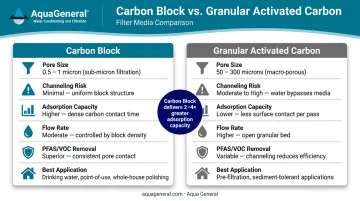
GAC does have legitimate advantages. It's less expensive, easier to regenerate at scale, and practical for whole-house entry-point systems where flow rate matters. Many well-designed systems combine GAC pre-filtration with a carbon block polishing stage: this delivers both throughput and fine contaminant removal in a single setup.
PFAS Removal: How Effective Are Carbon Block Filters?
What PFAS Are (and Why They're Persistent)
PFAS (per- and polyfluoroalkyl substances) are a family of synthetic chemicals manufactured since the 1940s, used in nonstick coatings, stain-resistant fabrics, food packaging, and firefighting foam. The USGS estimates there are more than 12,000 types of PFAS, not all detectable with current testing methods.
Their defining characteristic is the carbon-fluorine bond — one of the strongest in organic chemistry. This makes PFAS resistant to environmental breakdown and capable of accumulating in water supplies and human tissue over time.
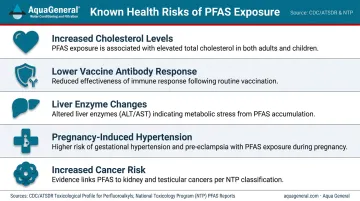
The health picture is concerning. The CDC/ATSDR associates PFAS exposure with:
- Increased cholesterol levels
- Lower antibody response to vaccines
- Liver enzyme changes
- Pregnancy-induced hypertension
- Increased risk of kidney and testicular cancer
The National Toxicology Program concludes that PFOA and PFOS are presumed immune hazards to humans.
Long-Chain vs. Short-Chain: An Important Distinction
Carbon block filters are not equally effective across all PFAS variants:
| PFAS Type | Carbon Block Performance | Examples |
|---|---|---|
| Long-chain | Well-adsorbed | PFOA, PFOS, larger hydrophobic compounds |
| Short-chain | Poorly adsorbed | PFBS, GenX, smaller water-soluble variants |
For long-chain PFAS, a high-quality certified carbon block filter is a legitimate and practical solution. For comprehensive coverage including short-chain variants, pairing carbon block with ion exchange resin or reverse osmosis is recommended. The EPA identifies activated carbon adsorption, ion exchange resins, and high-pressure membranes (RO/nanofiltration) as the three recognized PFAS treatment technologies.
The Certification Requirement
Whatever combination of technologies you choose, the filter itself must carry NSF/ANSI Standard 53 certification with a specific PFAS reduction claim to be considered verified. NSF requires certified filters to reduce PFAS below 20 ppt (parts per trillion). A filter with only NSF 42 certification — which covers taste and odor — makes no verified claim about PFAS removal at all.
Verify any filter at the NSF certified drinking water treatment unit database before purchasing.
VOC Removal with Carbon Block Filters
What VOCs Are and How They Enter Tap Water
VOCs (volatile organic compounds) in drinking water include:
- Industrial solvents — trichloroethylene (TCE), tetrachloroethylene (PCE)
- Petroleum-related compounds — benzene, toluene, xylenes
- Disinfection byproducts — trihalomethanes (THMs) including chloroform, haloacetic acids
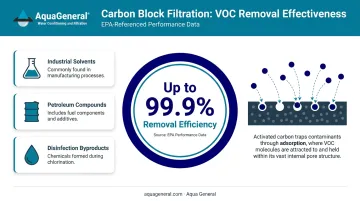
They enter water supplies through industrial spills and runoff, contaminated groundwater, and as a direct consequence of chlorinating municipal water. According to USGS research, chloroform was the most frequently detected VOC found in samples from drinking-water supply wells.
Why Carbon Block Excels at VOC Removal
Adsorption is the right mechanism for VOCs. Their organic molecular structure makes them highly attracted to carbon surfaces, and the EPA confirms that activated carbon treatment achieves removal efficiencies up to 99.9% for many VOCs including TCE and PCE. Carbon block's fine pore structure and elimination of channeling make it particularly well-suited compared to loose GAC for these contaminants.
When shopping for a filter, look beyond generic "carbon filter" claims. NSF-certified carbon block filters carry specific certification categories to look for:
- VOC Reduction — validates removal of solvents and petroleum compounds
- TTHM Reduction — confirms trihalomethane reduction from chlorinated water
- NSF/ANSI Standard 42 or 53 — the applicable standards for chemical reduction claims
The Houston Relevance
Houston's water quality picture makes VOC filtration more than a theoretical concern. A 2025 peer-reviewed study confirmed the Houston Ship Channel area as a petrochemical hub with elevated VOC profiles near industrial corridors. Houston's municipal water system also uses chloramines as a disinfectant — verified in the city's 2024 Water Quality Report — which means disinfection byproducts are a genuine ongoing concern for area households.
For homes in Harris, Brazoria, Fort Bend, Galveston, and surrounding counties, a certified carbon block filter is a first-line defense against chlorination byproducts and chemically similar organic contaminants.
What Carbon Block Does NOT Remove
Carbon block does have limits. Standard filtration does not reliably address:
- Fluoride
- Nitrates
- Dissolved heavy metals (lead, arsenic, hexavalent chromium) in significant concentrations
- Bacteria and viruses
- Short-chain PFAS variants
A professional water test before selecting any filtration system is the logical starting point — it tells you exactly what you're dealing with.
NSF Certifications to Look for in a Carbon Block Filter
NSF/ANSI Standard 53 vs. NSF 42
| Standard | What It Covers | PFAS Claims? |
|---|---|---|
| NSF/ANSI 53 | Health-effect contaminants, including PFOA/PFOS | ✅ Yes — with specific claim listed |
| NSF/ANSI 42 | Aesthetic impurities (chlorine, taste, odor) | ❌ No |
| NSF/ANSI 58 | Reverse osmosis systems | ✅ Yes — for RO units |
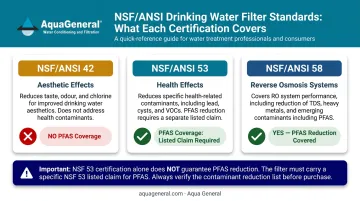
A filter must list the specific contaminant claim — "PFOA/PFOS Reduction" — on its NSF product listing. The certification standard number alone is not sufficient.
What Happened to NSF P473?
NSF P473 was an earlier protocol specifically written for PFOA and PFOS reduction. It has since been retired and replaced by NSF/ANSI Standard 53 and 58. If you see P473 on an older product label, it's functionally equivalent to the current standard, but verify the product appears in the current NSF database rather than relying on old packaging.
How to Verify
- Search the NSF certified drinking water treatment unit database directly
- The WQA Gold Seal Program also certifies products to NSF/ANSI standards — an equivalent third-party validation when the listing shows the same standard and reduction claim
For Houston-area homeowners using that verification process, Aqua General's systems appear in the WQA certification database with documented standard and reduction claims — the same third-party validation described above.
When Carbon Block Alone Isn't Enough
Carbon block is genuinely effective for long-chain PFAS and most VOCs. It's not a complete water treatment solution on its own.
Contaminants requiring additional treatment:
- Short-chain PFAS (PFBS, GenX) → ion exchange resin or reverse osmosis
- Lead, arsenic, hexavalent chromium → RO or certified specialty media
- Nitrates → RO or ion exchange
- Bacteria and viruses → UV purification or certified disinfection stage
- Sediment and turbidity → pre-filtration media stage
Multi-Stage Approaches
The most comprehensive residential systems layer multiple treatment technologies:
- Sediment pre-filtration — removes particles that would blind downstream media
- Carbon block stage — adsorbs VOCs, long-chain PFAS, chlorine, THMs
- Reverse osmosis membrane — blocks short-chain PFAS and a broader contaminant range
- Post-filtration polishing — final quality pass before the tap
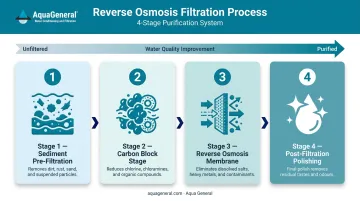
For whole-house protection, systems that combine softening, anti-microbial media, chemical reduction, and fine particle filtration address contaminants at the point of entry — before water reaches every tap, appliance, and shower in the home.
Houston municipal water uses chloramines rather than chlorine as its primary disinfectant — and standard activated carbon struggles with chloramine breakdown. Aqua General's AquaGuard® 9-Stage Reverse Osmosis system addresses this directly, with a dedicated catalytic carbon stage engineered for chloramine removal. Catalytic carbon is measurably more effective at this than conventional activated carbon.
Start With a Water Test
Choosing a filter without knowing what's in your water is guesswork. A water test identifies which contaminants are present and at what concentrations — the only reliable basis for selecting the right filter configuration. Aqua General offers free on-site water testing across their service area covering Harris, Fort Bend, Brazoria, Galveston, Montgomery, and surrounding counties.
Frequently Asked Questions
Does a carbon block filter remove PFAS?
Certified carbon block filters effectively adsorb long-chain PFAS compounds like PFOA and PFOS, but the filter must carry NSF/ANSI Standard 53 certification with a specific PFAS reduction claim to be verified. Short-chain PFAS variants (PFBS, GenX) are less effectively captured and may require reverse osmosis or ion exchange as additional treatment.
What filter system removes PFAS most completely?
Multi-stage systems combining certified carbon block with reverse osmosis or ion exchange provide the most comprehensive PFAS coverage. The EPA recognizes three treatment technologies: granular activated carbon, ion exchange resin, and high-pressure membranes (RO or nanofiltration). Pairing them addresses both long-chain and short-chain variants.
Does a carbon block filter remove VOCs?
Carbon block filtration is highly effective for most VOCs, including industrial solvents, trihalomethanes, chloroform, and disinfection byproducts. Activated carbon achieves removal efficiencies up to 99.9% for many VOCs per EPA data, making it well-suited for areas with chlorinated municipal water or nearby industrial contamination.
What's the difference between carbon block and GAC filters?
Carbon block uses finely powdered carbon compressed into a solid matrix, achieving 0.5–1 micron filtration with no channeling risk and 2–4x greater adsorption capacity per volume than equivalent GAC. GAC uses loose granules allowing faster flow but creating channeling risk where water bypasses the media. Carbon block is the preferred choice for PFAS and VOC removal.
How often does a carbon block filter need to be replaced?
Replacement frequency depends on water usage, contaminant load, and the product's rated capacity, though 6 months is a common manufacturer guideline. Once saturated, all adsorption sites fill and contaminants pass through untreated rather than being captured.
Does a carbon block filter remove chlorine and chloramine?
Standard carbon block filters are highly effective at reducing chlorine and its byproducts. Chloramine, used by Houston's municipal system, requires catalytic activated carbon, which has enhanced oxidizing capability specifically engineered to break down this more resistant disinfectant compound.