Every appliance, shower, load of laundry, and glass of water in your home is affected by what's in that supply line. That makes a whole-house filtration system one of the most impactful home investments a Houston homeowner can make—not a luxury, but a practical response to documented water quality realities.
This guide covers what whole-house filtration actually is, why Houston's specific water profile makes it particularly relevant, the six factors that should drive any purchase decision, and how to find a system matched to your home's actual needs.
Key Takeaways
- A whole-house (point-of-entry) system treats all water before it reaches any tap, shower, or appliance.
- Houston's municipal water contains chloramines, hardness minerals, and trace contaminants that require whole-home treatment.
- The right system matches your water test results—not marketing claims or popularity rankings.
- NSF/WQA certification is the most reliable way to verify a system will perform as claimed.
- Get a professional water assessment before making any purchase decision.
What Is a Whole-House Water Filtration System?
A whole-house water filtration system—technically a point-of-entry (POE) device—installs on your main supply line before water distributes to any fixture. Every drinking faucet, shower head, washing machine, dishwasher, and water heater receives treated water.
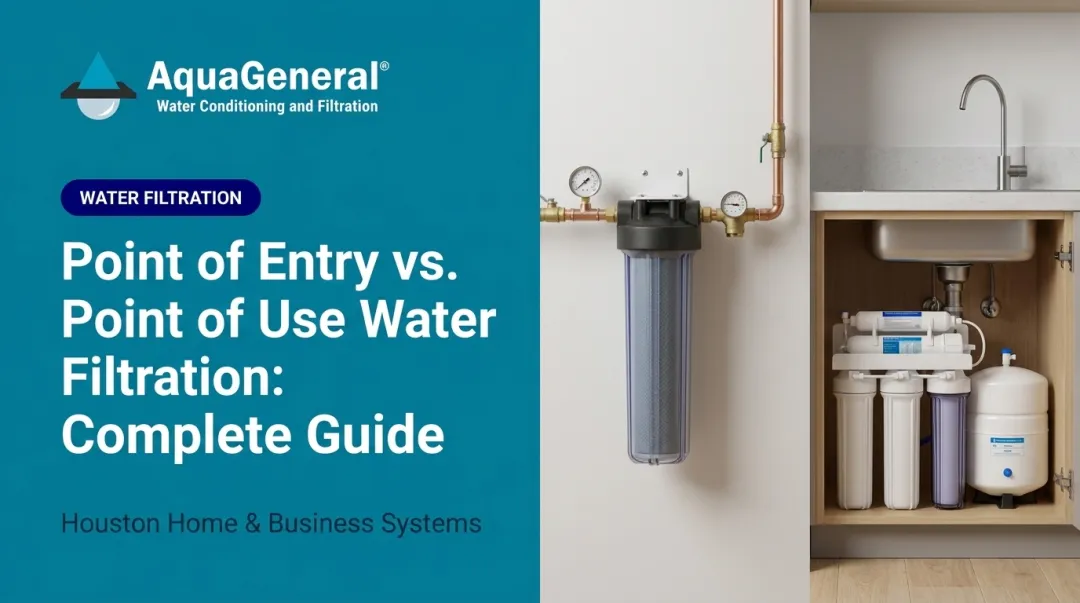
That's the key difference from point-of-use (POU) filters like pitcher filters, faucet attachments, or under-sink units. A POU filter protects one tap. A POE system protects everything.
Types of Systems
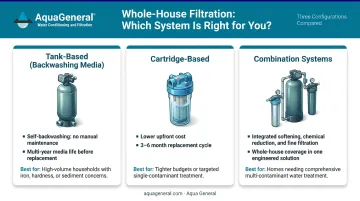
Three main configurations are available, each suited to different water problems and budgets:
- Tank-based (backwashing media): Fills a pressure vessel with catalytic carbon, greensand, or anti-microbial media. The tank self-backwashes periodically to regenerate, and media lasts several years — low-maintenance once installed.
- Cartridge-based: Pushes water through replaceable canisters. Lower upfront cost, but cartridges need changing every 3–6 months depending on usage and water quality.
- Combination systems: Integrates softening, anti-microbial inhibition, chemical reduction, and fine particle filtration into one unit — a practical choice when a home has multiple water quality issues.
Key Benefits Beyond Taste
The obvious benefit is better-tasting drinking water. Less obvious but equally important:
- Reduced chloramine and chlorine exposure during showers — these chemicals vaporize in steam, meaning inhalation exposure during a hot shower is real
- Protection of water heaters and appliances from scale buildup, which reduces energy efficiency and shortens equipment life
- Softer skin and hair after bathing
- Brighter, longer-lasting laundry
- Reduction of disinfection byproducts, VOCs, lead, hexavalent chromium, arsenic, and alpha particle radioactivity not fully addressed by standard municipal treatment
Why Houston Homeowners Have a Specific Problem to Solve
Houston's water isn't dangerous by regulatory standards—but it does have characteristics that make whole-house filtration more than a nice-to-have.
Chloramines, Not Just Chlorine
Houston's 2024 Water Quality Report confirms that the city uses chloramines as its primary disinfectant. Chloramine is a chlorine-ammonia compound that's harder to remove than free chlorine. Standard carbon filters need 3–4 minutes of contact time to address chloramine versus 1–2 minutes for chlorine, per WQA research. An undersized or incorrectly specified carbon system that looks adequate on paper can still underperform at real household flow rates.
Houston homeowners specifically need catalytic carbon media sized correctly for contact time—not just any carbon filter marketed for "chlorine taste and odor."
Hard Water and Appliance Impact
Houston's 2024 CCR reports total hardness at 66.4 ppm as CaCO3 for the main system. Scale deposits from calcium and magnesium accumulate inside water heaters, pipes, and appliances over time, reducing efficiency and shortening equipment life.
A WQA summary of the Battelle study found gas storage water heaters lost 4% efficiency for every 5 grains per gallon of hardness—that adds up fast in a city where hot water runs year-round.
The Broader Contamination Picture
National data reinforces why "treated" doesn't mean "clean." Three issues stand out for Houston households:
- USGS reported in 2023 that at least 45% of U.S. tap water contains one or more PFAS compounds, based on samples from both public supplies and private wells
- EPA estimates 4 million lead service lines still serve U.S. properties—lead can enter water after it leaves a treatment plant, through older pipes or household plumbing
- Sediment and bacteria can accumulate in distribution lines between the treatment plant and your tap, regardless of what meets EPA limits at the source
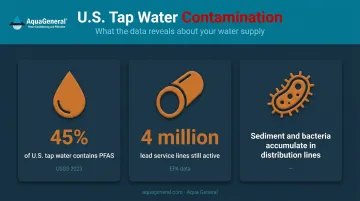
Point-of-entry filtration addresses all three issues at once, treating every gallon before it reaches any fixture in your home.
Six Factors to Evaluate Before You Buy
No single system is right for every home. The following framework connects your actual water quality profile to a system's verified capabilities.
1. Water Source and Starting Quality
A city water customer's primary concerns—chloramines, disinfection byproducts, trace metals—differ significantly from a well water customer dealing with iron, hydrogen sulfide, bacteria, and sediment.
Start here before comparing systems:
- Request your Consumer Confidence Report (CCR) from your municipal supplier (Houston's is published annually by Houston Public Works)
- Get a certified lab water test for contaminants the CCR doesn't cover in detail
- Buying without this data risks spending money treating the wrong problems
2. Contaminant Removal Capability
Contaminant removal is the primary performance metric. The system must be verified to reduce the specific contaminants in your water—not just a generic "removes 10+ contaminants" claim.
Pay attention to micron rating: systems filtering down to 0.02–5 microns (smaller than a human red blood cell at approximately 7–8 microns) provide substantially stronger protection than systems filtering at 25 or 50 microns.
Finer filtration matters most for households with immune-compromised members, infants, or elevated particulate counts in their water test results.
3. Flow Rate and Sizing
A whole-house system sits on your main line. If it can't maintain adequate flow, every fixture in the house loses pressure simultaneously. A rough guide based on manufacturer examples:
| Home Size | Recommended Flow Rate |
|---|---|
| 1–3 bathrooms | ~9 GPM |
| 4–6 bathrooms | ~12 GPM |
| 7+ bathrooms | ~20 GPM |
Size to peak simultaneous demand, not average use—a kitchen faucet, shower, and washing machine running at the same time can easily exceed 8–10 GPM combined.
4. Filter Media Type and Micron Rating
Match media to your water test results:
- Catalytic carbon treats chlorine, chloramines, VOCs, THMs, and disinfection byproducts
- KDF media targets heavy metals and inhibits scale, bacteria, and algae buildup
- Anti-microbial media inhibits bacterial growth inside the system itself — Aqua General's whole-house systems include this as a standard feature, not an add-on
- Sediment media removes particles, sand, and silt
- Greensand/Birm handles iron, manganese, and hydrogen sulfide (primarily for well water)
For Houston municipal water, the starting conversation is sediment plus chloramine-capable catalytic carbon. Specialty media gets added when your water test shows specific additional contaminants.
Knowing which media you need makes the next step clearer: verifying that the system you choose has actually been tested to perform as claimed.
5. Certifications and Third-Party Testing
Don't take manufacturer claims at face value. Here's what the certifications actually cover:
| Standard | What It Covers |
|---|---|
| NSF/ANSI 42 | Aesthetic contaminants: chlorine, chloramine, taste, odor, particulates |
| NSF/ANSI 53 | Health contaminants: lead, cysts, VOCs, chromium (50+ contaminants) |
| NSF/ANSI 401 | Emerging compounds: pharmaceuticals, herbicides, pesticides |
| WQA Gold Seal | Independent product validation with annual retesting and facility inspection |
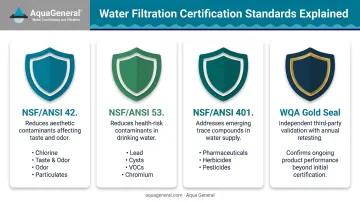
A product certified to NSF/ANSI 42 is not automatically certified for lead or PFAS. Ask for the specific standard number and the specific contaminant claim — each piece of that answer matters separately.
6. Total Cost of Ownership
The purchase price is the starting point, not the full picture. Installation and annual maintenance costs vary by system type, home size, and service provider — request a quote from a certified local specialist for an accurate total cost of ownership estimate.
The more useful comparison is replacement frequency:
- Cartridge systems require new cartridges every 3–6 months, depending on water quality
- Tank media systems need media replacement every 5–10 years or hundreds of thousands of gallons
- Sediment pre-filters need replacement every 6–12 months, regardless of system type
A cartridge system with a lower upfront cost can exceed the total cost of a tank system over 5–7 years. Calculate both.
How Aqua General Approaches This for Houston Homeowners
Aqua General has been serving the Greater Houston area since 1994, with installations going back to 1978 across Harris, Fort Bend, Montgomery, Galveston, Brazoria, Chambers, Waller, and Wharton Counties.
President David A. Davies was among the first professionals in Texas to earn a TCEQ Class III Water Treatment Specialist License and holds the WQA Certified Water Specialist designation. Both credentials directly shape every system recommendation the company makes.
That expertise has been recognized at the state and national level: Davies received the Texas Water Quality Association's Man of the Year Award in 2022 and the Water Quality Association's Regents Award in 2024.
Aqua General's exclusive whole-house water conditioner combines four treatment functions in a single unit:
- Softening — removes hardness minerals that damage appliances and fixtures
- Anti-microbial media — actively inhibits bacteria growth inside the system (not standard in most competitor products)
- Chemical reduction — targets chlorine, disinfection byproducts, and other contaminants
- Fine particle filtration — captures particles down to 0.02–5 microns, smaller than a human red blood cell
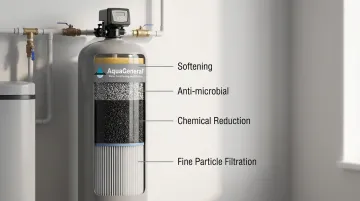
All systems and components are tested, certified, and validated by the WQA and NSF.
Aqua General also services and maintains systems from a wide range of other manufacturers, making them a practical resource whether or not you purchased from them originally. Their parts inventory includes discontinued models that most other service providers can no longer support.
Every recommendation starts with a custom water assessment — no system is proposed until your water has actually been tested.
Conclusion
The most effective whole-house filtration system is the one matched to what is in your water, sized correctly for your household's peak demand, and verified by credible third-party certification. Popularity and marketing don't determine performance — your water chemistry and household needs do.
Start with a water test. Use the six factors in this guide to evaluate your options. Then reach out to Aqua General at (713) 664-4601 or service@aquageneral.com for a consultation with a team that has spent over 32 years understanding exactly what Houston water contains—and what to do about it.
Frequently Asked Questions
What is the most effective whole-house water filtration system?
The most effective system is the one matched to your home's specific contaminants and verified by NSF or WQA certification. For most Houston households, a combination unit covering softening, chemical reduction, anti-microbial protection, and fine particle filtration offers the broadest whole-home coverage in a single system.
What is the best water filter for Cryptosporidium?
Cryptosporidium requires a filter rated at 1 micron absolute or smaller, or certified to NSF/ANSI 53 or 58 for cyst reduction — standard carbon filters alone won't do it. A UV purification stage can inactivate cysts as an alternative or additional layer of protection.
Is a whole-house water filter worth it for Houston homeowners?
Yes—Houston's chloramine-based disinfection, documented hardness, and aging regional infrastructure make whole-house filtration particularly practical. It protects appliances from scale, reduces chemical exposure at every tap and shower, and eliminates reliance on bottled water throughout.
How long does a whole-house water filtration system last?
Tank-based systems with quality media typically run 5–10 years before media needs replacement. Cartridge-based systems require new cartridges every 3–6 months. Sediment pre-filters generally need replacement every 6–12 months regardless of the main system type.
What contaminants does a whole-house water filter remove?
The contaminants removed depend on the filtration media used:
- Catalytic carbon — chlorine, chloramines, VOCs, and disinfection byproducts
- KDF media — heavy metals
- Anti-microbial media — inhibits bacteria growth within the system
- Fine particle filtration — sediment and cysts down to 0.02 microns
A combination system addresses all of these simultaneously.
Do I need a water test before buying?
Yes — without knowing which contaminants are present and at what levels, you risk buying a system that misses the real problems. A certified water specialist can test your water on-site, interpret the results, and recommend a system that actually fits your home.