What makes VOCs particularly concerning is that many are invisible and odorless at low concentrations, yet linked to serious long-term health risks including liver damage, nervous system disorders, and cancer. City of Houston water data reviewed by EWG shows average trihalomethane (TTHM) levels of 30.4 ppb and chloroform at 13.7 ppb — both VOC-class disinfection byproducts present in finished municipal water.
Carbon block whole house filters are one of the most effective activated carbon technologies for reducing VOCs throughout the entire home. This guide covers what VOCs are, how carbon block systems work, their limitations, and how to choose the right system.
Key Takeaways
- Carbon block whole house filters use adsorption to trap VOC molecules at the point of entry — protecting every faucet, shower, and appliance.
- Greater Houston homeowners face documented Superfund site runoff and chlorination byproducts that make VOC filtration a practical necessity.
- Carbon block outperforms loose granular activated carbon (GAC) for many VOCs by minimizing channeling and maximizing contact time.
- Carbon block cannot remove hardness minerals, iron, bacteria, or nitrates — those require separate treatment stages.
- Media replacement (typically every 3–5 years for municipal water) is the primary ongoing maintenance requirement.
What Are VOCs and Why Are They a Water Quality Concern?
What VOCs Actually Are
Volatile organic compounds are carbon-based chemicals that vaporize easily at room temperature. In water, they enter groundwater and municipal supplies through several pathways:
- Industrial discharge and chemical plant runoff
- Leaking underground fuel storage tanks
- Agricultural pesticide and herbicide runoff
- Chlorination of municipal water (producing disinfection byproducts)
- Natural geological processes near contaminated sites
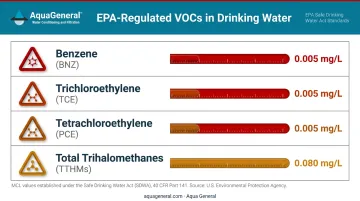
The EPA regulates over 20 specific VOCs under the Safe Drinking Water Act, setting maximum contaminant levels (MCLs) for compounds including benzene (0.005 mg/L), trichloroethylene or TCE (0.005 mg/L), tetrachloroethylene or PCE (0.005 mg/L), and total trihalomethanes (0.080 mg/L), per federal drinking water regulations.
VOC Risk in Greater Houston
Harris County has approximately 25 documented Superfund entries maintained by TCEQ. The Jones Road Ground Water Plume in northwest Harris County — traced to a former dry cleaning operation — has documented PCE, TCE, and DCE in groundwater, according to EPA and ATSDR records.
If you're on city water rather than a private well, the more consistent concern is disinfection byproducts. Houston's 2023 Water Quality Report showed TTHMs averaging 23.1 ppb, ranging from 1.0 to 46.2 ppb. Benzene, TCE, and PCE were not detected in finished City of Houston water in the EWG dataset reviewed — but trace toluene (0.0134 ppb average) and total xylenes (0.130 ppb) were recorded.
Health Risks From VOC Exposure
The EPA classifies benzene as a known human carcinogen. TCE and PCE are both characterized as likely or known carcinogens. Health effects break down by exposure duration:
Short-term exposure:
- Headaches, nausea, dizziness
- Eye, nose, and throat irritation
Long-term chronic exposure:
- Liver and kidney damage
- Nervous system disorders
- Elevated cancer risk from carcinogens like benzene, TCE, and PCE
Why a Whole House Filter Matters
Those health risks aren't limited to what you drink. An under-sink filter only treats water at one tap — VOCs also vaporize from hot water during showers and are absorbed through skin during bathing.
ATSDR's SHOWER model specifically evaluates inhalation and dermal exposure to volatile contaminants during household water use. Peer-reviewed research has confirmed ingestion, inhalation, and dermal exposure pathways for chloroform and TCE from tap water.
A point-of-entry (whole house) filter treats water at the main line before it reaches any fixture — showers, baths, kitchen taps, laundry — cutting off all three exposure pathways at once rather than addressing just one.
How Carbon Block Whole House Filters Remove VOCs
The Adsorption Mechanism
Carbon block filters remove VOCs through adsorption, a physical process where VOC molecules bond to the enormous internal surface area of activated carbon as water flows through.
According to the Water Quality Association, one pound of activated carbon can contain more than 35 acres of internal surface area, giving it substantial capacity to trap organic chemical molecules before they reach a faucet or showerhead.
This is distinct from absorption (where a substance is drawn into a material). In adsorption, contaminants stick to the carbon surface and stay there until the media is replaced.
What Makes Carbon Block Different From Loose GAC
Granular activated carbon consists of loose granules through which water can flow around the media (a phenomenon called channeling). Carbon block compresses activated carbon into a solid matrix, forcing every water molecule to travel through the media rather than around it.
Key advantages of this design:
- Maximizes contact time between water and the carbon surface
- Eliminates channeling, improving removal consistency across every gallon
- Achieves filtration down to 0.5 microns or finer, rated by micron size rather than flow estimates
For VOC removal purposes, contact time is critical. The WQA measures this using empty bed contact time (EBCT) , meaning media volume divided by flow rate , or how long water actually spends in contact with the media. A 1 cubic foot bed at 2.5 gallons per minute produces approximately 3 minutes of contact time , and sizing decisions directly affect how well VOCs are captured.
VOC Categories Carbon Block Effectively Reduces
Carbon block filters certified to NSF/ANSI Standard 53 (health effects contaminants) address VOC reduction claims. Compounds typically covered by certified systems include:
- Trihalomethanes (chloroform, bromodichloromethane, dibromochloromethane, bromoform)
- Benzene, toluene, ethylbenzene, xylenes (BTEX compounds)
- Trichloroethylene (TCE) and tetrachloroethylene (PCE)
- Pesticides and herbicides
- Disinfection byproducts broadly
NSF/ANSI 42 covers aesthetic claims like chlorine taste and odor. For health-effects VOC removal claims, look specifically for NSF/ANSI 53 certification on any system you're evaluating.
The Role of Catalytic Carbon for Chloramine Treatment
Houston's municipal water is treated with chloramines rather than free chlorine. Standard activated carbon is significantly less effective at reducing chloramines . Catalytic carbon is an enhanced form that chemically breaks down chloramine compounds rather than simply adsorbing them, making it the better choice for Houston-area water. The WQA notes catalytic carbon requires approximately 5 minutes of EBCT for effective chloramine reduction.
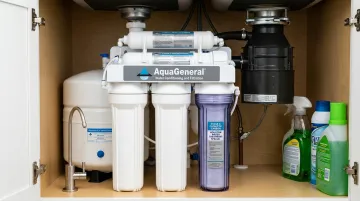
Because Houston's water chemistry is a known variable, Aqua General's AquaGuard® 9-Stage Reverse Osmosis system includes a dedicated catalytic carbon stage specifically engineered for chloramine removal. For whole house carbon options, confirming whether standard or catalytic-grade media matches your source water is a straightforward step that prevents undersized performance from the start.
What a Carbon Block Filter Cannot Remove
Carbon block filtration is contaminant-specific. NSF certification is claim-based: a filter is only credited for what it's tested and certified to reduce. Knowing the gaps matters as much as knowing the strengths.
What Carbon Block Does NOT Address
| Contaminant Category | Why Carbon Block Falls Short | Recommended Solution |
|---|---|---|
| Hardness (calcium, magnesium) | Carbon doesn't ion-exchange minerals | Water softener |
| Iron and manganese | Iron coats carbon pores, reducing VOC capacity | Iron filter upstream of carbon |
| Bacteria and viruses | Carbon adsorbs, it doesn't disinfect | UV system (NSF/ANSI 55 certified) |
| Nitrates | Dissolved inorganic; passes through carbon pores | Reverse osmosis |
| Fluoride | Inorganic ion; not captured by carbon | Reverse osmosis |
| Arsenic | Dissolved heavy metal | Reverse osmosis or dedicated arsenic filter |
| Total dissolved solids (TDS) | Inorganic dissolved compounds | Reverse osmosis |
Iron deserves special attention in Greater Houston homes. Iron in source water coats carbon surfaces over time, gradually clogging pores and reducing the system's capacity to adsorb VOCs, even when the carbon media itself isn't fully exhausted. Homeowners in Harris or Montgomery counties with iron in their water supply should get iron treatment installed upstream of any carbon block system.
For homes with biological contamination concerns, particularly those on private wells, a UV disinfection system installed downstream of the carbon block provides the disinfection coverage that carbon cannot.
How to Choose the Right Carbon Block Whole House Filter for VOC Removal
Start With a Water Test
Before purchasing any system, know what's actually in your water. A full water quality test — not just a TDS meter reading — will identify VOC levels, iron concentration, hardness, pH, and biological content. Each of these affects which system to select and the correct installation sequence.
Aqua General, licensed by the TCEQ and certified by the WQA, offers free on-site water testing across its eight-county Greater Houston service area, including Harris, Fort Bend, Montgomery, Galveston, and Brazoria counties. A professional assessment is the most reliable starting point before committing to any filtration equipment.
Key Specifications to Evaluate
When comparing carbon block whole house systems, focus on:
- NSF/ANSI 53 certification — required for verified VOC health-effects claims (not just NSF 42)
- Micron rating — finer ratings improve removal of smaller organic molecules
- Carbon volume — larger media beds mean more surface area and longer service life
- Flow rate capacity — must match your home's peak demand (WQA and IAPMO guidance suggests typical single-family design flow around 10–15 gallons per minute)
- Media type — confirm standard versus catalytic-grade carbon based on your municipal water treatment chemistry
Be skeptical of any system that doesn't disclose media type, carbon volume, or third-party certification.
Treatment Sequence for Homes With Multiple Issues
When multiple water quality problems are present, the order of treatment components matters. A conditional sequence based on your specific water test results:
- Sediment prefiltration — protects downstream media from particulate fouling
- Iron treatment (if iron is present) — prevents carbon pore clogging
- Carbon block filter — VOC and chemical reduction
- UV disinfection (if biological concerns exist) — disinfection of treated water
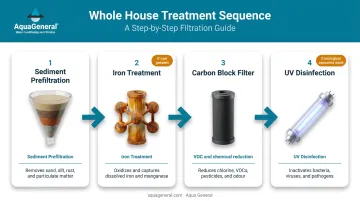
This sequence protects the carbon media and maximizes its effective service life. Your water treatment specialist should confirm the right sequence for your specific water chemistry.
Filter Maintenance and Replacement Intervals
Carbon media becomes exhausted over time and must be replaced. When carbon is fully saturated, VOCs pass through untreated — a condition called breakthrough. Signs of breakthrough include the return of chlorine taste, chemical odor, or the smell of the original contaminants.
Replacement intervals depend on water usage, contaminant load, and media volume. For municipal water, replacement is commonly needed every 3–5 years. Well water or high-VOC environments may require more frequent service. A WQA-certified specialist can establish a maintenance schedule based on your actual household usage and water quality data.
Frequently Asked Questions
Will a carbon filter remove VOCs?
Activated carbon — particularly carbon block — is one of the EPA-recognized methods for reducing a wide range of VOCs from drinking water through adsorption. Performance depends on carbon type, contact time, micron rating, and whether the system carries NSF/ANSI 53 certification for health-effects VOC reduction claims. Always verify certification for the specific product being installed.
What does a carbon filter not remove?
Carbon filters do not remove hardness minerals, iron, bacteria, viruses, nitrates, fluoride, arsenic, or total dissolved solids. These require separate technologies: water softeners for hardness, UV systems for biological contamination, and reverse osmosis for dissolved inorganic compounds like nitrates and fluoride.
What are the most common VOCs found in Houston-area drinking water?
The most consistently detected VOC-class compounds in City of Houston finished water are trihalomethanes — chloroform averaging 13.7 ppb and TTHMs at 30.4 ppb in recent EWG data. Trace toluene and xylenes have also been recorded. Benzene, TCE, and PCE are better characterized as documented groundwater concerns near Superfund sites (such as the Jones Road plume in northwest Harris County) than as detected finished-water contaminants in reviewed municipal datasets.
How does a carbon block filter differ from a GAC filter for VOC removal?
Carbon block forces water through a compressed solid matrix, increasing contact time and reducing channeling. GAC allows water to flow around loose granules at higher flow rates, making it better suited for backwashing in sediment-heavy applications. For VOC-focused municipal water treatment, carbon block's reduced channeling makes it the more effective point-of-entry choice.
How often should I replace a whole house carbon block filter?
For city water, media replacement is typically needed every 3–5 years. Well water or high-contamination environments may require more frequent replacement. Signs that the media is exhausted include a returning chlorine taste, chemical smell, or VOC odor — indicating breakthrough has begun and contaminants are passing through untreated.
Can VOCs in water affect me beyond just drinking it?
Yes. VOCs vaporize from hot water and can be inhaled during showers; ATSDR's SHOWER model was developed specifically to evaluate this inhalation and dermal exposure pathway. A point-of-entry whole house system treats water at the main line, protecting against vapor inhalation and skin absorption that a kitchen sink filter cannot address.