The short answer is yes — UV purifiers do kill bacteria and viruses. The longer answer involves understanding how UV disinfection works, what conditions it depends on, and where it falls short. This guide covers all of it.
Key Takeaways
- UV purifiers use UVC light (200–280 nm) to damage microbial DNA and RNA, preventing replication
- Water clarity matters — turbidity and particles create "shadows" that shield microorganisms from UV exposure
- UV disinfection does not remove chemicals, heavy metals, sediment, or dissolved minerals
- Some pathogens require higher UV doses — system certification matters for real-world performance
- Replace UV lamps annually, even when they still appear to be working
What Is a UV Water Purifier?
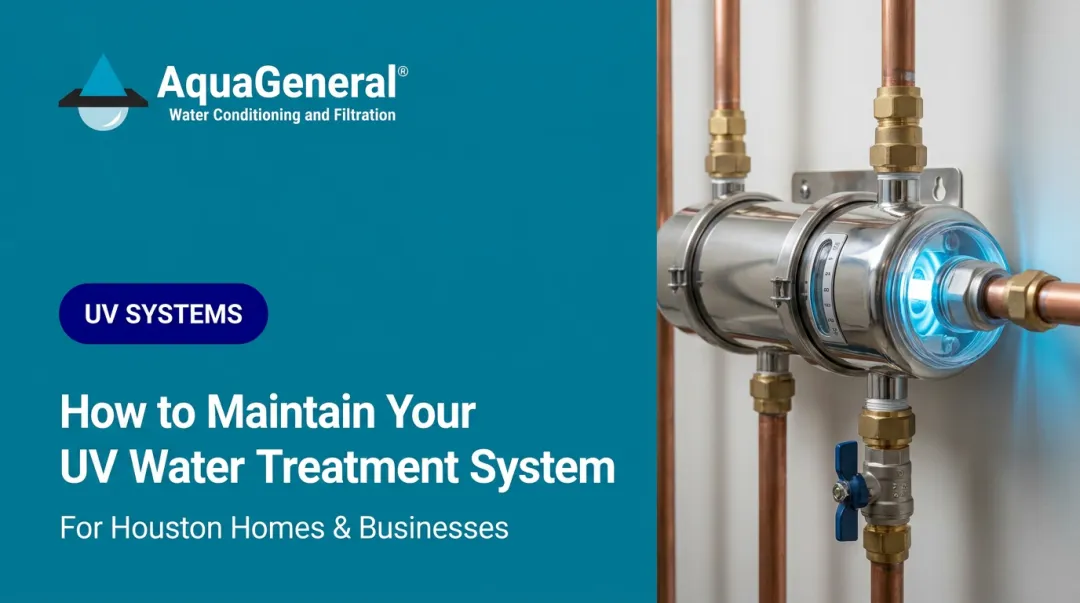
A UV water purifier is a microbiological disinfection device — not a filter. It uses ultraviolet light in the UVC band (200–280 nm) to inactivate bacteria, viruses, and other microorganisms as water flows through a treatment chamber. It does not physically remove particles, chemicals, or dissolved minerals.
The Three UV Types — and Why Only UVC Matters
There are three UV bands: UVA, UVB, and UVC. Only UVC is germicidal. The EPA confirms that UVC is completely absorbed by the Earth's ozone layer — none reaches the surface naturally. Every UV water purifier generates its own UVC artificially, typically using low-pressure mercury lamps that emit at 253.7 nm, close to the ~260 nm peak where DNA and RNA absorb UV light most efficiently.
What a UV Purifier Is Not
This distinction matters for setting realistic expectations:
- Sediment and turbidity pass through untouched — UV does not filter particles
- Chlorine, heavy metals, and disinfection byproducts are unaffected
- Hardness minerals remain in the water unchanged
- No chemical residual is added — unlike chlorine, UV leaves nothing behind after treatment
The water that exits a UV chamber looks, tastes, and tests the same chemically — the only thing that changes is whether the microorganisms in it are still viable. That distinction shapes what UV can and can't do for your water supply.
How Does a UV Water Purifier Kill Bacteria and Viruses?
Water enters the UV chamber, passes an ultraviolet lamp housed inside a quartz sleeve, and exits. The physical path is simple. What happens to microorganisms during that transit is precise and measurable.
UV Exposure: The Core Mechanism
As microorganisms flow through the chamber, UVC radiation penetrates their cell walls and is absorbed by their nucleic acids — DNA in bacteria, RNA in viruses. This absorption causes photochemical damage, specifically the formation of molecular lesions (such as pyrimidine dimers) that break the bonds holding genetic material together.
The organism loses its ability to replicate — it can no longer reproduce or infect a host. Note that it isn't physically removed from the water; it's rendered biologically inert. According to the EPA's Ultraviolet Disinfection Guidance Manual, this photochemical damage is the primary mechanism of microbial inactivation across all pathogen types.
UV Dose: The Performance Variable
Effectiveness isn't binary — it depends on UV dose, calculated as:
UV Intensity (mW/cm²) × Exposure Time (seconds) = UV Dose (mJ/cm²)
Higher dose means more thorough inactivation. Laboratory fluence data shows how dose requirements vary significantly by pathogen:
| Pathogen | Approximate 4-log inactivation dose |
|---|---|
| E. coli | ~8.4 mJ/cm² |
| Salmonella typhi | ~7.8 mJ/cm² |
| Murine norovirus surrogate | ~27 mJ/cm² |
| Adenovirus type 2 | ~121 mJ/cm² |
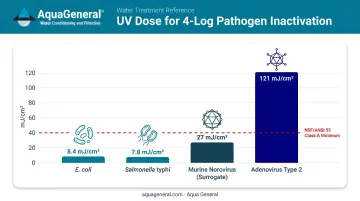
These are laboratory benchmarks, not field performance guarantees. For residential and commercial installations, the relevant benchmark is NSF/ANSI Standard 55 Class A, which requires a minimum delivered dose of 40 mJ/cm² — a threshold validated through reactor testing under real flow conditions.
One critical operational point: certified systems are engineered to deliver that dose at a rated flow rate. Exceeding the rated flow reduces water's time in the chamber, which drops the delivered dose below certified levels. Match your system's rated flow to your peak demand — undersizing is one of the most common reasons UV systems underperform in the field.
What Affects the Effectiveness of a UV Water Purifier?
UV disinfection is sometimes called "line-of-sight" technology — if UV light can't reach a microorganism, it can't inactivate it. Several real-world factors create that problem.
Water Clarity
Turbidity is the most significant performance limiter. Suspended sediment, iron, manganese, and dissolved organics all absorb or scatter UV light, casting shadows that shield microorganisms. UV system pre-treatment guidelines specify that ideal UV water quality should meet:
- Turbidity: <1 NTU
- Suspended solids: <10 mg/L
- Iron: <0.3 mg/L
- Manganese: <0.05 mg/L
- UV transmittance: >75%
For Houston-area homeowners, this is worth taking seriously. Houston's water system draws 86.5% from surface water sources, and a June 2025 public notice reported a turbidity treatment-technique violation at the Northeast Water Purification Plant involving levels above 1.0 NTU. Pre-filtration isn't just a general recommendation — it's performance protection.
Pre-Filtration Requirements
UV system installation documentation requires a 5-micron nominal sediment filter installed upstream before the UV chamber. This is a functional requirement, not an optional upgrade. Water that enters a UV system chamber carrying particles will compromise disinfection regardless of lamp quality.
Lamp Age
UV lamps degrade over time. UV system manufacturers document a 9,000-hour rated lamp life — approximately one year of continuous operation. A lamp can continue to emit visible light well past its effective germicidal life while delivering insufficient UVC intensity for disinfection. Manufacturers recommend annual replacement regardless of visual appearance.
Does UV Light Work on All Waterborne Pathogens?
UV disinfection is broadly effective, but not uniformly so across all pathogen types.
Bacteria and Viruses
At NSF/ANSI Standard 55 Class A dose levels (40 mJ/cm²), certified UV systems are designed to inactivate bacteria and viruses from contaminated water. Common UV-sensitive bacteria targets include:
- E. coli
- Salmonella
- Legionella
Most viruses are also addressed at Class A doses. The notable exception is adenovirus, which requires substantially higher doses than most other waterborne pathogens.
The Protozoan Picture
The EPA's Long Term 2 treatment framework shows that Cryptosporidium and Giardia actually require lower doses than some viruses for inactivation — approximately 22 mJ/cm² for 4-log reduction. The real consideration is ensuring the installed system is validated to deliver the required dose at your home's actual flow rate and water quality conditions.
No Residual Protection
Once water leaves the UV chamber, it has no ongoing protection. UV leaves no disinfectant residual. Biofilms in downstream pipes, backflow events, or plumbing issues after the UV unit can reintroduce contamination. Installation location matters: positioning the UV unit as close to the point of use as possible reduces that risk.
What UV Purifiers Cannot Do — and How to Fill the Gaps
A UV purifier addresses one specific threat: microbiological contamination. It cannot:
- Remove sediment or suspended particles
- Reduce lead, arsenic, or other heavy metals
- Address chlorine or disinfection byproducts
- Remove hardness minerals
- Treat chemical contaminants of any kind
The NSF Contaminant Reduction Claims Guide does not list UV systems as certified for lead, arsenic, chlorine, or TTHM reduction. If these contaminants are present in your water, a UV system alone won't address them.
The Multi-Barrier Approach
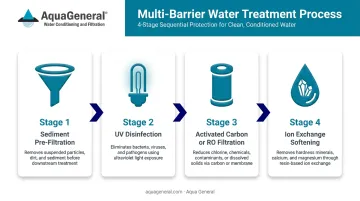
Comprehensive water safety requires treating UV as one layer within a broader system. The most practical configuration pairs:
- Sediment pre-filtration upstream of the UV unit to clear particles that block UV penetration
- UV disinfection to inactivate bacteria, viruses, and protozoa
- Activated carbon or RO filtration to reduce chlorine, organics, and disinfection byproducts
- Ion exchange softening for hardness, where applicable
For Greater Houston homeowners dealing with multiple water quality concerns, Aqua General's whole-house treatment systems address both biological and non-biological contaminants in sequence. Their AquaGuard® system combines silver-impregnated anti-microbial media, fine particle filtration down to 0.02–5 microns, activated carbon, and ion exchange softening. UV disinfection is available as a separate upstream component for homes with confirmed microbial risk.
Certification to Look For
When evaluating any UV system:
- NSF/ANSI Standard 55 Class A (40 mJ/cm²): Designed for water with potential microbial contamination — the right choice for private wells, untreated sources, or unknown-quality water
- NSF/ANSI Standard 55 Class B (16 mJ/cm²): Supplemental bactericidal treatment for already disinfected municipal water — not appropriate for pathogen elimination from unsafe sources
Conclusion
UV water purifiers do kill bacteria and viruses — by disrupting their DNA and RNA and preventing replication. But performance depends on water clarity, rated flow rate, lamp condition, and appropriate system sizing. A UV purifier running in turbid water with an aging lamp at oversized flow rates won't deliver the disinfection its certification promises — making proper system design and maintenance non-negotiable.
For households and businesses that need protection beyond microbial disinfection — covering sediment, chemical contaminants, and hardness alongside biological threats — the right answer is a multi-barrier system matched to your specific water source.
Aqua General has served the Greater Houston area for over 32 years as a WQA Certified, TCEQ Licensed water treatment specialist. They offer free on-site water testing and custom-designed treatment solutions. Reach them at (713) 664-4601 or at aquageneral.com.
Frequently Asked Questions
Does UV water filter kill viruses?
Yes. UV light damages the RNA of viruses, preventing them from replicating and causing illness. Consistent effectiveness depends on adequate UV dose and clear water; turbidity or excessive flow can reduce performance.
How long does it take UV light to kill bacteria in water?
As water passes through the UV chamber, inactivation occurs within seconds. Contact time is determined by chamber length and rated flow rate; exceeding that flow rate reduces UV exposure and can compromise the delivered dose.
What is the best water filter for bacteria and viruses?
UV combined with pre-filtration is highly effective for microbial concerns. A multi-stage system (mechanical filtration followed by UV) is the standard approach for comprehensive protection. Look for NSF/ANSI Standard 55 Class A certification when treating water from non-municipal or unknown-quality sources.
Does a UV water purifier remove all contaminants from water?
No. UV purifiers address only microbial contamination. They do not remove sediment, chemicals, heavy metals, chlorine, hardness minerals, or dissolved solids. A separate filtration system is needed for those concerns.
Does UV water purification require pre-filtration?
Yes. Turbid or particle-laden water blocks UV light from reaching microorganisms. Pre-filtration (typically to 5 microns) is a functional requirement, not an optional add-on, for effective UV disinfection.
How often should UV purifier lamps be replaced?
Most manufacturers recommend annual replacement after approximately 9,000 hours of operation. UV intensity degrades before lamps fail visibly: a lamp that appears to glow normally may no longer deliver sufficient germicidal output.