Pick the wrong system and you're either over-engineering a simple car wash rinse setup (and paying for purity you don't need) or under-delivering for a dental office where water quality directly affects equipment and patient safety.
This guide breaks down how each system works, compares them head-to-head, and helps you identify which configuration fits your application — whether you're a Houston-area business owner, a facility manager, or a homeowner with specific water purity requirements.
Key Takeaways
- Mixed bed deionizers combine both resins in one tank, reaching up to 18.2 MΩ·cm purity for labs, medical/dental, and electronics
- Dual bed systems run two tanks in sequence, suited for high-volume use where moderate purity is acceptable
- Dual bed resin regenerates on-site for low cost; mixed bed requires specialized off-site service
- Many commercial setups combine both: dual bed for volume, mixed bed as a final polisher
- Houston's hard water (TDS up to 272 ppm) exhausts resin faster, so proper system sizing is critical
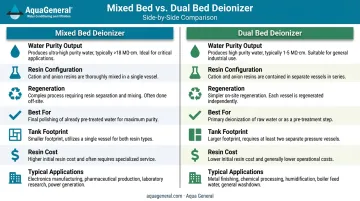
Mixed Bed vs Dual Bed Deionizer: Quick Comparison
Here's a side-by-side breakdown of how mixed bed and dual bed deionizers compare on the factors that drive most purchasing decisions.
| Factor | Mixed Bed | Dual Bed |
|---|---|---|
| Water Purity Output | Up to 18.2 MΩ·cm resistivity | Lower resistivity; design-dependent |
| Resin Configuration | Cation + anion blended in one tank | Separate cation tank, then anion tank |
| Regeneration | Requires resin separation; off-site or specialized equipment | Independent regeneration with acid and caustic; simpler |
| Best For | Low-volume, high-purity applications | High-volume, moderate-purity applications |
| Tank Footprint | Single compact tank | Two-tank setup, larger footprint |
| Resin Cost | Higher | Generally lower |
| Typical Applications | Labs, dental/medical, electronics, pharma | Car washes, light manufacturing, boiler feed, beverage |
What Is a Mixed Bed Deionizer?
A mixed bed deionizer is a single vessel containing both cation (H⁺ form) and anion (OH⁻ form) exchange resins blended together — typically in a 40:60 cation-to-anion ratio by volume, as specified for industry-standard mixed bed resins.
How the Ion Exchange Works
Water flowing through the tank encounters thousands of microscopic exchange zones simultaneously:
- Cation resin captures positively charged ions (calcium, sodium, magnesium, iron) and releases hydrogen ions (H⁺)
- Anion resin captures negatively charged ions (chlorides, sulfates, nitrates, silica) and releases hydroxide ions (OH⁻)
- The released H⁺ and OH⁻ combine to form pure water (H₂O)
Blending both resins this way means water effectively passes through many demineralization cycles in a single pass. The result: resistivity greater than 18 MΩ·cm at 25°C, verified by leading resin manufacturers for ultrapure polishing applications.
The Regeneration Challenge
Because both resins are blended, they must be physically separated before regeneration can occur — cation resin settles by density, anion resin floats. Each resin then requires its own chemical treatment (acid for cation, caustic for anion) before being re-blended.
This process needs specialized equipment and isn't practical on-site. Mixed bed resin is typically sent off-site for regeneration or managed through a service exchange program.
Use Cases for Mixed Bed Deionizers
Applications that specifically require mixed bed purity include:
- Dental and medical offices — equipment rinsing and sterilization processes
- Laboratory and research — ASTM D1193 specifies mixed bed polishing followed by membrane filtration for Type I reagent water
- Pharmaceutical and biotech — USP conductivity and TOC standards require tightly controlled ionic purity
- Semiconductor and electronics manufacturing — ultrapure water targets greater than 18.2 MΩ·cm per industry specifications
- Final polishing stage — mixed bed tanks downstream of RO or dual bed systems catch trace ions that upstream treatment misses
What Is a Dual Bed Deionizer?
A dual bed deionizer (also called a two-bed or separate bed system) uses two distinct tanks in series. The first tank contains strong acid cation resin; the second contains strong base anion resin. Water flows through each sequentially.
The Two-Step Process
- Cation tank: Positively charged ions are exchanged for hydrogen ions, producing acidic water
- Anion tank: Negatively charged ions are exchanged for hydroxide ions; H⁺ and OH⁻ combine to produce deionized water
Industry documentation confirms that cation bed effluent is acidic, and dual bed systems often serve as a precursor stage before a downstream mixed bed polisher in high-purity treatment trains.
The Sodium Leakage Limitation
Sodium ions carry a relatively weak charge and can pass through cation resin without being fully exchanged. Most leakage from cation units is sodium — which then converts to sodium hydroxide in the anion tank. WC&P's analysis gives a concrete example: with 1,000 ppm feedwater, sodium leakage can produce roughly 5 ppm residual sodium, resulting in approximately 60,000 ohm-cm resistivity and elevated pH.
Dual bed systems can't match mixed bed purity on their own. That's why many installations add a mixed bed polisher downstream as a final treatment stage.
The Regeneration Advantage
Because cation and anion resins are in separate tanks, each regenerates independently. Since no resin separation is required, regeneration is straightforward — often handled through a simple tank exchange service — with considerably less operational complexity than mixed bed systems.
Use Cases for Dual Bed Deionizers
Dual bed systems work well where volume and flow rate matter more than maximum purity:
- Spot-free car wash rinse systems using portable dual bed units
- Window and glass cleaning where water below 9 ppm TDS eliminates streaking
- Boiler feed, cooling tower makeup, and industrial process water
- Beverage and restaurant operations requiring consistent mineral-free water
- Bulk ion removal as a pretreatment stage before a downstream mixed bed polisher
Mixed Bed vs Dual Bed: Which Should You Choose?
The decision comes down to three variables: required purity, daily volume, and regeneration logistics.
Choose a Mixed Bed Deionizer When:
- Your application demands resistivity above 10 MΩ·cm (dental/medical equipment, laboratories, electronics rinsing)
- Volume requirements are modest and consistent purity is non-negotiable
- You're using it as a final polishing stage after RO or dual bed pretreatment
Choose a Dual Bed Deionizer When:
- Moderate purity is sufficient for your process (car washes, manufacturing, beverage production)
- You need high daily volumes with continuous or high-flow output
- Simpler, more cost-effective regeneration through tank exchange is a priority
Consider the Combination Approach
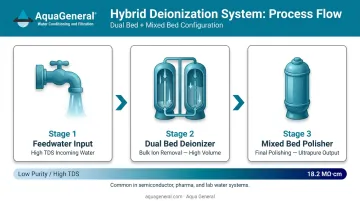
For high-demand commercial and industrial applications, the most practical setup is both systems working in series. A dual bed unit handles bulk ion removal at high volume; a downstream mixed bed polishing tank then elevates the final output to meet critical purity specifications. This hybrid configuration is common in semiconductor rinsing, pharmaceutical processing, and laboratory water systems — anywhere throughput and precision both matter.
The Houston Factor
Houston's municipal water carries real mineral load. According to the City of Houston's 2024 Water Quality Report, Main System TDS ranges from 144 to 272 ppm with hardness measured as CaCO₃ at 43 to 137 ppm. Higher TDS means faster resin exhaustion — which directly affects your service exchange schedule and total operating cost.
Those TDS levels mean a DI system sized for average municipal water will underperform here. Aqua General's team — WQA certified and TCEQ licensed — evaluates your incoming water chemistry, daily volume requirements, and application needs to recommend the right configuration from the start.
Frequently Asked Questions
What is mixed bed deionization?
Mixed bed deionization blends cation and anion resins in a single tank so water undergoes simultaneous ion exchange in every pass through the bed. The result is water at or near theoretical maximum purity — resistivity up to 18.2 MΩ·cm — making it the standard for ultrapure water applications.
What are the different types of deionizers?
The three main types are dual bed (separate cation and anion tanks in series), mixed bed (both resins combined in one tank), and combination systems (dual bed followed by a mixed bed polisher). Systems within each category may use weak or strong base anion resin depending on target purity and the ions present.
What is the difference between EDI and mixed bed?
EDI (electrodeionization) uses electricity to continuously regenerate resin without chemicals, making it ideal for large-scale continuous operations. Mixed bed achieves comparable or slightly higher peak purity but requires periodic off-site chemical regeneration, so it's more cost-effective at smaller scales or in non-continuous applications.
Can I use a dual bed and mixed bed deionizer together?
Yes — this is a common and effective configuration. The dual bed handles high-volume bulk ion removal, and the downstream mixed bed polisher delivers final high-purity output. This hybrid design is widely used in commercial and industrial settings where both flow rate and purity matter.
How often does deionizer resin need to be regenerated or replaced?
Frequency depends on incoming water TDS, daily volume, and application. Houston's hard water exhausts resin faster than softer-water regions, so monitoring output conductivity and scheduling exchanges based on actual readings rather than fixed calendar intervals is the most reliable approach.
Which deionizer is best for dental offices or restaurants?
Dental and medical offices typically need mixed bed systems to meet the purity demands of sterilization equipment and sensitive instruments. Restaurants and food/beverage operations often work well with a dual bed or combination setup, depending on their water quality requirements and daily usage volume.