 Worth It? A Complete Guide](https://file-host.link/website/aquageneral-z0it4x/assets/blog-images/1bcd8dda-1cfc-45c4-83b0-32f72cf73c96/1783026454876024_c162e908f1804d418c90ac953e4999ea/360.webp)
The "is it worth it" question is fair. Whole house water filtration systems require upfront investment and ongoing maintenance. But their actual value only becomes clear when you look at what untreated water costs you daily — in appliance wear, household chemicals, bottled water purchases, and health exposure you may not even be tracking.
This guide breaks down what these systems do, what the research actually shows, and how to decide whether one makes sense for your home.
Key Takeaways
- A whole house system filters all incoming water before it reaches any tap, shower, or appliance — not just your kitchen sink
- Houston's tap water contains 56 detected contaminants, with 18 exceeding EWG health guidelines despite meeting legal standards
- Hard water causes measurable appliance efficiency loss — up to 24% in water heaters at higher hardness levels
- Whether a system is worth it depends on your water source, household health priorities, and what you're already spending on workarounds like bottled water
- Start with a professional water quality test — it's the only way to know what your water actually contains before choosing a system
What Is a Whole House Water Filtration System?
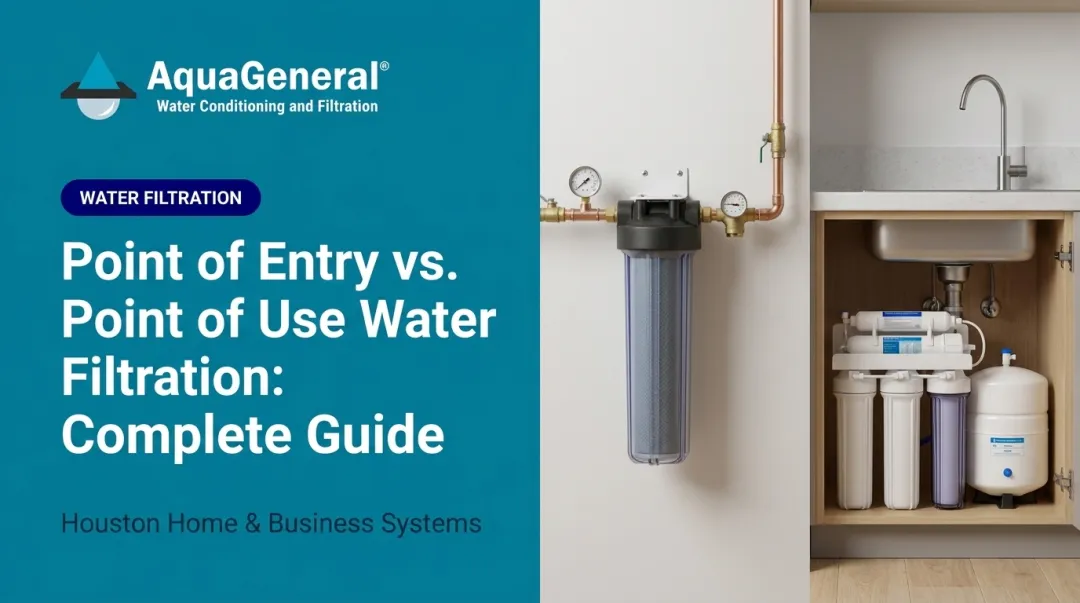
A whole house system — technically a point-of-entry (POE) system — installs on the main water line coming into your home. Every faucet, shower, toilet, dishwasher, and washing machine receives filtered water. Compare this to a point-of-use filter, which treats water at a single tap only.
The distinction matters more than most homeowners realize. Chlorine exposure, for example, doesn't only happen when you drink water — it happens when you shower, run the dishwasher, or do laundry.
How These Systems Are Layered
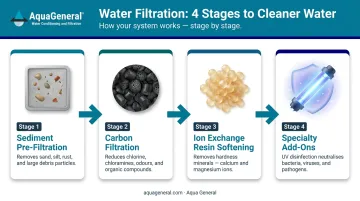
Most whole house systems combine multiple treatment stages:
- Sediment pre-filtration — removes large particles, rust, and debris before they reach finer filtration stages
- Carbon filtration — reduces chlorine, chloramines, VOCs, and chemical byproducts that affect taste and odor
- Ion exchange resin (water softening) — removes calcium and magnesium that cause hard water scale
- Specialty add-ons — UV purification, activated alumina for arsenic, or anti-microbial media for bacteria control
Aqua General's AquaGuard® whole house conditioner, for example, combines all five stages in a single unit: polishing gravel, physical filtration down to 2–5 microns, high-grade ion exchange resin, activated carbon, and silver-impregnated anti-microbial media — a configuration that goes well beyond what a basic softener or single-stage carbon filter handles on its own.
That whole-home reach is what separates POE systems from countertop or under-sink filters. Plumbing lifespan, appliance efficiency, laundry results, bathing comfort, and cooking water quality are all on the table — which is why the decision is closer to a home infrastructure upgrade than a kitchen appliance purchase.
Key Advantages of Whole House Water Filtration
Comprehensive Contaminant Protection at Every Water Source
A countertop or under-sink filter handles your drinking water. It does nothing for your shower, your dishwasher, or the steam you inhale while cooking. Contaminant exposure happens through multiple routes — not just ingestion.
Research published in Environmental Health Perspectives found that showering and bathing contribute significantly to total household trihalomethane exposure through both inhalation of volatilized compounds and dermal absorption — meaning ingestion-only risk assessments underestimate your actual exposure.
According to the EWG Tap Water Database, Houston's water system contains 56 detected contaminants, with 18 exceeding EWG health guidelines while remaining within legal limits. These include:
- Total trihalomethanes at up to 67 ppb (EWG guideline: 0.15 ppb)
- Haloacetic acids detected up to 70 ppb (EWG guideline: 0.1 ppb)
- Hexavalent chromium at 0.235 ppb — approximately 12x the EWG health guideline, with no federal maximum contaminant level
- PFOA and PFOS at levels exceeding EWG guidelines by more than 100x
A single point-of-entry system addresses all of these across every water outlet simultaneously, which no combination of individual faucet filters can replicate. This comprehensive coverage is especially critical in homes with young children, elderly residents, or anyone with a compromised immune system.
Appliance and Plumbing Protection That Compounds Over Time
Houston's water averages 128 mg/L total hardness — firmly in the "hard" category by USGS classification. Hard water deposits calcium and magnesium scale inside water heaters, pipes, showerheads, and dishwashers. The damage is gradual and invisible until something fails.
The Water Quality Research Foundation's Battelle study quantified exactly what this costs:
- Gas water heaters lose 4% efficiency for every 5 grains per gallon of hardness — reaching 24% efficiency loss at high hardness levels
- Tankless water heaters on hard water failed completely in as little as 1.6 years due to scale plugging
- Showerheads lost 75% of their flow rate within 18 months on hard water
Replacing a tank water heater is a significant unplanned expense that whole house softening can defer. Beyond the heater, the savings compound:
- Laundry detergent use drops 50% with softened water, with equal or better cleaning results
- Dishwasher detergent use drops 70%, and dishes come out cleaner
- Pipes maintain proper flow without narrowing, reducing the risk of pressure problems and corrosion
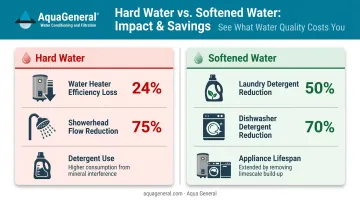
For Houston homeowners with appliances over three years old, early-stage scaling is likely already underway, even without visible signs.
Healthier Water for Skin, Hair, and Daily Wellness
Houston uses chloramines as its primary disinfectant. Chloramines — and hard water minerals — strip natural oils from skin and hair, which shows up as persistent dryness, scalp sensitivity, and eczema flare-ups that resist other treatments.
A population-based cohort study published in the Journal of Allergy and Clinical Immunology found a statistically significant association between higher domestic hard water concentrations and increased eczema prevalence in adults. For households already managing sensitive skin conditions, softened and filtered water removes a persistent environmental trigger.
Beyond skin health, the quality-of-life returns are straightforward:
- Better-tasting water directly from the tap eliminates most household bottled water purchases
- Softer water produces visibly cleaner dishes and brighter laundry without extra detergent
- Reduced chemical exposure during bathing improves comfort for the whole household, including children
Americans spent $50.5 billion on bottled water in 2024. A whole house filtration system eliminates that expense at the source — for every tap in the home, not just one.
What Happens When You Skip Whole House Filtration
Skipping whole house filtration doesn't eliminate costs. It just moves them somewhere harder to see.
Without whole house filtration, the pattern tends to look like this:
- Year 1–3: Hard water scale begins accumulating in the water heater and dishwasher. Efficiency drops quietly. Showerhead flow starts to reduce.
- Year 3–5: Appliance repair calls start. Soap scum on fixtures increases. Household spends more on cleaning products and bottled water.
- Year 5–10: Water heater fails early or requires major service. Pipes narrow in older homes. Showerheads require replacement.
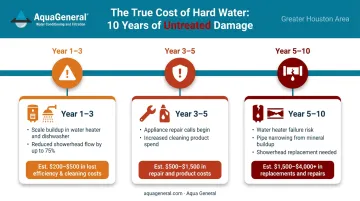
Each of these costs appears as a maintenance bill or replacement expense — not as a filtration budget line. That makes the impact easy to underestimate, because the alternative (a filtration system) has a visible upfront cost while the damage from untreated water accumulates invisibly.
For Houston-area homeowners, hard water and municipal disinfection byproducts create a compounded effect on appliances and household comfort that exceeds what most regions deal with.
Addressing symptoms one at a time — a failed appliance here, bottled water costs there — consistently runs higher over a 10-year horizon than installing filtration at the point of entry.
Is a Whole House Water Filtration System Worth It for Your Home?
The honest answer: it depends on your specific situation. Here's a practical framework.
Whole House Filtration Is Clearly Worth It If:
- You rely on well water with no municipal treatment baseline
- Your home has confirmed hard water (very common across Harris, Fort Bend, Montgomery, and surrounding Houston counties)
- You have young children, elderly family members, or anyone with compromised immunity
- You're currently buying bottled water regularly for taste or safety concerns
- You're dealing with frequent appliance scale issues or early water heater failure
A Partial Solution May Be Sufficient If:
- You rent and can't install whole-home equipment
- Your only concern is drinking water taste at one faucet
- You want to start gradually before committing to a full system
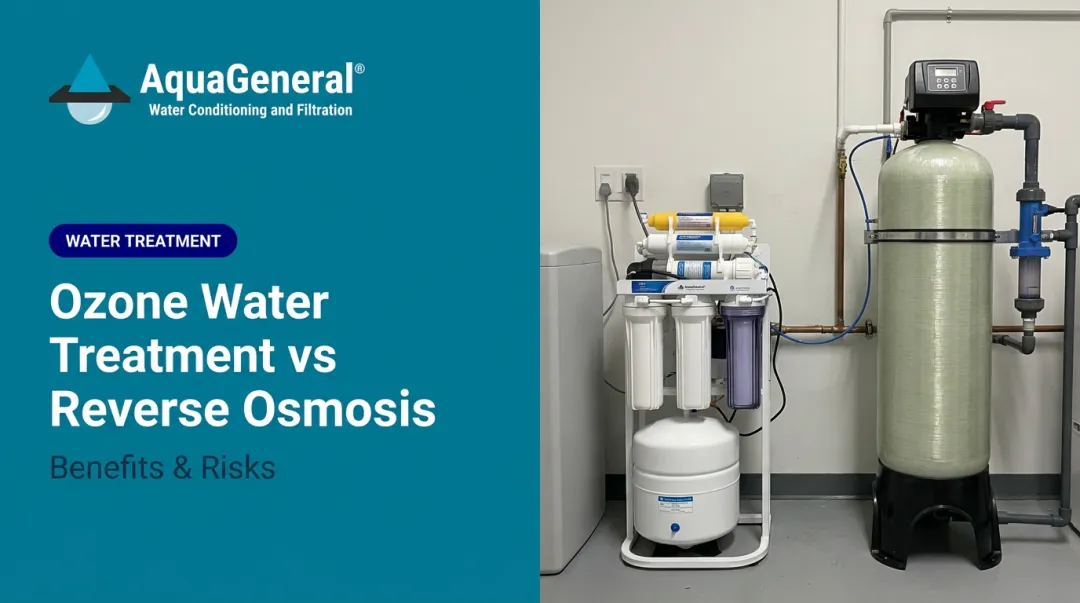
In partial-solution cases, a point-of-use under-sink reverse osmosis system at the kitchen tap is a more appropriate starting point — though it won't address appliances, plumbing, bathing exposure, or laundry.
What to Look for in a Houston-Specific System
Houston homeowners should look for systems certified to address the full range of Houston-area contaminants, not just chlorine taste and odor. Key targets include:
- Disinfection byproducts
- Lead and hexavalent chromium
- Arsenic
- Hard water minerals (calcium and magnesium)
- Fine particulates down to 0.02–5 microns
Aqua General's exclusive whole house water conditioner is built specifically for the Greater Houston water profile, combining softening, anti-microbial protection via silver-impregnated media, activated carbon chemical reduction, and fine particle filtration in a single WQA/NSF-certified system.
Contact Aqua General for a custom quote on whole house water treatment system installation in the Houston area — pricing varies by system type, complexity, and configuration.
How to Get the Most Value from Your System
Start with a Water Quality Test
Skipping the test and buying a generic system is the most common mistake. A professional water quality test identifies what's actually in your water — hardness level, specific contaminants, sediment load — so you can select filtration stages that address real problems rather than assumed ones.
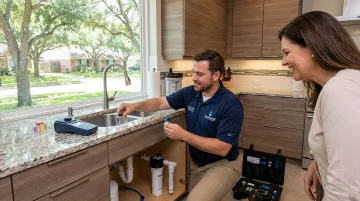
Aqua General offers free on-site water testing for homeowners across the Greater Houston area, covering Harris, Fort Bend, Montgomery, Brazoria, Galveston, and surrounding counties. The process moves from test results to system recommendation to installation, matched to each home's actual water profile.
Keep Up with Maintenance
A whole house system is only as effective as its maintenance schedule. General industry guidance for filter replacement intervals:
| Component | Typical Replacement Interval |
|---|---|
| Sediment pre-filter | Every 3–6 months |
| Carbon filter | Every 6–12 months |
| UV bulb | Annually |
| Specialty media tanks | Every 5–10 years |
A neglected filter can reduce flow rate, allow contaminants to pass through, and create the false impression the system isn't working. Staying on schedule maintains performance and protects the full investment.
Work with a Certified Local Specialist
Water quality varies significantly across the Houston region, depending on which of the city's public water sources supplies your home and your local water district's treatment practices. A certified local specialist understands these regional differences and will recommend a system built around your actual conditions, not a generic package.
Aqua General's team holds WQA certification and a TCEQ Class III Water Treatment Specialist License, with over 32 years of Greater Houston installations. Their ongoing service program keeps systems running at full performance well after the initial setup.
Frequently Asked Questions
How much should a whole house water filtration system cost?
System costs vary based on configuration, home size, and water conditions. Multi-stage systems combining softening, chemical reduction, and fine particle filtration require professional assessment to size and quote accurately. Contact a certified local water treatment specialist for a tailored estimate.
Do I really need a whole house water filtration system?
Well water users, households with hard water, and families with health-sensitive members typically need whole-home protection. If your only concern is drinking water taste and you rent or have very soft water, an under-sink point-of-use filter may be sufficient. A professional water test is the most reliable way to decide.
What is the best whole house water filter for arsenic?
Standard carbon or sediment filters don't reduce arsenic. You need a system with a certified arsenic-reduction stage — typically activated alumina, anion exchange, or reverse osmosis — verified under NSF/ANSI 53 or NSF/ANSI 58. Always confirm the certification covers arsenic specifically, not just general filtration claims.
What contaminants does a whole house water filtration system remove?
A multi-stage system addresses sediment, chlorine, chloramines, VOCs, disinfection byproducts, lead, and heavy metals. With the right add-on stages, it can also target bacteria, hardness minerals, arsenic, and PFAS. What it removes depends entirely on which stages are included and their certifications.
How long do whole house water filtration systems last?
Filter cartridges typically need replacement every 6–12 months depending on water quality and usage. The system housing and major components commonly last 10–20 years with proper maintenance — annual check-ups help catch performance issues before they affect water quality.
Do whole house water filters work with hard water?
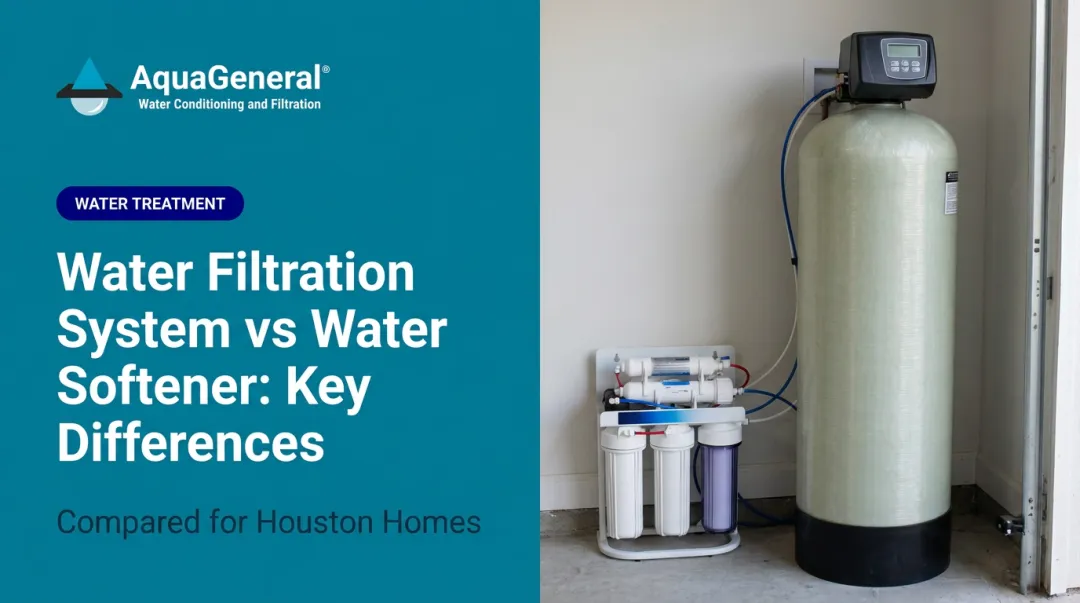
Standard carbon or sediment filters don't soften hard water — they're separate problems requiring separate solutions. A system combining a water softener or ion exchange conditioner with filtration stages addresses both hardness and chemical contaminants together. In the Greater Houston area, where both hard water and chemical contaminants are common, a combined system is usually the most effective approach.