For homeowners weighing their filtration options, the choice usually comes down to two approaches: whole house systems that treat every drop entering the home, or under-sink systems that filter water at a single tap. Picking the wrong one means either overspending on coverage you don't need — or underprotecting the water your family actually drinks.
This guide breaks down how each system works, what each removes, what they cost, and how to match the right solution to your home's actual water profile.
Key Takeaways
- Whole house systems protect your plumbing, appliances, and every faucet from sediment, chloramines, and hard water scale
- Under-sink filters deliver deeper contaminant removal (lead, PFAS, arsenic, nitrates) for drinking and cooking water specifically
- Whole house systems carry a higher upfront cost; under-sink filters are more affordable but protect only one tap
- Houston's chloramine-treated, moderately hard water makes whole house protection especially valuable
- Pairing both systems delivers the strongest protection for families with serious drinking water concerns
Whole House vs. Under-Sink Water Filters: Quick Comparison
| Whole House Filter | Under-Sink Filter | |
|---|---|---|
| Coverage Scope | Every faucet, shower, appliance | Single tap only |
| Contaminant Removal | Sediment, chlorine/chloramines, scale, some metals | Lead, PFAS, arsenic, nitrates, cysts, dissolved solids |
| Installation | Professional required at main line | Professional installation at kitchen sink |
| Maintenance | Pre-filter every 6–9 months; media every 3–5 years | Pre/post filters every 6–12 months; membrane every 2–5 years |
NSF/ANSI Certifications to Look For
Marketing claims don't equal verified performance. When evaluating any system, check for these NSF/ANSI standards:
- NSF/ANSI 42: covers aesthetic effects — chlorine, taste, odor, and particulates (applies to both system types)
- NSF/ANSI 53: covers health-effect contaminants including lead, VOCs, chromium, and cysts
- NSF/ANSI 58: specific to reverse osmosis systems, covering TDS reduction plus optional claims for arsenic, nitrates, and fluoride
The WQA Gold Seal complements these standards by independently testing and validating products against NSF/ANSI benchmarks — a useful independent confirmation that a system performs as advertised.
What Is a Whole House Water Filter?
A whole house filter is a point-of-entry (POE) system installed at the main water supply line. Every drop entering your home — at every shower, faucet, dishwasher, washing machine, and water heater — passes through filtration before it touches your pipes or appliances.
How These Systems Work
Most whole house systems work in multiple stages. A sediment pre-filter captures large particles first. Carbon media then handles chlorine and chemical reduction. Advanced systems add specialty media for finer contaminant removal.
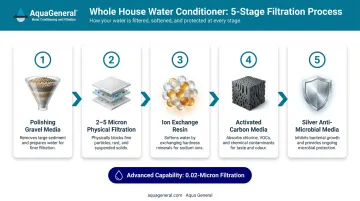
Aqua General's AquaGuard® Whole-House Water Conditioner combines all of this into a single five-stage unit:
- Polishing gravel media — initial filtration stage
- 2–5 micron physical filtration media — removes sediment and suspended solids (a human red blood cell is approximately 5 microns)
- Fine mesh 10% cross-linked ion exchange resin — removes hardness minerals (calcium and magnesium), heavy metals, and certain radioactive metals
- Filtrex® activated carbon media — reduces chlorine, disinfection byproducts, and organic chemicals
- Silver-impregnated anti-microbial media — inhibits bacteria growth within the system itself
The system can filter particles down to 0.02 microns — 250 times smaller than a red blood cell — far beyond what a traditional water softener can achieve on its own.
Why This Matters for Houston Homes
Houston's Main System uses chloramines rather than free chlorine. According to WQA's GAC fact sheet, reducing chloramines requires approximately four times more contact time with carbon media than removing free chlorine — meaning system design directly affects whether your filter actually works. Standard carbon filters designed for chlorine may underperform against chloramines.
Chloramine performance is only part of the challenge. USGS classifies water above 121 mg/L as hard, and Houston's Main System averages 110 ppm with peaks at 137 ppm. That puts local water on the borderline between moderately hard and hard — and scale buildup in water heaters, dishwashers, and pipes is a real, ongoing cost.
Household-Wide Benefits
- Extends appliance lifespan by preventing scale buildup in water heaters and dishwashers
- Reduces skin dryness and hair irritation from de-chlorinated shower water
- Keeps fabrics brighter and cuts detergent use with softer water
- Improves taste at every tap, not just the kitchen sink
The Key Limitation
Whole house systems filter water at the point of entry — before it reaches your home's internal plumbing. If your home has older pipes or fixtures that leach lead or other metals after the filter, those contaminants won't be caught. That's where under-sink systems fill the gap.
What Is an Under-Sink Water Filter?
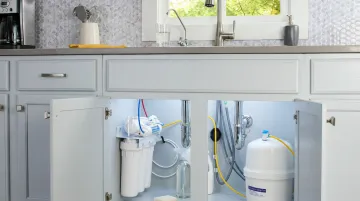
An under-sink filter is a point-of-use (POU) system installed beneath the kitchen sink (or another single faucet). It treats water immediately before it's dispensed — which means it also captures contaminants that may have entered the water from the home's own plumbing, including lead from older pipes or fixtures.
How Under-Sink Filtration Works
Water moves slowly through multi-stage filter media — activated carbon, ceramic, and in reverse osmosis versions, a semi-permeable membrane. This slower flow rate enables removal of much smaller contaminants than most whole house systems can address, which is why most models include a dedicated filtered water faucet rather than running through your main tap.
A high-performance RO system — such as Aqua General's AquaGuard® 9-Stage Undersink RO, which filters down to 0.001 microns at the membrane stage — can address a wide range of contaminants, including:
- Lead, arsenic, barium, copper, hexavalent chromium
- Chloramines (via dedicated catalytic carbon stage)
- Fluoride, nitrates, pharmaceuticals, and PFAS
- Viruses, cysts, and bacteria
- Alpha particles and microplastics
NSF/ANSI 58-certified RO systems must reduce TDS and may carry optional certified claims for lead, arsenic, nitrate, chromium, cysts, VOCs, fluoride, and radium — making them the strongest tool for targeted drinking water safety.
Where Under-Sink Filters Excel
EPA identifies RO as a treatment technology for arsenic, nitrates, and chromium-6 specifically. For Houston homeowners concerned about the city's reported arsenic (average 1.8 ppb, max 9.9 ppb approaching the 10 ppb MCL) or lead (9 samples exceeding the action level in the 2024 CCR), an under-sink RO system provides targeted, verified protection at the point of consumption.
Practical Advantages for Homeowners and Renters
- Affordable entry point compared to whole house systems
- Quick professional installation at one location
- Eliminates reliance on bottled water
- Ideal for renters or those focused primarily on drinking water quality
Where Under-Sink Filters Fall Short
That convenience comes with a clear boundary: single-point coverage. An under-sink filter does nothing for shower water, laundry, appliances, or any other tap in the home. It won't prevent scale damage to your water heater or reduce chloramine exposure during bathing. To cover the whole home, you'd need multiple units, which quickly negates the cost advantage.
Which Water Filtration System Is Right for Your Home?
Start with your water, not a product catalog. Houston homeowners can request their annual Consumer Confidence Report (CCR) by calling 311 or emailing waterquality@houstontx.gov. For older homes or well water, a professional water test is worth the investment.
Clear Decision Framework
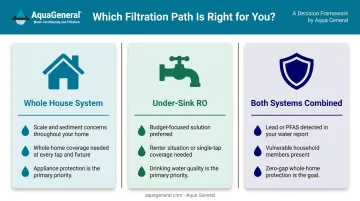
Choose a whole house system if:
- Your primary concerns are scale, sediment, or chloramine exposure affecting appliances, plumbing, and bathing
- You want improved water quality at every tap and shower — not just the kitchen
- You're seeing hard water damage on fixtures, shortened appliance lifespans, or soap that won't lather
Choose an under-sink system if:
- Your budget is limited and your main concern is safe drinking and cooking water
- You're in a rental or plan to move
- You want to eliminate bottled water without a whole-home commitment
Consider combining both if:
- Your water report shows both sediment/chemical issues and health-concern contaminants like lead or PFAS
- Your household includes children, elderly members, or anyone with a compromised immune system
- You want comprehensive protection without any gaps
What Does It Cost?
| System Type | Annual Maintenance |
|---|---|
| Whole house filter/conditioner | Pre-filter replacements + periodic media service |
| Under-sink RO | Pre/post filters every 6–12 months; membrane every 2–5 years |
When a whole house system is installed upstream of an RO unit, RO pre-filters can last nearly twice as long — because incoming water is already cleaner. For many Houston homeowners, that extended filter life alone can offset a significant portion of the whole house system's annual maintenance cost within the first few years.
The Case for Both in Houston
Houston's chloramine-treated municipal water, moderate-to-hard water hardness, and the presence of arsenic and lead in the supply report create conditions where neither system alone addresses the full picture. A whole house system handles sediment, chloramines, and scale at entry. An under-sink RO then handles finer dissolved contaminants for drinking and cooking, including anything that may leach from internal plumbing before reaching your glass.
For homes where both concerns are present, a layered approach isn't over-engineering — it's the most direct path to complete coverage. Aqua General's WQA Certified Water Specialists have been assessing Houston-area homes across eight counties for over 32 years. A professional water assessment identifies exactly what your water needs and which combination of systems will address it — contact Aqua General to schedule one for your home.
Frequently Asked Questions
Is a whole house reverse osmosis system better than an under-sink RO?
Whole house RO provides blanket coverage but at significantly higher cost and complexity. For most municipal water homes, pairing a standard whole house filter with an under-sink RO delivers better value — whole-home protection for scale and chemicals, plus targeted removal of dissolved contaminants at the tap.
Is it healthier to drink tap water or filtered water?
Houston's tap water meets legal safety standards, but filtered water typically tastes better and removes residual contaminants — chlorine, lead, disinfection byproducts — that may be present at non-zero levels. For daily consumption, filtered water is the more conservative and healthier choice.
What is the best water filter for Giardia?
CDC recommends filters certified to NSF/ANSI 53 or 58 for cyst reduction, or filters with an absolute pore size of 1 micron or smaller. Under-sink RO systems and whole house systems with sub-micron filtration capability both provide effective protection — confirm the specific certification claim before purchasing.
Can I use both a whole house filter and an under-sink filter together?
Yes — for many Houston homes, this is the recommended approach. The whole house system handles sediment, chlorine/chloramines, and scale at entry. The under-sink filter then adds a second layer for drinking and cooking water, catching finer contaminants that remain after whole-house treatment.
How often do filters need to be replaced?
Whole house pre-filters typically need replacement every 6–9 months; carbon media lasts roughly 3–5 years depending on usage. Under-sink RO pre- and post-filters run 6–12 months, with the membrane lasting 2–5 years. A drop in water pressure or change in taste usually signals it's time.
Does a whole house water filter replace a water softener?
Standard filters and softeners serve different purposes — filters remove contaminants while softeners specifically address hardness minerals through ion exchange. Some advanced systems combine both functions. Aqua General's AquaGuard® Whole-House Conditioner combines both: true ion exchange softening alongside chemical reduction, sediment filtration, and anti-microbial protection in a single unit.