The choice between point of entry (POE) and point of use (POU) filtration shapes every faucet, appliance, and glass of water in your home. Choose wrong, and you're either overspending on protection you don't need or leaving a real problem unaddressed.
This guide breaks down exactly how each system works, what Houston's water profile means for your decision, and when using both together makes the most sense.
Key Takeaways
- POE systems treat all water entering your home—protecting plumbing, appliances, skin, and laundry
- POU systems treat water at a single tap, delivering the highest-purity drinking water achievable
- Houston's 2024 Water Quality Report shows average hardness of 110 ppm and chloramine at 3.0 ppm, affecting both whole-home and drinking water quality
- Neither system is universally better; the right choice starts with knowing what's actually in your water
- Most Houston homeowners benefit from combining both systems for comprehensive water quality coverage
POE vs. POU: Quick Comparison
| Factor | POE (Whole House) | POU (Under-Sink/Tap) |
|---|---|---|
| Installation location | Main water supply line entering the home | Single faucet, under-sink, or countertop |
| Coverage | 100% of water used throughout the home | Only the water drawn at that one point |
| Treatment goal | Hardness, sediment, chlorine/chloramine, microorganisms | Heavy metals, nitrates, fluoride, dissolved solids |
| System size | Larger; professional installation required | Compact; minimal space needed |
| Installed cost range | $1,129–$10,000 depending on system type | Roughly $150–$1,500 depending on technology |
| Annual maintenance | Roughly $150–$500/year for filters and media | Filter replacements every 6–12 months; typically $50–$200/year |
What Is a Point of Entry (POE) Water Filtration System?
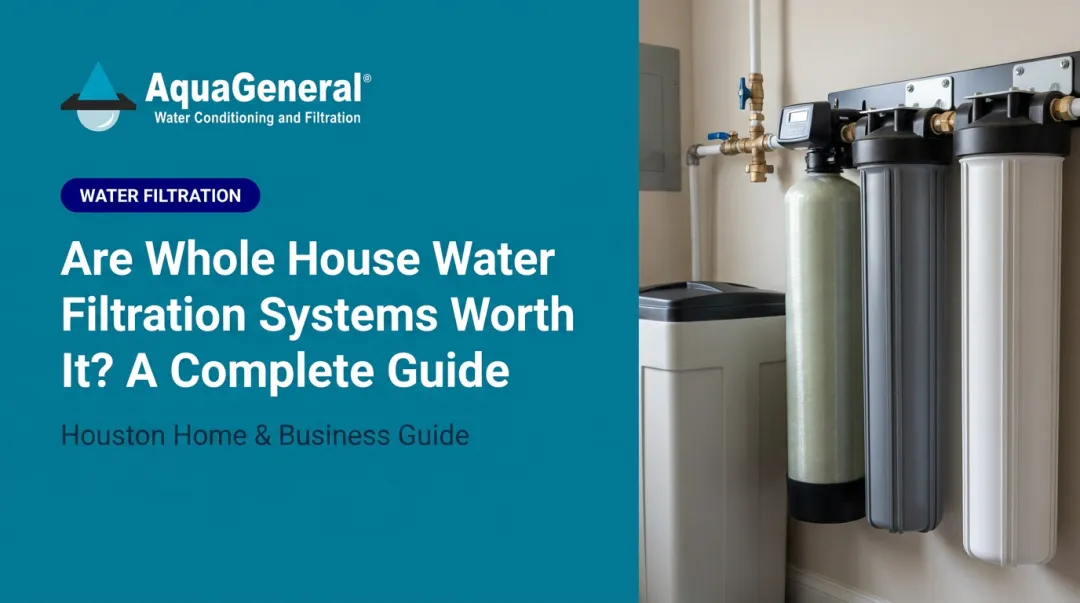
A POE system—also called a whole-house filter—installs at your main water supply line before water distributes to any fixture. Every tap, shower, washing machine, and dishwasher receives treated water. You'll hear "POE" and "whole-house filter" used interchangeably.
Treatment Technologies in POE Systems
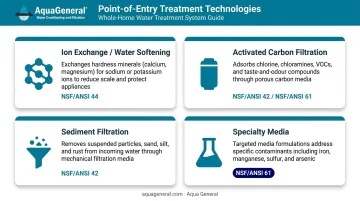
Common POE treatment approaches include:
- Ion exchange (water softening): Removes calcium and magnesium ions responsible for hard water scale, governed by NSF/ANSI 44 for residential softeners
- Activated carbon filtration: Reduces chlorine taste and odor, certified under NSF/ANSI 42 for aesthetic effects
- Sediment filtration: Captures particulate matter before it reaches appliances and fixtures
- Specialty media: Addresses iron, sulfur, or microbial concerns specific to the water source
Aqua General's exclusive whole-house water conditioner goes further, combining softening, anti-microbial media, chemical reduction, and fine particle filtration down to 0.02–5 microns in a single system—smaller than a human red blood cell.
What POE Protection Means for Your Home
A functioning POE system delivers concrete, whole-home benefits:
- Prevents scale buildup in water heaters (WQRF research found up to 24% efficiency loss at 30 grains per gallon of hardness)
- Reduces soap and detergent usage—softened water maintains cleaning effectiveness at lower doses and temperatures
- Protects plumbing infrastructure from mineral accumulation over time
- Improves laundry results and extends fabric life
- Delivers softer water for bathing
Houston's Water Profile Makes POE Systems Especially Relevant
According to Houston's 2024 Water Quality Report, the city's Main System hardness averages 110 ppm (ranging up to 137 ppm)—placing Houston water in the moderately hard to hard range by USGS classification. Chloramines average 3.0 ppm, and total trihalomethanes (TTHM) reach a locational running annual average of 45 ppb.
These figures stay within regulatory limits, but they're the kind of daily water quality conditions—hardness, disinfectants, byproducts—that a POE system directly targets.
One important boundary: POE systems are not designed to remove dissolved contaminants like nitrates, fluoride, or trace pharmaceuticals. This is a deliberate design distinction, not a limitation. Ultra-fine purification at the tap is the job of a POU system.
POE Use Cases
POE systems are the right choice when:
- Your water is hard (very common across Greater Houston)
- You're on well water with sediment or bacterial concerns
- Municipal chlorine or chloramine affects taste, odor, or skin
- You want to protect plumbing and appliances throughout the entire home
What Is a Point of Use (POU) Water Filtration System?
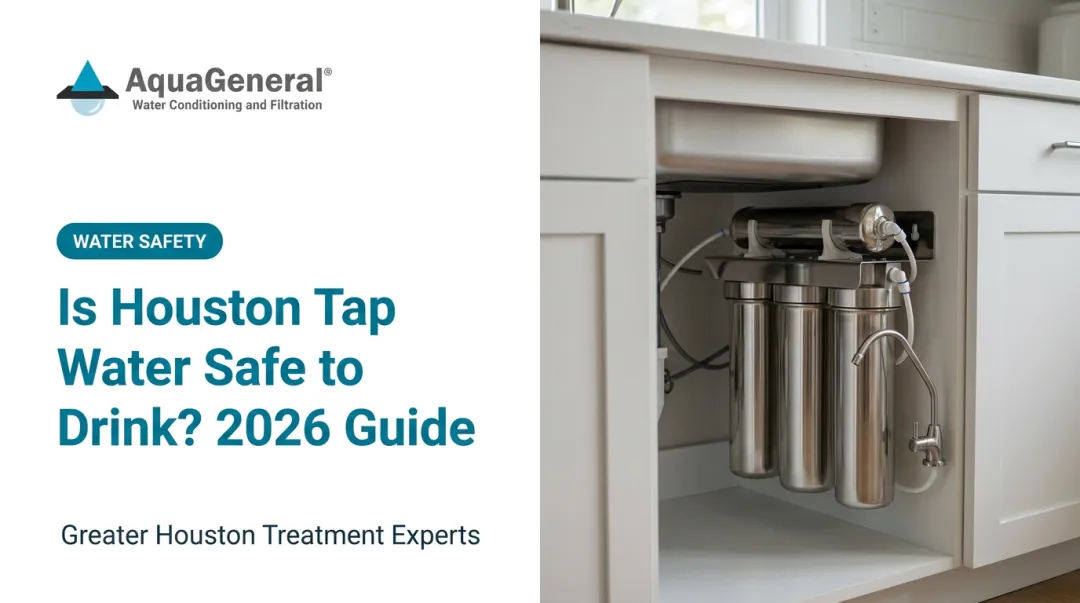
A POU system installs at a single location—typically under the kitchen sink—and treats only the water drawn at that point. The goal is highest-purity drinking and cooking water, not whole-home coverage.
Reverse Osmosis: The Core POU Technology
The most capable POU option is a reverse osmosis (RO) system. It pushes water through a semi-permeable membrane to remove dissolved contaminants that whole-house systems can't target. Under NSF/ANSI 58, certified RO systems can carry optional reduction claims for:
- Lead
- Arsenic
- Hexavalent chromium
- Nitrates and nitrites
- Fluoride
- Trivalent chromium
TDS (total dissolved solids) reduction is mandatory under NSF/ANSI 58; other claims are optional and specific to each certified system. Always verify which claims apply to the exact model you're considering.
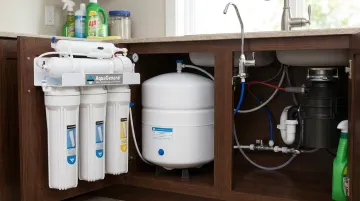
That certification framework matters when matching a system to local water. Aqua General's under-sink RO system, for example, operates at 50 gallons per day and includes a catalytic carbon stage for chloramine removal—a relevant concern for Houston's municipally treated water—plus a remineralization stage that restores beneficial minerals and raises pH.
Other POU Options
For situations where full RO isn't needed:
- Countertop filters: Easy to install, good for renters, lower filtration capability
- Faucet-mounted filters: Convenient, but generally limited to aesthetic improvements
- Inline refrigerator filters: Address taste and odor for ice and chilled water
Each of these works well for targeted aesthetic concerns—taste, odor, sediment—but won't address dissolved contaminants like lead or nitrates.
The Critical POU Limitation
A POU system only protects the user at that tap. Showers, laundry, the dishwasher, and every other fixture still receive untreated water. If hard water scale or chloramine exposure throughout the home is a concern, a POU system alone doesn't solve it.
POU Use Cases
POU systems are the right fit when:
- Your primary concern is drinking and cooking water quality
- You want to eliminate bottled water purchases
- Targeted contaminants like lead, nitrates, or PFAS pose an ingestion risk rather than a whole-home exposure concern
- You want to add a final polishing stage after a POE system is already installed
Which System Is Right for Your Houston Home?
Start with a Water Test
This is the foundational step that too many homeowners skip. The contaminants in your specific water—not assumptions about your neighborhood or municipal system—should drive your system choice. Houston's 2024 report gives city-wide averages, but your actual tap results can vary.
Aqua General provides free on-site water testing across Harris, Fort Bend, Montgomery, Galveston, Brazoria, and surrounding counties. A test first means no guesswork.
Decision Framework
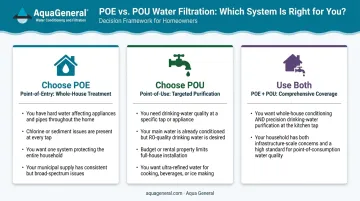
Choose POE if:
- Your water is hard (scale on fixtures and appliances is a visible sign)
- You notice chlorine or chloramine odor in showers or from the tap
- Sediment or iron affects water appearance or taste
- You want whole-home protection for plumbing, appliances, and skin
Choose POU if:
- Your main concern is the quality of water you drink and cook with
- You want to remove dissolved contaminants—lead, fluoride, nitrates—that whole-house systems aren't certified to target
- You're a renter without the option for a whole-house installation
Use both if:
- Your water test shows both hardness/aesthetic issues and dissolved contaminants of concern
- You want comprehensive protection: appliances, plumbing, and drinking water purity
The Case for Using Both Together
The layered approach is what water quality professionals most often recommend. A POE system pre-treats incoming water by removing hardness, sediment, and chlorine. The RO system downstream then works on already-conditioned water, making its job far easier.
The practical benefit: Aqua General's field experience shows that RO pre-filters lasting 6–12 months under standard conditions can last nearly twice as long when a whole-house system handles upstream contaminants. The RO membrane also stays cleaner longer, maintaining peak performance between replacement cycles.
A Typical Houston Scenario
Consider a homeowner in Katy or Sugar Land dealing with white scale buildup on showerheads and fixtures, plus water that tastes faintly of chlorine. A POE whole-house conditioner addresses the hard water, protects plumbing and appliances, eliminates chloramine odor in showers, and reduces the buildup that shortens water heater life.
An under-sink RO at the kitchen tap then handles drinking water—removing residual dissolved contaminants and delivering quality comparable to bottled water. If your test results show both aesthetic and dissolved contaminant concerns, that combination is worth a conversation with a water specialist.
Frequently Asked Questions
What is a point of entry water filtration system?
A POE system installs at the main supply line entering your home, treating all water before it reaches any fixture. Every tap, shower, appliance, and water-using device in the house receives treated water—which is why it's also called a whole-house filter.
How much does a point of entry water filtration system cost?
Costs vary widely based on system type and home size. Industry aggregate data puts standard whole-house filter installations at $1,129–$3,540, with more advanced multi-stage treatment systems ranging up to $10,000. Annual maintenance typically runs $150–$500. A professional water assessment gives you an accurate quote for your specific situation.
What is the difference between POE and POU water filters?
POE filters treat all water entering the home; POU filters treat water at a single outlet like a kitchen faucet or under-sink tap. They serve different purposes—POE handles whole-home water quality, POU handles drinking-water purity—and they work best as a pair, not as alternatives.
Can I use both a POE and POU system at the same time?
Yes—and it's the most comprehensive approach. The POE system improves whole-home water quality while the POU reverse osmosis system provides the highest-purity drinking water. POE pre-treatment also reduces the workload on the RO system, extending filter and membrane life.
Do I need a POE filter if I already have a water softener?
A water softener is a type of POE system, but it addresses only hardness. Depending on your water test results, you may still benefit from additional POE filtration for chlorine, sediment, or microbial concerns—plus a POU reverse osmosis system for drinking water contaminants like lead or nitrates.
How often do POE and POU systems need maintenance?
It varies by system. EPA WaterSense requires a labeled RO membrane to last at least one year, while WQA guidance puts typical membrane life at 2–5 years with pre/post-filter changes every 6–12 months. POE media and service intervals depend on system design and local water quality.
Aqua General has been helping Houston-area homeowners find the right answer for over 32 years—with free on-site water testing, WQA certification, TCEQ licensing, and the expertise to recommend the right POE, POU, or combined solution for your specific water and home.
Call (713) 664-4601 or visit aquageneral.com to schedule your free water quality assessment.