Industrial reverse osmosis systems solve this by stripping feed water down to a near-mineral-free baseline. Brewmasters can then rebuild that water precisely — adding calcium sulfate for a dry West Coast IPA, calcium chloride for a malt-forward porter, or almost nothing at all for a delicate Czech Pilsner. The result is repeatable chemistry, batch after batch.
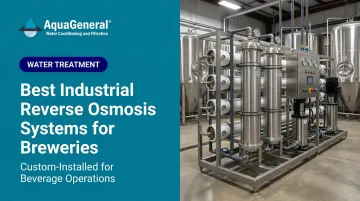
This article covers key evaluation criteria for industrial RO systems for breweries, what separates industrial systems technically, and the factors that actually matter when you're making a capital infrastructure decision.
Key Takeaways
- Beer is ~90% water; without RO, seasonal changes in municipal water chemistry cause unpredictable mash pH and flavor drift
- Industrial RO removes 95–99% of dissolved salts, chlorine, and hardness minerals — creating a controllable brewing baseline
- Top industrial RO systems are evaluated on flow rate scalability, TDS rejection, sanitary standards, and pre-treatment compatibility
- Sizing by daily barrels (BBL) and pairing with a Hot Liquor Tank (HLT) matters more than brand name
- Breweries in Greater Houston can contact Aqua General for water analysis and custom system sizing
Why Breweries Need Industrial Reverse Osmosis Systems
The Water Chemistry Problem
Three brewing outcomes are directly controlled by source water chemistry: mash enzyme activity (target pH 5.2–5.6, measured 10–15 minutes after dough-in), hop utilization efficiency, and final beer flavor expression. Sulfate ions drive a drier, more assertive hop bitterness; chloride produces a rounder, fuller malt impression. When those ion levels are wrong or inconsistent, the beer changes even when the recipe doesn't.
Many cities blend surface water and groundwater by season. The water profile a brewery tested in January may look nothing like what arrives in August. Craft Beer & Brewing documents this variation directly, noting that mash pH and flavor are downstream consequences of whatever mineral and alkalinity profile arrives at the brewhouse that day.
Why Industrial Units — Not Residential RO — Are Required
A coffee shop counter-top RO unit produces a few hundred gallons per day. A 30-barrel brewery might need several thousand gallons of process water on a brew day, with surge demand during mash-in and sparge. The gap is enormous.
Production brewery applications require:
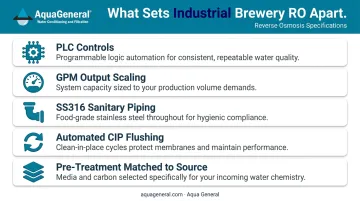
- Motors and PLC controls rated for continuous daily brew cycles, not occasional use
- GPM output scaled to brewhouse barrel capacity and production schedule
- SS316 sanitary piping and membrane housings for food-grade compliance
- Automated CIP (Clean-in-Place) flushing to sustain membrane performance
- Pre-treatment matched to the water source: carbon filtration for municipal chloramines, anti-scalant and iron reduction for well water
The Municipal and Well Water Threat
Membrane manufacturer documentation is clear: RO membranes tolerate free chlorine at less than 0.1 ppm. Continuous chlorine or chloramine exposure above that level causes irreversible oxidation damage. Municipal water routinely exceeds that threshold without upstream carbon pre-treatment.
Well water introduces different risks. High hardness (above 110 mg/L triggers anti-scalant requirements), iron fouling, and sediment loading each require specific pre-treatment. The right pre-treatment configuration depends entirely on what's in your source water — a site water test is the necessary starting point before any system is specified.
Key Evaluation Criteria for Industrial RO Systems
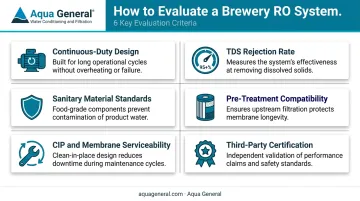
Industrial RO systems for breweries should be evaluated on flow rate scalability, TDS rejection rates (95-99%), sanitary material standards (SS316 piping and housings), pre-treatment compatibility for both municipal and well water, CIP and membrane serviceability, and third-party certification (NSF/ANSI 58, WQA Gold Seal).
Small to Mid-Size Brewery RO Systems
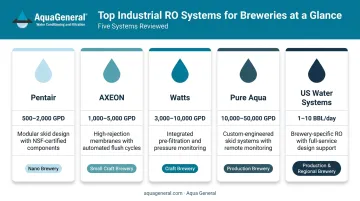
Commercial RO systems in the 200–20,000 GPD range are well-suited for nanobreweries, taprooms, and small production facilities needing ingredient-water polishing or partial mineral reduction. Key features to look for include NSF/ANSI 58 certification, blended-water output capability, and modular expandability.
Mid-Size to Large Production Brewery RO Systems
Custom-engineered industrial skids covering 12,000 GPD to hundreds of thousands of GPD support production breweries with demanding water volumes. These systems typically include ultra-low-energy membranes, smart TDS monitoring, pre-plumbed and pre-wired frames, and food-and-beverage-application-specific construction.
Brewery-Specific RO Configurations
Some commercial systems are packaged with brewery-day framing (BBL/day capacity), which simplifies sizing for brewmasters compared to raw GPD numbers. Features such as permeate-flush options, atmospheric storage tank pairing, and automatic membrane shutdown flushing are particularly valuable for breweries that don't run their RO continuously.
For breweries with challenging feed water — high TDS, high hardness, or variable well water — fully custom turnkey RO skids with SS316 high-pressure piping, PLC automation, 5-micron pre-filtration, and membrane cleaning skid (CIP) support provide the strongest engineering depth.
Aqua General provides industrial water treatment services for Houston-area brewery clients and can provide parts, service, and support through an established local channel. Contact Aqua General at (713) 664-4601 for system sizing and service.
Industrial RO vs. Other Water Treatment Methods for Breweries
Not every water treatment approach gives breweries what they actually need. Here's how the main options compare:
| Method | What It Does | Why It's Insufficient Alone |
|---|---|---|
| Carbon/sediment filtration | Removes chlorine odor, suspended solids | Doesn't reduce TDS, alkalinity, or hardness — mash pH and equipment scaling remain unresolved |
| Ion-exchange softening | Replaces calcium/magnesium with sodium | Raises sodium TDS; creates harsh, salty character in light lagers and Pilsners; no mineral-free baseline |
| Industrial RO | Removes 95–99% of dissolved salts | Requires mineral rebuilding afterward — RO permeate is a starting point, not finished brewing liquor |
Carbon filtration is essential as pre-treatment before RO — specifically for chlorine and chloramine removal to protect membranes. Water softening has legitimate scale-protection uses upstream of an RO system. Neither technology on its own gives a brewmaster a controllable mineral baseline.
Only industrial RO creates true "blank slate" water. From that baseline, brewmasters add back precisely what each style demands:
- Calcium sulfate for a dry, bitter West Coast IPA
- Calcium chloride for a malt-forward stout
- Minimal additions for a soft Czech Pilsner
That precision is impossible when the source water's mineral content is unknown or uncontrollable — which is exactly why RO is the starting point, not the finish line.
How We Chose the Best Industrial RO Systems for Breweries
The Evaluation Framework
Systems were assessed against criteria that reflect real brewery operating conditions:
- Continuous-duty design: industrial motors, PLC controllers, and skid-mounted construction rated for daily brew cycles
- TDS rejection rate: industry standard TFC membranes achieve 95–99% or greater TDS rejection, depending on membrane type, temperature, and operating pressure
- Sanitary material standards: SS316 piping and membrane housings meeting food-grade compliance requirements
- Pre-treatment compatibility: supports both municipal (chloramine removal) and well water (anti-scalant, iron filtration) configurations
- CIP and membrane serviceability: cleaning more than six times per year signals poor pre-treatment or off-spec operation
- Third-party certification: NSF/ANSI 58 and WQA Gold Seal were both checked — verified at the model level, not just the brand level
Applying these criteria in practice also means knowing where buyers go wrong. The mistakes below are directly tied to the gaps these criteria are designed to catch.
Common Purchasing Mistakes to Avoid
Several errors lead to undersized or misapplied brewery RO systems:
- Sizing for a coffee shop, not a brewery: light-commercial units lack the output for production brewing volumes
- Ignoring brine discharge: industrial RO systems reject a significant percentage of feed water as concentrate — facility drainage must account for this upfront
- Underestimating peak GPM demand: RO production is continuous, but sparge and cleaning demand surges on brew days — an atmospheric HLT buffer closes this gap
- Assuming brand certifications cover every model: always verify at the specific model being purchased, not just the product line
- Skipping a water analysis: feed water TDS, hardness, chloramine, and iron content all determine which pre-treatment configuration is required
Conclusion
Choosing an industrial RO system is a major infrastructure investment. The right unit should be matched to your brewery's specific water source (municipal or well), daily production volume in BBL, and the style range you brew — not just the lowest price point on a spec sheet.
Before purchasing, get a professional water analysis. Evaluate vendors on membrane maintenance support, pre-treatment options, scalability as production grows, and access to local technical service — not just initial GPM output.
For breweries in the Greater Houston area, that local technical expertise is available close to home. Aqua General — a WQA Certified Water Specialist and TCEQ Class III licensed water treatment expert with over 32 years of commercial and industrial experience — serves clients across Harris, Fort Bend, Montgomery, Galveston, and surrounding counties.
David A. Davies, Aqua General's president and 2024 WQA Regents Award recipient, can assess your water profile and identify the right industrial RO configuration for your operation. Contact Aqua General at (713) 664-4601 or visit aquageneral.com/contact-us.
Frequently Asked Questions
Which RO system is best for commercial brewery use?
The best commercial brewery RO systems are continuous-duty industrial units with 95–99% TDS rejection, SS316 sanitary construction, and pre-treatment matched to the feed water source. The right choice depends on your daily BBL output, whether you're on municipal or well water, and available floor space. No single unit fits every operation.
Is reverse osmosis water good for brewing beer?
RO water is ideal as a starting point for brewing. It removes 95–99% of dissolved minerals and chlorine, giving brewmasters a neutral baseline to rebuild precisely — calcium sulfate for hoppy IPAs, calcium chloride for malt-forward styles, minimal additions for soft lagers. The key is rebuilding minerals deliberately after filtration.
How much does a commercial reverse osmosis system cost?
Commercial RO system costs vary widely depending on flow rate, automation level, and pre-treatment complexity. Always factor in total cost of ownership — membrane replacement, pre-filter media, and service — not just the purchase price.
How often should RO membranes be replaced in a brewery?
With proper pre-filtration and regular membrane flushing, industrial RO membranes in brewery applications typically last 2–4 years. Light-industrial elements are expected to last more than three years under good operating conditions. Premature failure typically traces back to chlorine breakthrough, fouled pre-filters, or incorrect operating pressure.
What flow rate does a brewery need from an RO system?
Size by total daily liquor demand and brew schedule, not instantaneous GPM alone. Most craft breweries pair their RO unit with a Hot Liquor Tank to buffer surge demand during mash-in and sparge, letting the RO run continuously to fill storage rather than matching peak draw. A 5 BBL brewhouse running two batches daily needs a meaningfully different unit than a 30 BBL production facility.
Can you brew any beer style with RO water?
Yes. RO water supports any style because it starts mineral-free, giving brewers full control over mineral additions. Add calcium sulfate for West Coast IPAs, calcium chloride for porters and stouts, or keep additions minimal for Czech Pilsners and other soft-water lagers. The blank-slate baseline is the advantage.