Introduction
Water is the one ingredient every food and beverage operation shares. It shows up in the product itself — beverages, ice, sauces, recipes — and behind the scenes in cleaning, cooling, and sanitation. That dual role means water quality isn't a secondary concern. It's foundational.
Yet many Houston-area restaurants, hotels, and beverage operations treat water as an afterthought until something goes wrong: cloudy ice, off-tasting coffee, a boiler knocked out by scale buildup — or a food safety incident that could have been prevented.
What follows is a practical breakdown of the contaminants that cause the most problems, the treatment methods that address them, and how to choose the right system for your facility. Houston operators will find specific local context on municipal water quality throughout.
Key Takeaways:
- Water quality affects product taste, safety, shelf life, and equipment performance simultaneously
- Houston's municipal water contains chloramines and moderate-to-hard minerals that require targeted treatment
- Multi-stage treatment — softening, carbon filtration, RO, and anti-microbial media — covers most F&B needs
- NSF and WQA-certified systems support regulatory compliance documentation
- Start with professional water testing — treatment without testing is guesswork
Why Water Quality Is Critical in Food and Beverage Operations
It's in the Product
Water is the primary ingredient in coffee, tea, fountain drinks, soups, sauces, and most beverages. Any variation in dissolved minerals, chlorine, or microbial content changes what ends up in the cup or on the plate.
The Specialty Coffee Association has quantified this precisely: alkalinity above 20 ppm CaCO3 affects coffee acidity more than pH does, and total hardness above 250 ppm is associated with overextracted, bitter flavor profiles. Houston's Main System averages 110 ppm hardness — within acceptable range, but variable enough across the city's sub-systems to shift extraction results from one facility to another.
Beer, carbonated beverages, and tea follow the same logic. Mineral content, chloramine residuals, and dissolved organics interact with flavor chemistry in ways that produce inconsistent results between batches.
Food Safety and Shelf Life
Contaminated water introduces pathogens and chemicals that cause foodborne illness. The CDC estimated 9.9 million domestic foodborne illnesses in 2019, with the USDA placing the total cost at $74.7 billion in 2023 dollars. The risk isn't limited to beverages — any food prepared with, rinsed in, or cooked with facility water is exposed.
Poor water quality also accelerates microbial spoilage, shortening shelf life and producing batch-to-batch inconsistency that damages brand reputation over time.
Equipment and Utility Water
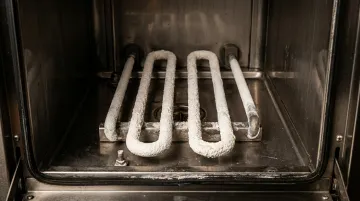
Water running through boilers, ice machines, dishwashers, and steam equipment must be treated too. Hard water deposits calcium and magnesium scale inside these systems, reducing thermal efficiency, increasing energy draw, and shortening equipment life. Houston's municipal water hardness ranges from 43 to 137 ppm across different service areas — some neighborhoods sit in moderately hard territory, others approach the hard classification.
Regulatory Requirements
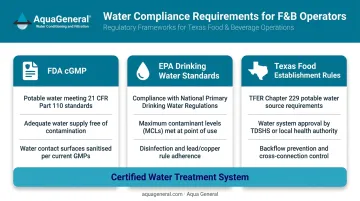
These operational risks also carry legal weight. FDA's 21 CFR Part 117 requires that water contacting food or food-contact surfaces be safe and sanitary. EPA National Primary Drinking Water Regulations establish enforceable contaminant limits. Texas Food Establishment Rules add state-level requirements for source approval, pressure, and backflow prevention. A single compliance failure can trigger facility closure, product recalls, or enforcement actions — consequences that routinely cost more than years of proper water treatment would have.
Common Water Contaminants That Affect Food and Beverage Quality
Understanding what's in your water is the starting point for any treatment decision. F&B operators face three primary categories of concern:
Microbial Contaminants
Bacteria, viruses, and parasites — including E. coli and Cryptosporidium — pose direct health risks and accelerate food spoilage. Houston's 2024 water quality report showed a highest monthly total coliform positive rate of 1.4%, well within EPA's 5% limit, but point-of-use treatment remains critical because premise plumbing conditions vary and municipal compliance doesn't guarantee facility-level safety.
Chemical and Disinfection Byproducts
Houston's municipal system uses chloramines (not free chlorine), with 2024 residuals ranging from 0.03 to 5.4 ppm. Chloramines can react with organic matter to produce disinfection byproducts (DBPs). EPA limits total trihalomethanes (TTHM) to 0.080 mg/L; Houston's 2024 highest LRAA was 45 ppb — within the limit but worth monitoring for beverage operators.
Carbon filtration must be specifically designed for chloramine removal, not just free chlorine.
Hard Minerals and Heavy Metals
Calcium and magnesium cause scale in equipment and alter beverage taste. Houston's 2024 data also showed:
- Arsenic: detected at up to 9.9 ppb (EPA limit: 10 ppb)
- Lead: 90th percentile at 4.4 ppb, with 9 samples above 15 ppb (primarily from premise plumbing)
- Copper: 90th percentile at 0.25 ppm, with 2 samples above the 1.3 ppm action level
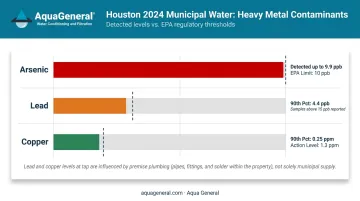
These metals require targeted treatment — especially in older buildings where pipes introduce contamination between the meter and the tap.
Key Water Treatment Methods for Food and Beverage Facilities
No single technology handles every contaminant category. Effective F&B water treatment uses multiple stages, each targeting a specific problem.
Sediment Pre-Filtration
The first stage removes suspended particles, dirt, and debris from raw water. This protects downstream membranes and media from premature fouling, extending the operational life of more expensive treatment components.
Activated Carbon Filtration
Activated carbon adsorbs chlorine, chloramines, organic compounds, and the chemicals responsible for off-tastes and odors. For any business where water flavor directly affects the final product (restaurants, coffee shops, breweries, fountain drink operations), skipping this stage risks off-flavors that customers will notice immediately. NSF/ANSI 42 certifies carbon systems for aesthetic effects like chlorine taste and odor reduction.
Water Softening and Ion Exchange
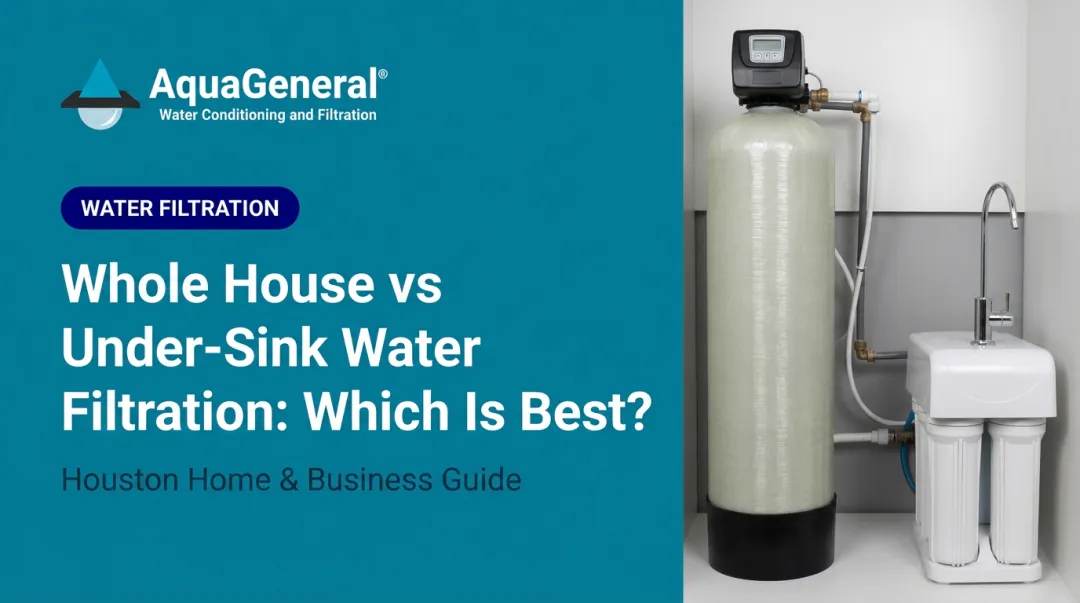
Ion exchange resin replaces calcium and magnesium with sodium ions, eliminating scale buildup in pipes, boilers, ice machines, and dishwashers. NSF/ANSI 44 covers cation-exchange softeners. Given Houston's variable hardness (reaching up to 175 ppm in sub-systems like Willow Chase), proper softening is one of the highest-ROI investments an F&B operator can make in equipment protection.
Reverse Osmosis
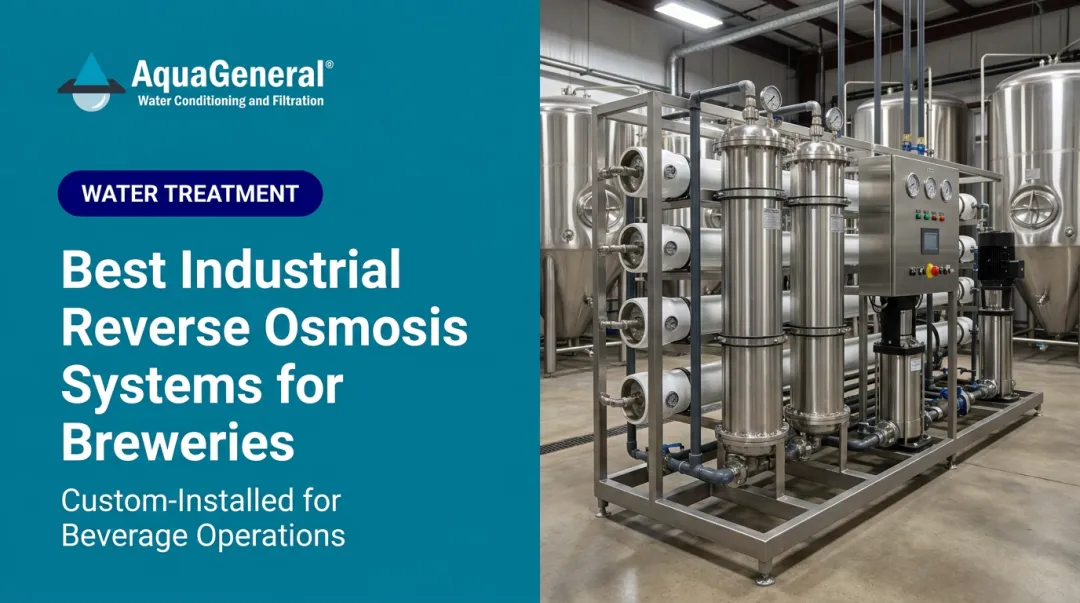
RO systems use a semi-permeable membrane to remove dissolved solids, heavy metals, bacteria, and a broad spectrum of chemical contaminants. NSF/ANSI 58 covers RO systems. This technology produces high-purity water suitable for beverage formulation, bottling, ice production, and other applications where precise water chemistry matters. Aqua General's commercial AQRO systems use high-rejection industry-standard TFC membranes with double 20" pre-filters and fully automatic operation, designed for the continuous demands of F&B environments.
UV and Chemical Disinfection
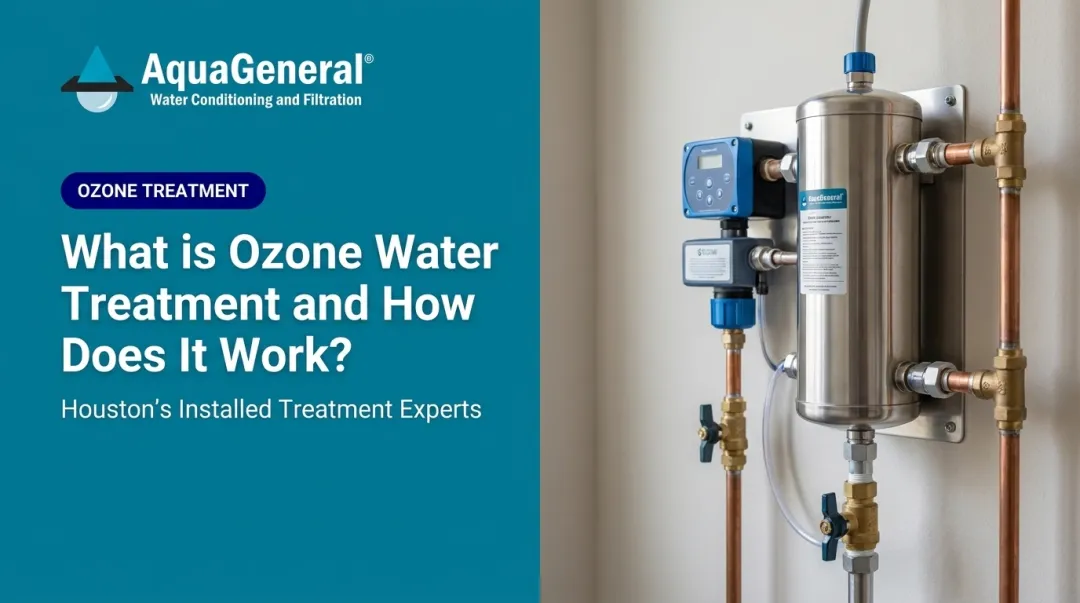
UV systems neutralize bacteria, viruses, and pathogens without adding chemicals or affecting taste. NSF/ANSI 55 Class A systems are validated for inactivation of bacteria and viruses. Ozone and controlled chlorination serve similar purposes in larger industrial settings.
Anti-Microbial Filtration Media
One of the more overlooked vulnerabilities in water treatment is the treatment system itself. Standard filters can accumulate bacteria internally over time, reintroducing contamination into water that's already been processed.
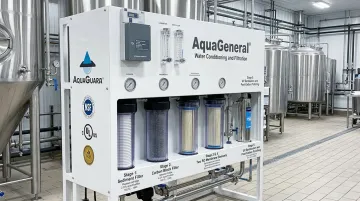
Aqua General's commercial conditioning systems address this directly. Each unit incorporates silver-impregnated anti-microbial media that actively inhibits bacterial growth inside the system itself — not just at the point of filtration. The result is a five-stage point-of-entry unit covering:
- Hardness control via high-grade ion exchange resin
- Chemical reduction via Filtrex® activated carbon
- Fine particle filtration to 2–5 microns (smaller than a human red blood cell)
- Microbial inhibition via silver-impregnated anti-microbial media
- Broad-spectrum protection validated by WQA and NSF certification
Benefits of Proper Water Treatment for Food and Beverage Businesses
Product Quality and Brand Protection
Treated water produces consistent, predictable results across production batches. Taste, appearance, and shelf life all improve when the water variable is controlled. For restaurants and beverage operations competing on product quality, this consistency directly affects customer retention and brand reputation.
The financial stakes are significant. The USDA estimates foodborne illnesses cost the U.S. $74.7 billion annually — a figure that includes medical costs, productivity losses, and pain and suffering estimates. Product recalls linked to contamination drive up costs further through lost inventory, regulatory response, and reputational damage.
Equipment Protection and Operational Savings
Scale buildup from untreated hard water creates costs that compound across every piece of equipment in your operation. Effects include:
- Reduced thermal efficiency in boilers and water heaters (more energy to achieve the same output)
- Increased descaling frequency and chemical costs
- Shortened equipment lifespan for ice machines, dishwashers, and coffee equipment
- Unplanned downtime during peak service periods
For Houston operators, where some municipal sub-systems deliver water approaching 175 ppm hardness, untreated water accelerates these outcomes faster than operators in softer-water cities might expect.
Compliance and Sustainability
Proper treatment supports compliance with multiple overlapping standards and creates documentation for regulatory inspections:
- FDA cGMP requirements for food-grade water use in production
- EPA drinking water standards applicable to commercial operations
- Texas Food Establishment Rules enforced at the state level
Beyond compliance, some modern treatment systems support water recycling and reuse — reducing both intake volume and wastewater. A 2024 EPA white paper on water reuse in beverage manufacturing signals that regulatory expectations in this area are tightening.
How to Choose the Right Water Treatment System for Your F&B Operation
Start with Water Testing
A professional water quality analysis is the necessary first step — it identifies which contaminants are present (hardness, chlorine or chloramines, bacteria, heavy metals, TDS) and at what concentrations. The results determine which treatment stages are necessary and how each should be sized. Aqua General provides free on-site water testing for commercial clients across the Greater Houston area.
Match Treatment to Your Specific Operation
Different F&B applications have different priorities:
| Operation Type | Primary Concerns | Likely Treatment Focus |
|---|---|---|
| Coffee shop / restaurant | Taste, consistency, scale | Carbon, softening, RO |
| Ice-making facility | Clarity, taste, equipment | RO, softening |
| Brewery / beverage production | Precise mineral profile | RO, blending, mineral adjustment |
| Food processing facility | Safety, compliance, volume | Multi-stage with microbial control |
| Hotel / hospitality | Taste, scale, laundry | Softening, carbon |
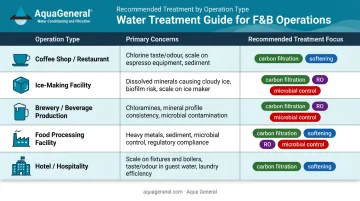
System sizing must also account for peak water demand, flow rate requirements, and physical space constraints — factors best assessed during a site visit.
Evaluate Certifications
Look for systems certified by NSF and WQA. Relevant standards include:
- NSF/ANSI 42 — Aesthetic effects (chlorine, taste, odor)
- NSF/ANSI 53 — Health-effect contaminants (lead, Cryptosporidium, VOCs)
- NSF/ANSI 44 — Cation-exchange water softeners
- NSF/ANSI 55 — UV systems
- NSF/ANSI 58 — Reverse osmosis systems
These certifications validate performance claims and support the compliance documentation F&B businesses need during regulatory inspections.
Work with a Licensed Local Specialist
A water treatment professional with knowledge of local conditions — Houston's chloramine use, the city's variable hardness across sub-systems, and premise plumbing variables in older buildings — can design a system that accounts for your actual source water, not generic assumptions.
Aqua General has served F&B businesses across the Greater Houston area since 1994. Key credentials include:
- TCEQ Class III Water Treatment Specialist License — among the first issued in Texas
- WQA Certified Water Specialist designation
- Water Quality Association Regents Award (2024)
Contact Aqua General to schedule a free on-site water analysis for your operation.
Frequently Asked Questions
What are the main methods of water treatment in the beverage industry?
The core methods are sediment filtration, activated carbon filtration, water softening (ion exchange), reverse osmosis, and UV disinfection. Most beverage operations use a multi-stage combination because different contaminant types require different removal mechanisms; no single technology handles everything on its own.
Why is water quality important in food and beverage production?
Water is both a direct ingredient and a process utility. Its quality affects product taste, safety, shelf life, and equipment lifespan. Regulatory compliance under FDA, EPA, and Texas rules also requires water to meet specific sanitary standards.
How does hard water affect food and beverage businesses?
Hard water deposits calcium and magnesium scale inside ice machines, boilers, dishwashers, and coffee equipment, reducing efficiency, increasing maintenance costs, and shortening lifespan. Elevated mineral content also alters the taste of coffee, tea, and other beverages; the shift can be subtle or pronounced depending on mineral levels.
What contaminants are most common in water used in food processing?
The main categories are microbial contaminants (bacteria, viruses, parasites), hardness minerals (calcium, magnesium), chlorine or chloramines and their disinfection byproducts, heavy metals (lead, arsenic, copper), and suspended sediment. Houston's municipal water contains measurable levels across most of these categories.
Does water quality affect the taste of coffee, tea, and fountain drinks?
Yes. Dissolved minerals, chloramines, and organic compounds directly alter flavor. Chloramines contribute off-tastes and odors; high hardness shifts coffee extraction toward bitter, overextracted profiles. Activated carbon filtration and RO are the most effective tools for improving beverage taste and batch consistency.
How often should commercial water treatment systems be serviced?
General intervals: RO pre-filters every 6–12 months, membranes every 2–3 years, softener salt every 2–4 months, and carbon or media filters every 3–5 years. High-volume food and beverage operations typically need more frequent service. A professional water assessment will give you the most accurate schedule for your system.