Ion exchange water softeners are the standard residential fix — but most homeowners who own one couldn't explain what actually happens inside the tank. This guide walks through the chemistry step by step, from how resin beads capture hardness minerals to how a salt brine restores the system, so you can make smarter decisions about sizing, maintenance, and whether a softener alone is enough for your home.
Key Takeaways
- Ion exchange softeners swap calcium and magnesium ions for sodium ions using a bed of charged resin beads
- Houston-area hardness ranges from 43 mg/L in parts of Harris County to over 230 mg/L in Lake Jackson — local water data is essential for proper sizing
- Water above 7 GPG (roughly 120 mg/L) is classified as hard and warrants treatment
- Demand-initiated regeneration (DIR) systems are more salt- and water-efficient than timer-based models
- Softeners remove hardness minerals only; chlorine, sediment, and disinfection byproducts require separate filtration
What Makes Water "Hard" — and Why It Matters
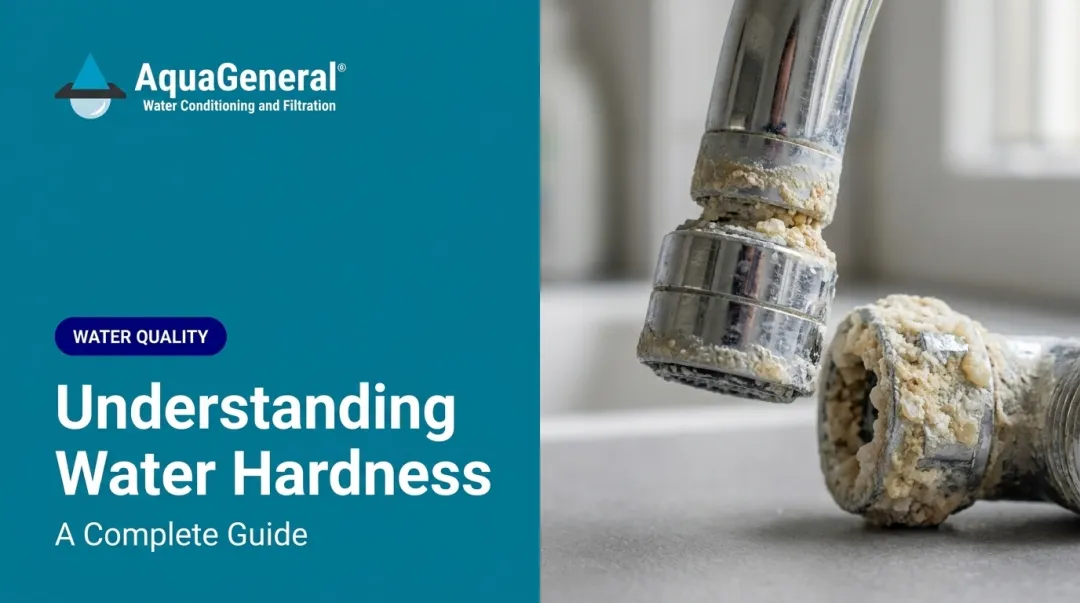
Hard water is simply water that has absorbed elevated concentrations of dissolved calcium (Ca²⁺) and magnesium (Mg²⁺) as it moves through soil and rock. The geology across Greater Houston — and throughout much of Texas — is particularly conducive to this. According to the USGS, hard water is prevalent across large portions of the United States, and local municipal data confirms the Houston area is no exception.
Houston-Area Hardness Varies More Than You'd Expect
There's no single hardness number for "Houston." According to the City of Houston's 2024 Water Quality Report, the Main System hardness ranges from 43.4 to 137 ppm, with an average of 110 ppm. Move outside city limits and the range shifts significantly:
| Area | Reported Hardness |
|---|---|
| City of Houston (Main System) | 43.4–137 ppm, avg. 110 ppm |
| City of Sugar Land | 34–211 ppm (2.0–12.3 GPG) |
| City of Galveston | 127 ppm |
| City of Lake Jackson | 230–250 mg/L average |
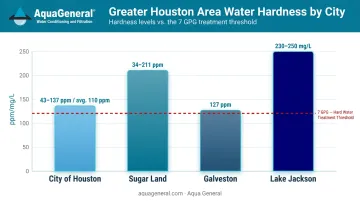
This variation is exactly why Aqua General offers free on-site water testing before recommending any system — what works for a home in Pearland may be undersized for one in Lake Jackson.
What Hard Water Actually Does in Your Home
Hard water calcium reacts with soap to form soap scum rather than lather, so you end up using more product for less result. Dishes spot, surfaces streak, and showers need constant scrubbing — all because of dissolved minerals doing their work behind the scenes.
Inside pipes and water heaters, the impact is harder to see but more costly. Scale deposits build up on heating components, forcing appliances to work harder. PNNL research commissioned by the DOE found that gas storage water heaters operating on 26.2 GPG hard water dropped from 70.4% to 67.4% efficiency and accumulated over a pound of scale annually — compared to just 0.01 lbs per year with softened water.
The Hardness Scale
Water hardness is measured in grains per gallon (GPG) or milligrams per liter (mg/L):
| Category | mg/L as CaCO₃ | GPG |
|---|---|---|
| Soft | 0–60 | 0–1 |
| Slightly hard | 17–60 | 1–3.5 |
| Moderately hard | 61–120 | 3.5–7 |
| Hard | 121–180 | 7–10.5 |
| Very hard | >180 | >10.5 |
Water above 7 GPG is the standard threshold where treatment becomes practical. That's where ion exchange softeners come in — and understanding what they're removing helps explain exactly how they work.
What Is an Ion Exchange Water Softener?
An ion exchange water softener is a cation exchange device — it removes dissolved hardness minerals by trading them for sodium (or potassium) ions on a chemically charged resin bed. That single exchange reaction is the entire mechanism.
What it is not:
- Not a sediment filter — it won't remove particulates or turbidity
- Not a carbon filter — it won't touch chlorine, chloramines, or organic compounds
- Not a reverse osmosis system — total dissolved solids remain in the water
- Not a disinfection system — bacteria, viruses, and biological contaminants require separate treatment
Softeners are rated by grain capacity — the total grains of hardness they can remove before needing to regenerate. For a free water analysis and expert sizing recommendation tailored to your home, contact Aqua General.
Systems also come in two regeneration types:
- Timer-based: runs on a fixed schedule, whether or not the resin is actually exhausted
- Demand-initiated (DIR): triggers only when resin approaches exhaustion — uses less salt and water for households with variable demand
How Ion Exchange Water Softeners Remove Hardness
Ion exchange softening happens through a precise chemical sequence inside two connected tanks — the resin tank and the brine tank — each with a distinct role.
The Resin Tank and the Brine Tank
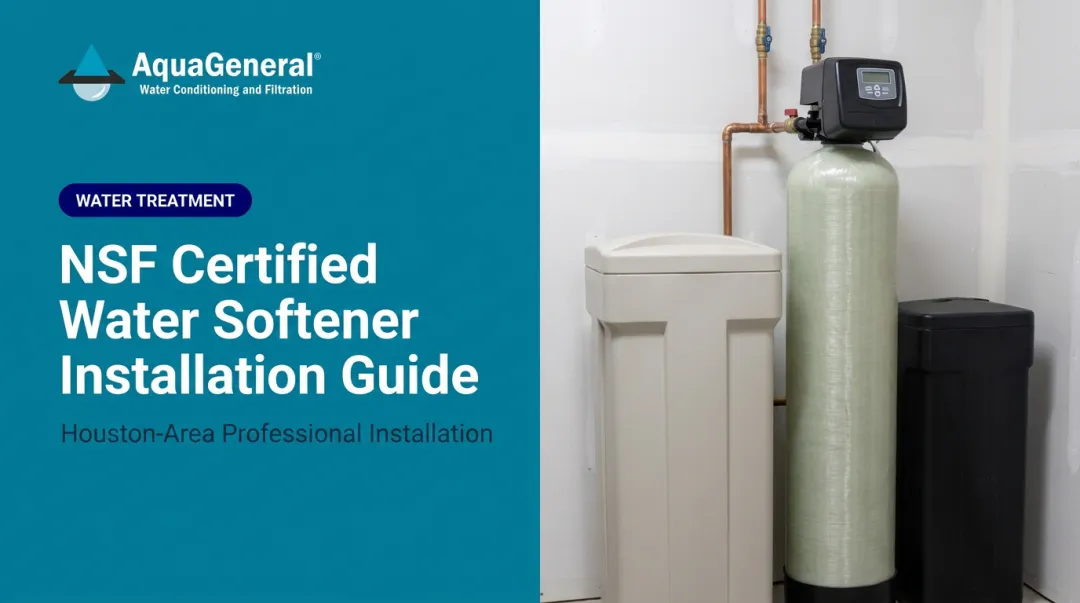
The resin tank contains millions of tiny, negatively charged polystyrene beads (technically, sulfonated styrene-divinylbenzene copolymer, the same base chemistry used across the water treatment industry). These beads come pre-loaded with sodium ions (Na⁺), held loosely to the beads' negative charge sites.
The brine tank sits alongside the resin tank and holds a concentrated salt solution used to restore the resin when it's exhausted.
Think of the charged bead as a magnet. Sodium, calcium, and magnesium are all positively charged, but calcium and magnesium carry a stronger double-positive charge (Ca²⁺, Mg²⁺). When hard water flows in, they outcompete sodium for the bead's binding sites.
The Ion Exchange in Action
As water moves through the resin tank, the exchange follows four steps:
- Hard water enters the resin tank from the top and passes down through the bead bed
- Calcium and magnesium ions — more strongly attracted to the negatively charged resin — displace the sodium ions sitting on the beads
- Calcium and magnesium attach to the resin; sodium ions release into the water stream
- Water exits the tank free of hardness minerals
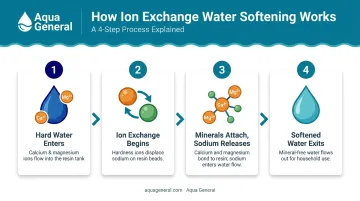
The total dissolved ion concentration in the water doesn't decrease — one set of minerals (calcium and magnesium) is simply swapped for another (sodium). Softened water is not purified or filtered; the minerals change, but the dissolved ion load stays roughly the same — something worth knowing if you're also considering an RO system for drinking water.
Potassium as an Alternative
Homeowners who want to reduce sodium in softened water can use potassium chloride (KCl) instead of sodium chloride in the brine tank. NSF/ANSI 44 — the certification standard covering residential cation exchange softeners — covers systems regenerated with either salt type. Potassium chloride costs more and requires slightly higher volumes to recharge the resin effectively. Aqua General's WQA-certified specialists can evaluate your household's water quality and health priorities to determine which salt type makes the most sense for your system.
The Regeneration Cycle: Restoring the Resin
Over time, every binding site on the resin beads fills with calcium and magnesium. At that point, the resin is exhausted — hard water flows through unchanged. The regeneration cycle is what resets it.
How Regeneration Works
The process draws a highly concentrated salt brine from the brine tank and flushes it through the resin bed. The sheer volume of sodium ions in the brine overwhelms the calcium and magnesium clinging to the beads, displacing them. The hardness minerals flush to drain; the beads reload with fresh sodium ions.
WQA best practices set efficiency benchmarks for this process:
- 4,000 grains of hardness removed per pound of salt
- No more than 5 gallons of water per 1,000 grains during regeneration
Those benchmarks matter because regeneration uses salt and water — a poorly configured system wastes both.
Timer-Based vs. Demand-Initiated Regeneration
| Feature | Timer-Based | DIR (Demand-Initiated) |
|---|---|---|
| Regeneration trigger | Fixed schedule | Based on actual water volume processed |
| Salt efficiency | Lower (may regenerate unnecessarily) | Higher |
| Water efficiency | Lower | Higher |
| Best for | Consistent daily usage | Variable household usage |
The EPA and WQA both favor DIR systems for residential use because they regenerate based on actual demand rather than a clock. When a softener runs past resin exhaustion — common with undersized or improperly configured systems — hard water passes through untreated, and scale buildup resumes in pipes and appliances as if no softener were installed.
What Ion Exchange Water Softeners Don't Remove
A cation exchange softener targets positively charged dissolved minerals — primarily calcium, magnesium, and some iron. That's where its capability ends.
Softeners certified to NSF/ANSI 44 are evaluated specifically for hardness reduction. They are not tested or certified for:
- Chlorine or chloramines
- Organic chemical compounds
- Disinfection byproducts (DBPs)
- Sediment or particulates
- Bacteria or viruses
This matters for Houston-area homeowners. The city's 2024 Water Quality Report documents chloramines in the Main System at 0.03–5.4 ppm, haloacetic acids with a highest LRAA of 39 ppb, and total trihalomethanes with a highest LRAA of 45 ppb. A standalone softener addresses none of those.
When a Softener Alone Isn't Enough
If your water has hardness plus additional concerns — chlorine taste and odor, chemical contaminants, or fine particulates — a multi-stage approach is needed. Given Houston's documented DBP and chloramine levels, Aqua General's AquaGuard® whole-house water conditioner is designed specifically for this overlap — a single integrated system combining:
- Ion exchange softening (high commercial-grade 10% cross-linked resin)
- Activated carbon media (for organic chemical and DBP reduction)
- Silver-impregnated anti-microbial media (inhibits bacteria growth within the system)
- Physical filtration down to 0.02–5 microns (finer than a human red blood cell)
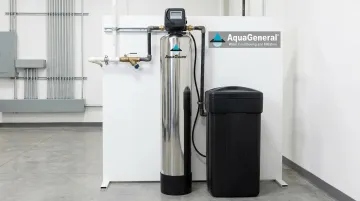
All systems and components are tested, certified, and validated by the WQA and NSF. If your water test reveals hardness alongside chemical or particulate concerns, contact Aqua General for a free on-site water test to determine which combination of treatment stages fits your home.
Conclusion
Ion exchange water softeners work through a clean, repeatable chemical process: negatively charged resin beads capture calcium and magnesium ions from hard water, release sodium in their place, and are periodically restored by a salt brine flush. Knowing how that cycle works helps you size the right system, set a realistic regeneration schedule, and spot when hard water is the core issue versus one piece of a larger water quality picture.
Greater Houston's water hardness varies county by county, and sometimes block by block. Testing your water before choosing or sizing a system is the practical step that keeps you from buying too little capacity or regenerating too often. Aqua General offers free on-site water testing across the Greater Houston area — it's the straightforward way to get accurate numbers before you decide anything.
Frequently Asked Questions
Does ion exchange remove hardness?
Yes. Ion exchange is designed specifically for this. Calcium and magnesium ions swap places with sodium ions on the resin bed, eliminating the minerals that cause scale, soap scum, and appliance damage. The hardness minerals are flushed to drain during regeneration.
What is the best water softener to remove calcium from the water system?
The right system depends on your water's hardness level in GPG, your household's daily water use, and whether other contaminants are present. Get your water tested first, then consult a WQA-certified specialist who can match system capacity and features to your specific conditions.
How often does an ion exchange water softener need to regenerate?
It depends on water hardness, daily usage, and the resin's grain capacity. Demand-initiated systems regenerate only when needed, typically every few days for an average household, while timer-based systems follow a fixed schedule regardless of water use.
Is softened water safe to drink?
For most people, yes. Softened water contains elevated sodium relative to untreated water. People on sodium-restricted diets should verify their water's sodium level and follow medical guidance, or ask about potassium chloride as an alternative regenerant.
What is the difference between a water softener and a water filter?
A softener uses ion exchange to remove dissolved hardness minerals. A filter physically or chemically removes particulates, chlorine, organics, and similar contaminants. They solve different problems and work well together in a whole-house treatment setup.
How do I know if my water is hard enough to need a softener?
Common signs include scale on fixtures and showerheads, spotty dishes, dry skin and hair after showering, and appliances that seem to underperform. Water above 7 GPG is generally classified as hard. A simple test strip or professional water test gives you a precise reading.