Introduction
Most Greater Houston homeowners are running water that registers well above 200 mg/L — hard enough to leave scale deposits inside pipes, reduce water heater efficiency, and shorten appliance lifespans. Hard water shapes how well your soap lathers, whether your dishwasher spots glassware, and how fast mineral buildup accumulates on fixtures.
Most people notice the symptoms long before they know the cause.
The Greater Houston area spans a wide range of hardness levels, from relatively soft surface water in some Houston service zones to readings well above 175 mg/L in communities like Willow Chase and Sugar Land — levels that put real strain on appliances and plumbing over time.
This guide covers what water hardness is, how it's measured, what it costs you in appliance wear and energy bills, and what your options are for addressing it.
Key Takeaways
- Water hardness measures dissolved calcium and magnesium, expressed as equivalent calcium carbonate (CaCO₃) per unit volume
- 1 gpg = 17.1 mg/L: the conversion needed to read any water quality report
- Hard water is safe to drink but damages appliances, wastes soap, and accelerates scale buildup in plumbing
- Houston-area hardness varies dramatically by utility and source: a single county can range from soft to very hard
- Get professional water testing before selecting any treatment system
What Is Water Hardness?
Water hardness measures the concentration of dissolved calcium (Ca²⁺) and magnesium (Mg²⁺) in water, expressed as an equivalent mass of calcium carbonate (CaCO₃) per unit volume. That's the definition WHO uses, and it's more precise than the common shorthand of "minerals in water."
Hardness isn't just a cosmetic nuisance. It acts as a constraint on soap effectiveness, a driver of scale deposition inside pipes and heating elements, and a limiting factor for water treatment equipment like reverse osmosis membranes. Understanding it as a design parameter — not just a comfort issue — changes how you think about treatment.
Temporary vs. Permanent Hardness
Temporary hardness is caused by dissolved calcium and magnesium bicarbonates. When water is boiled, heat converts bicarbonate to insoluble carbonate, which precipitates out. This is why a kettle develops scale. Boiling removes some hardness — but only the temporary fraction.
Permanent hardness comes from calcium and magnesium sulfates and chlorides. Boiling has no effect on these. Removing permanent hardness requires a mechanical or chemical treatment system: ion-exchange softening, reverse osmosis, or a combination of both. Most hard water contains both types, which is why boiling alone is never a complete solution.
How Hard Water Forms
Those bicarbonates and sulfates don't appear from nowhere — they're picked up directly from the geology the water passes through. The process starts with rainfall.
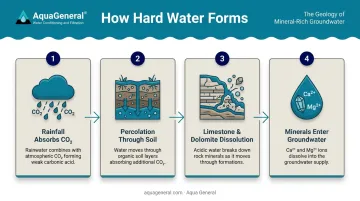
As rainwater absorbs CO₂ from the atmosphere, it becomes mildly acidic. When it percolates through limestone, chalk, or gypsum formations, that carbonic acid dissolves calcium and magnesium from the rock. USGS describes the full sequence as:
- CO₂ dissolves in rainwater, forming weak carbonic acid
- More CO₂ is absorbed as water moves through soil
- The acid dissolves carbonate minerals like calcite and dolomite
- Ca²⁺ and Mg²⁺ enter the groundwater supply
Texas sits atop significant limestone, dolomite, and gypsum formations — which explains why groundwater hardness in parts of the state can reach extreme levels. Texas Water Development Board data documents hardness maxima exceeding 500 mg/L in some Travis County water-bearing units.
The Water Hardness Scale: Measurement Units and Classifications
Two units dominate hardness reporting:
- Grains per gallon (gpg) — the standard in the U.S. water treatment industry
- Milligrams per liter (mg/L) — equivalent to parts per million (ppm), used in municipal water quality reports and scientific literature
Conversion: 1 gpg = 17.1 mg/L
If your water report says 120 mg/L, divide by 17.1 — that's roughly 7 gpg, sitting at the boundary between moderately hard and hard.
Classification Scales
Two frameworks are commonly used, and they don't align perfectly:
| Classification | Industry/Municipal Scale (gpg) | USGS Scale (mg/L as CaCO₃) |
|---|---|---|
| Soft | < 1 gpg | 0–60 mg/L |
| Slightly Hard | 1.0–3.5 gpg | — |
| Moderately Hard | 3.5–7.0 gpg | 61–120 mg/L |
| Hard | 7.0–10.5 gpg | 121–180 mg/L |
| Very Hard | > 10.5 gpg | > 180 mg/L |
Sources: Sugar Land municipal water quality page (five-band scale); USGS Water Science School (four-band scale)
The USGS uses four categories and skips "slightly hard." When someone gives you a hardness reading, ask which framework they're using — the label attached to the same number can differ between reports.
Safe vs. Problematic Thresholds
There is no federal regulatory limit for hardness. EPA does not list it as a primary contaminant, and it doesn't appear on the secondary drinking water standards list. Hard water is a mineral concentration issue, not a contamination problem — those require different solutions.
That said, the water treatment industry recognizes operational thresholds where scale damage becomes significant:
- Below 10 gpg (170 mg/L): Generally acceptable for RO membranes and water heaters without pre-treatment
- Above 10 gpg (170 mg/L): Many RO system manufacturers require upstream softening to prevent mineral scaling that degrades membrane performance and shortens equipment life
Water that's safe to drink may simultaneously be destructive to a water heater or RO membrane. Hardness management is often an equipment protection decision, not a health one.
Greater Houston Hardness in Context
Houston-area hardness is not a single number. It varies significantly depending on which utility serves a property and what blend of surface water and groundwater that utility uses. Verified data from municipal water quality reports illustrates the range:
| Utility / Area | Reported Hardness | Source Water |
|---|---|---|
| Houston Main System (2024) | 43.4–137 ppm; avg. 110 | 86.5% surface, 13.5% groundwater |
| Houston Willow Chase (2024) | 169–180 ppm; avg. 175 | Separate service area |
| Harris County MUD 43 (2021) | 143 ppm | Groundwater district |
| Sugar Land Main System | 35–280 ppm (2.0–16.4 gpg) | Blended surface/groundwater |
| Richmond | 167 mg/L (9.76 gpg) | City water |
| Lake Jackson (2023) | avg. 230–250 mg/L | Brazoria County municipal |
| Galveston (2024) | 127 ppm | Surface water via GCWA |
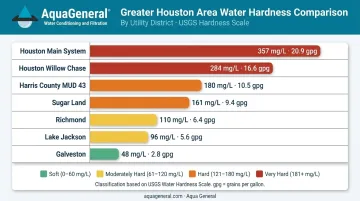
Two homes in the same county can sit in entirely different hardness ranges depending on their municipal district. Sugar Land alone spans 2.0–16.4 gpg — soft on one end, very hard on the other. A county-wide average tells you almost nothing useful; a utility-specific test tells you what's actually coming out of your tap.
How Hard Water Affects Your Home and Health
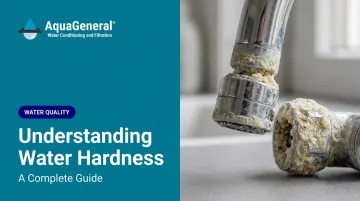
When hard water is heated or evaporates, dissolved calcium and magnesium precipitate out as calcium carbonate — the white, chalky deposits visible on faucets, shower doors, and inside kettles. That same process happens inside pipes and heating elements where you can't see it.
Impacts on Appliances and Plumbing
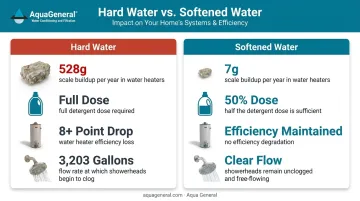
Scale accumulation inside a water heater forces the heating element to transfer heat through an insulating mineral coating rather than directly to the water. A Battelle study sponsored by the Water Quality Research Foundation tested water heaters under accelerated scaling conditions at 26.2 gpg:
- Tankless gas heater efficiency dropped from 80% to 72% at 1.6 equivalent years of use and required deliming
- Gas storage heater efficiency declined from 70.4% to 67.4% at two equivalent years
- Unsoftened water produced an estimated 528 grams of scale per year in gas storage units, compared to just 7 grams with softened water
Beyond water heaters, scale restricts flow in pipes, clogs showerhead nozzles and aerators, and blocks dishwasher spray arms. Low-flow showerheads in the same study clogged after just 3,203 gallons of unsoftened water.
Impacts on Soap, Cleaning, and Laundry
Calcium and magnesium ions react with the fatty acid salts in soap to form an insoluble precipitate , known as soap scum. This reaction destroys the soap's ability to lather, leaving film residue on dishes, shower walls, and skin rather than cleaning them.
WQRF laboratory tests quantified the effect: 50% of the recommended detergent dose in softened water at 60°F produced better stain removal and whiteness than a full dose in hard water at 100°F. Dishwasher tests found detergent savings of up to 70% with softened water. These results reflect controlled laboratory conditions; real household savings will vary, but the underlying chemistry is consistent.
Health and Cosmetic Effects
Hard water is not a health hazard. WHO reviewed the evidence and found no convincing data that drinking hard water causes adverse health effects. Calcium and magnesium are essential minerals, and drinking water can contribute positively to daily intake.
Cosmetically, the picture is different:
- Soap scum residue on skin can disrupt the skin's natural moisture barrier, contributing to dryness and irritation
- Mineral deposits on hair can leave it looking dull and feeling rough
- Some studies link harder water to increased childhood eczema incidence, though the evidence is mixed and softener trials haven't consistently reduced established eczema symptoms
Drinking exposure and skin exposure follow different biological pathways — which is why hard water can be safe to consume while still affecting your skin and hair over time.
How to Test for Water Hardness
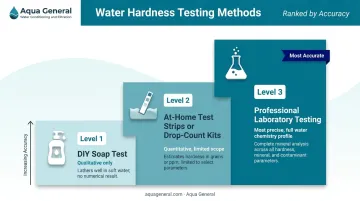
Three testing approaches exist, ranked by accuracy:
DIY soap test — Shake soap and water in a sealed bottle. Cloudy, milky results with few suds suggest hardness. This is qualitative only — it tells you hardness may be present, not how much.
At-home test strips or drop-count kits — These give a quantitative result in gpg or mg/L and are available at hardware stores. Accuracy varies, and they don't identify co-occurring issues that affect treatment selection.
Professional laboratory testing — The most precise option. A certified specialist can measure hardness alongside iron, pH, total dissolved solids, and other parameters that influence which treatment technology is appropriate.
City water customers can request their annual Consumer Confidence Report (CCR) as a starting point. However, reported values reflect conditions at the treatment plant — not necessarily at your tap after water has traveled through distribution mains and your home's internal plumbing.
Aqua General's WQA Certified Water Specialists offer free on-site water testing across Harris, Fort Bend, Montgomery, Brazoria, Galveston, and surrounding counties. The right treatment solution depends on the full water chemistry picture — evaluating hardness alongside iron, pH, and dissolved solids produces a more accurate recommendation than treating hardness in isolation.
To schedule a test, contact Aqua General at (713) 664-4601 or through aquageneral.com.
Common Misconceptions About Water Hardness
"Boiling your water will fix hard water."
Boiling reduces temporary hardness caused by bicarbonates. It has no effect on permanent hardness from sulfates and chlorides. Since most hard water contains both types, boiling is at best a partial fix. It's also impractical at the scale needed to protect appliances and plumbing.
"Hard water is contaminated or unsafe to drink."
Hard water results from naturally occurring dissolved minerals, not contamination. It is not regulated as a contaminant under the EPA's Safe Drinking Water Act, and WHO has found no convincing evidence of adverse health effects from drinking it. The household problems it causes are real, but they're operational problems — not safety ones.
"A water softener solves all water quality problems."
A conventional ion-exchange water softener replaces calcium and magnesium with sodium. That addresses hardness effectively, but it does nothing for chemical contaminants, disinfection byproducts, lead, bacteria, iron, or other water quality concerns that may be present simultaneously.
A comprehensive water quality assessment identifies the full picture. That's why Aqua General evaluates multiple parameters before recommending a treatment approach — and why the AquaGuard® whole-house system combines softening with anti-microbial media, chemical reduction, and fine particle filtration.
Frequently Asked Questions
What is a good hardness level for water?
Water below 1 gpg is soft and ideal for appliances and household use; levels of 1–7 gpg are manageable for most homes. Above 7 gpg (120 mg/L), scale buildup, soap inefficiency, and appliance wear become noticeable. That's the threshold where treatment is typically worth considering.
Is 30 gpg hard water?
At 513 mg/L, 30 gpg is nearly three times the "very hard" threshold of 10.5 gpg. Water at this level causes accelerated scale in pipes and water heaters, severely reduces soap lathering, and shortens appliance lifespan. Levels this high occur in parts of Texas groundwater — they're not typical for Houston municipal systems but are not unheard of in the region.
Does hard water cause health problems?
No. The WHO has found no convincing evidence of adverse health effects from drinking hard water — calcium and magnesium are beneficial dietary minerals. Hard water can cause dry skin and dull hair, and some studies have associated it with childhood eczema, though that link remains inconclusive.
What are the signs of hard water in my home?
Look for: white or chalky scale on faucets, showerheads, and around drains; soap scum or film on shower walls and dishes; reduced water pressure from clogged aerators; stiff or dull laundry; and shampoo or soap that won't lather well.
What is the difference between temporary and permanent water hardness?
Temporary hardness comes from bicarbonates and can be partially reduced by boiling. Permanent hardness comes from sulfates and chlorides and requires a softener or RO system. Most hard water contains both, so professional treatment is typically needed for complete softening.
How do I remove hardness from my water?
The main options are ion-exchange water softeners for whole-home treatment, reverse osmosis systems for point-of-use drinking water, and combination systems that address hardness alongside other water quality issues. The right choice depends on your hardness level and what else is in your water — professional testing should come first.